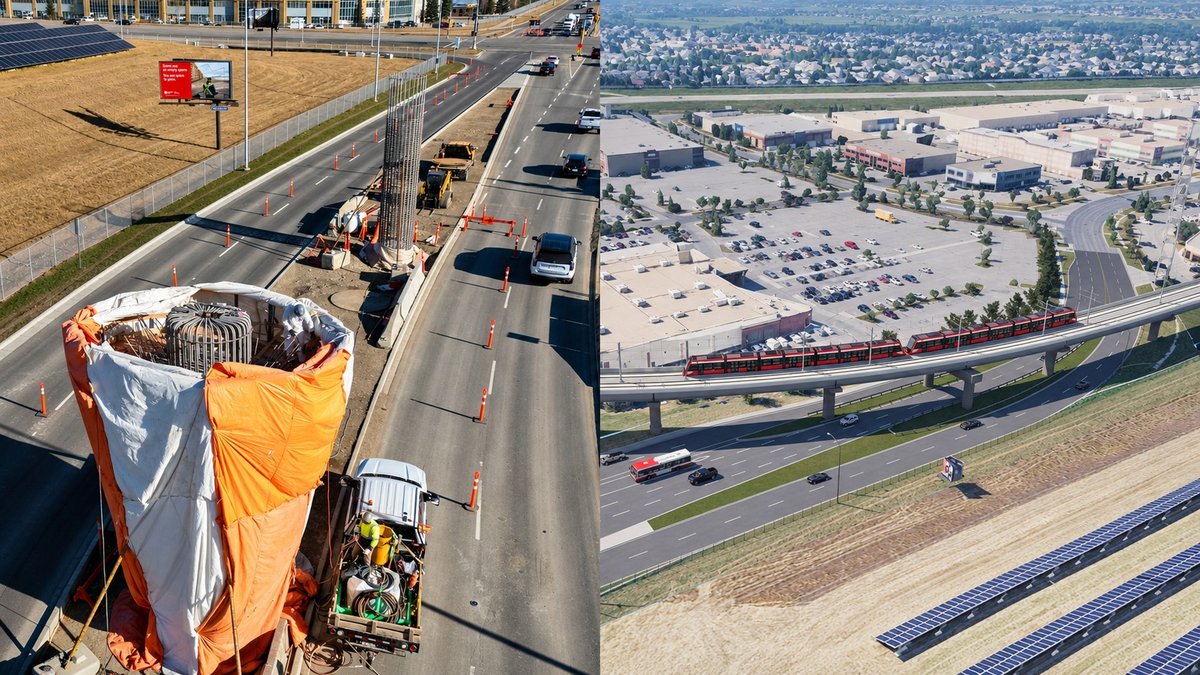
After a decade of maps, votes, cancellations and revivals, Calgary’s Green Line is something you can see from your windshield.
The concrete columns going up beside the Deerfoot Inn and Casino at 114 Avenue and Barlow Trail SE are piers. Fifteen of them will carry a 570-metre elevated section of LRT track over the intersection, so trains never cross traffic. Several are standing. More go up through the winter.
The City expects this piece of the line done by August 2028.
What’s being built
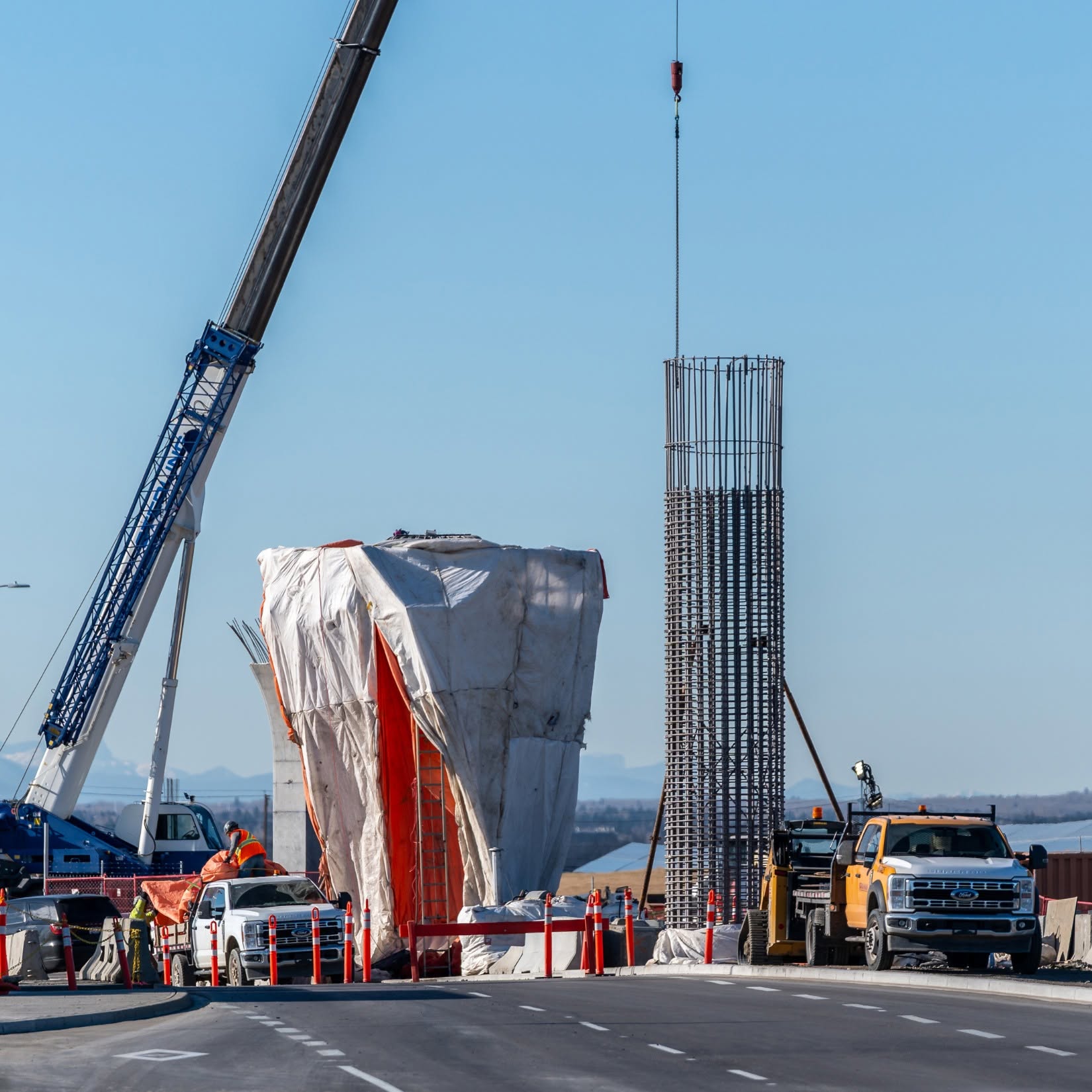
The guideway sits just east of the future Douglas Glen station, in the stretch between Quarry Park and Shepard at the south end of the line. It is a bridge, in effect: piers, steel girders across them, and a reinforced concrete deck on top where the rails go. The approaches on either side are raised earth held by retaining walls, which is why the structure needs abutments at each end where the track comes back to ground.
Before any of it showed above ground, crews moved utilities, shifted the road and drove 22 foundation piles. Those are the hidden half. The piers are the part everyone can finally see.
Graham was awarded the contract in June 2026. The scope covers the elevated structure plus earthworks, drainage, grading and retaining walls.
Why trains go over the road
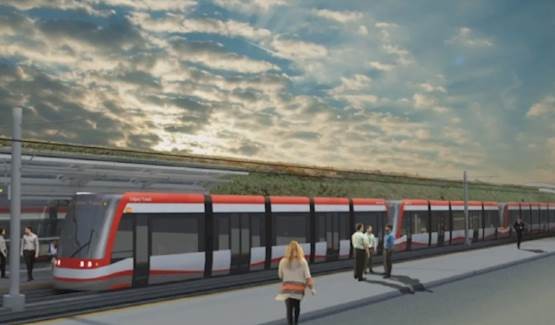
Trains above, traffic below. That is the City’s whole argument, and it holds.
Barlow Trail is a major truck and commuter route, and 114 Avenue feeds the industrial area and the casino. An LRT crossing at grade would mean gates dropping every few minutes in both directions. Lifting the track removes the conflict. Drivers pass underneath. Trains keep moving.
How a pier gets built
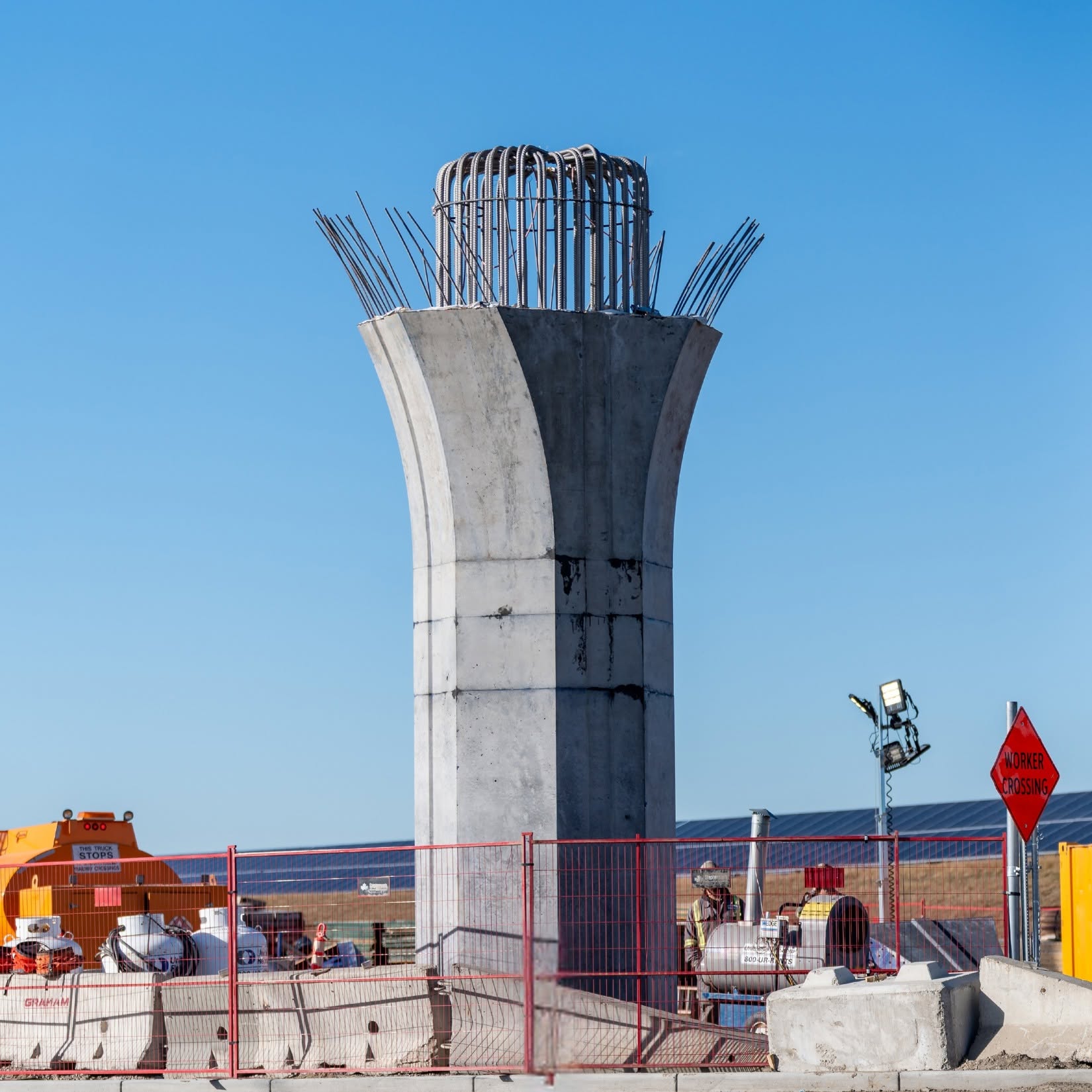
Each one starts as a cage of reinforcing steel, assembled off site so the welding and tying happen away from the roadside. The cage is trucked in and stood up. Custom steel forms, built once and reused for every pier, are wrapped around it. Concrete is poured, cures, the forms come off, and the pier is done.
The reusable forms mean every one of the 15 comes out identical.
What happens next
| When | Work |
|---|---|
| Now | West abutment, where the guideway comes down toward ground level |
| Later in November | South abutment begins |
| Spring 2027 | Retaining walls along the raised approaches |
| Through 2027-28 | Girders and deck placed on the piers |
| August 2028 | Anticipated completion of the guideway package |
That date is for this structure, not the line. Trains need stations, track, power, signals and a maintenance facility before anyone rides.
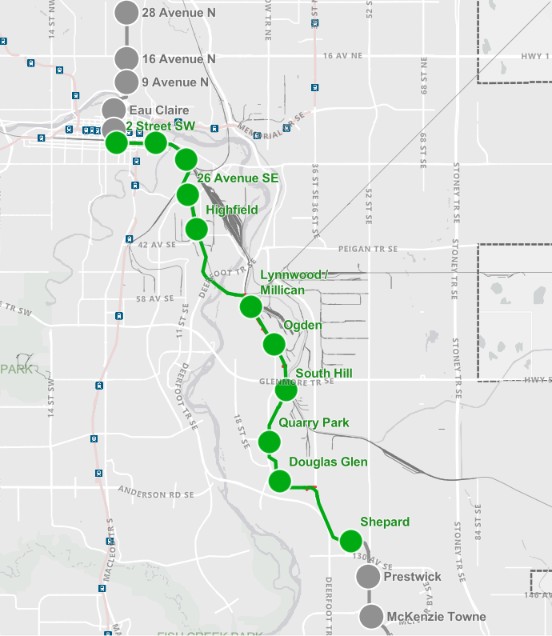
Where the Green Line stands
Phase 1 is 17 kilometres of twin track and 11 stations: 16 km and 10 stations in the southeast from Shepard to the Event Centre/Grand Central station, plus about a kilometre and one more station downtown. Council settled the downtown piece on Sept. 22, 2026, approving a surface alignment that ends at a station on 10 Avenue near 2 Street SW.
The line also includes three park-and-ride lots, a maintenance and storage facility at Shepard, and 28 low-floor trains.
Funding commitments total $6.248 billion: $2.905 billion from the City, $1.702 billion from Alberta and $1.641 billion from Ottawa.
The City projects an opening in 2031.
Getting here took some turns. In July 2024 the route was cut back to end at Lynnwood/Millican. In September 2024 council voted to wind the project down. A month later the City and province cut a deal that brought back the southeast section and five cancelled stops, including Shepard. The groundbreaking was June 26, 2025. We asked in February whether Calgarians were still buying it. The piers are the first concrete answer.
What it means for a southeast commute
The City’s planning estimate for Douglas Glen to 2 Street SW is 30 to 35 minutes by train, against 55 to 60 minutes on today’s buses. Two-car trains are expected every five to eight minutes at rush hour. Those are estimates, not a timetable, and they are five years out.
For now, the change is the view. Check the City’s Green Line construction notices before driving through 114 Avenue and Barlow Trail, and expect the skyline there to keep changing through 2028.
Sources:

Comments