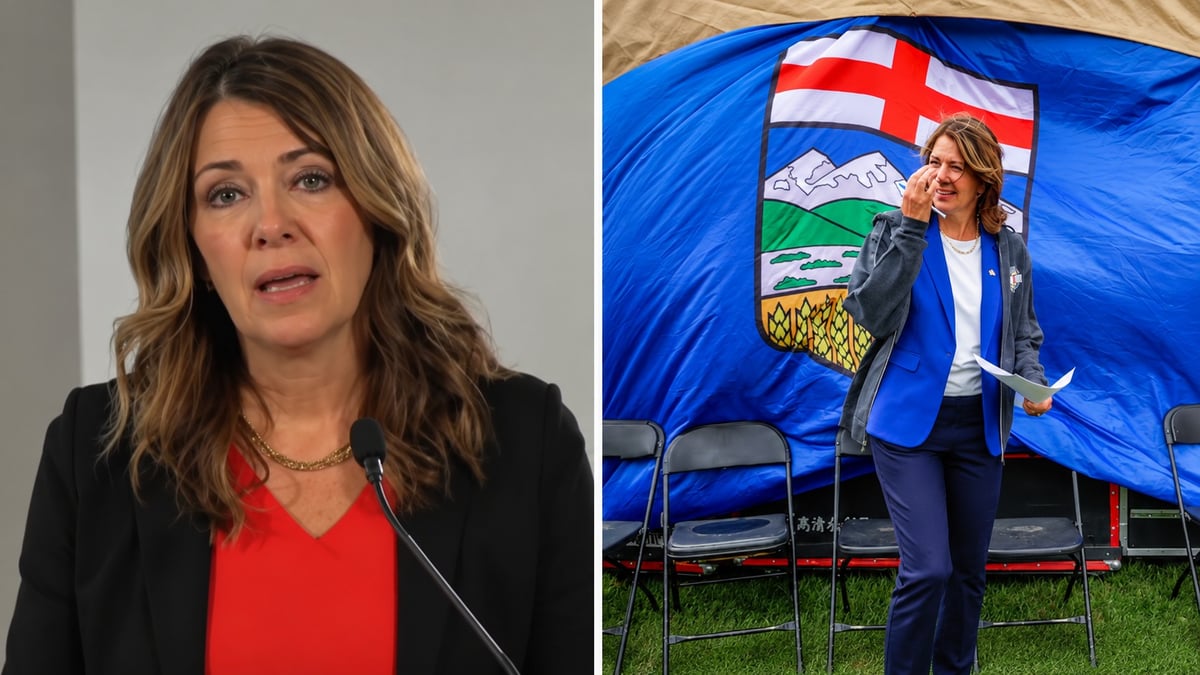
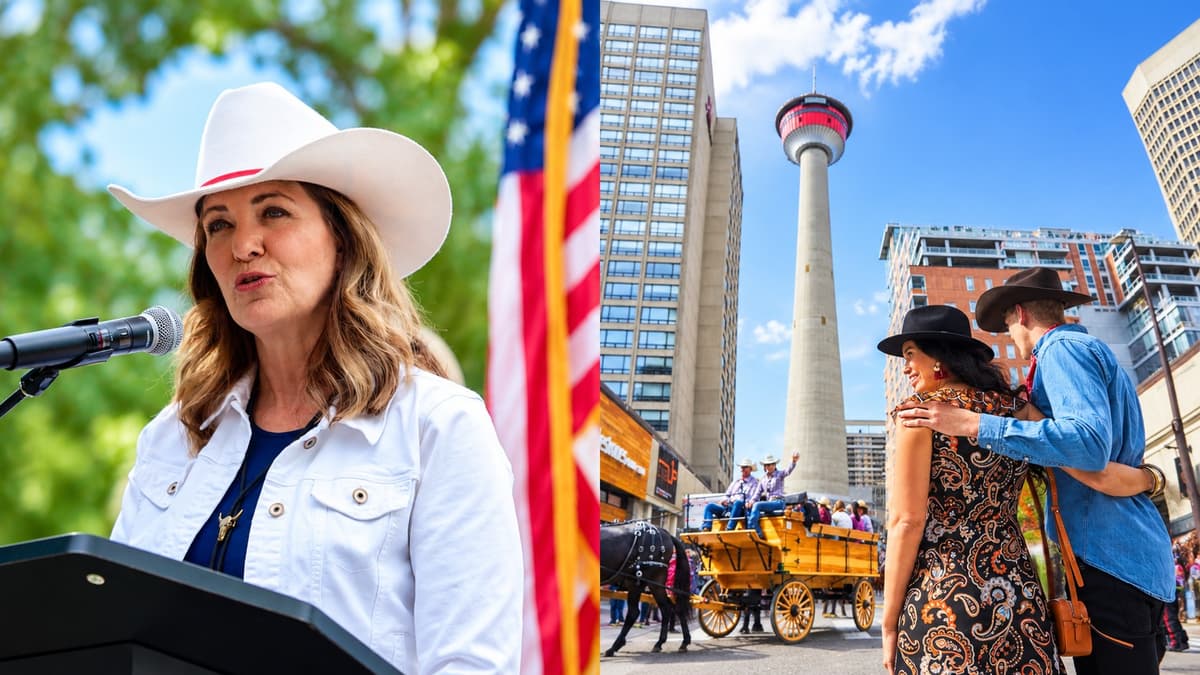
Premier Danielle Smith stopped mid-sentence Saturday while talking about why some Albertans have begun questioning their province's place in Canada.
"I hear it at town halls, in coffee shops, at hockey rinks and in my email inbox," Smith said.
She began describing Albertans she said have felt the effects of federal policies before her voice broke.
"From the farmer that felt pressured... sorry all," she said, pausing and taking several deep breaths.
The moment came during the Alberta and the West Assembly, a virtual forum co-hosted by former Reform Party leader Preston Manning and former British Columbia premier Gordon Campbell.
Smith was making the case for Alberta to remain in Canada.
But her remarks also highlighted something that can get lost in the fight over the October 19 referendum. The public pressure for a vote did not come entirely from the independence movement.
Two petitions pushed Alberta in opposite directions
Smith pointed to two citizen petition campaigns that approached Alberta's future from opposing sides.
One was Alberta Forever Canada, the citizen initiative led by former Alberta deputy premier Thomas Lukaszuk, asking whether Alberta should remain within Canada. Elections Alberta confirmed it met the threshold required for a successful citizen initiative.
The other was the independence petition associated with Stay Free Alberta, which sought a referendum on Alberta leaving Canada. Elections Alberta later determined that petition had also succeeded.
Smith has repeatedly described the two efforts together as representing approximately 700,000 signatures calling for Albertans to have a vote. Her government used the combined campaigns as part of its justification for adding the Canada question to the October ballot.
That doesn't mean 700,000 unique Albertans signed. The published totals don't establish whether anyone signed both petitions. But it does mean substantial signature campaigns emerged on both sides.
"Between the Forever Canada petition and the Stay Free Alberta petition, roughly 700,000 Albertans asked for a vote on our place in Canada," Smith told Saturday's forum.
That distinction matters.
The referendum is often discussed through the lens of Alberta separatism. One of the two large petition drives behind it was explicitly created to keep Alberta in Canada.
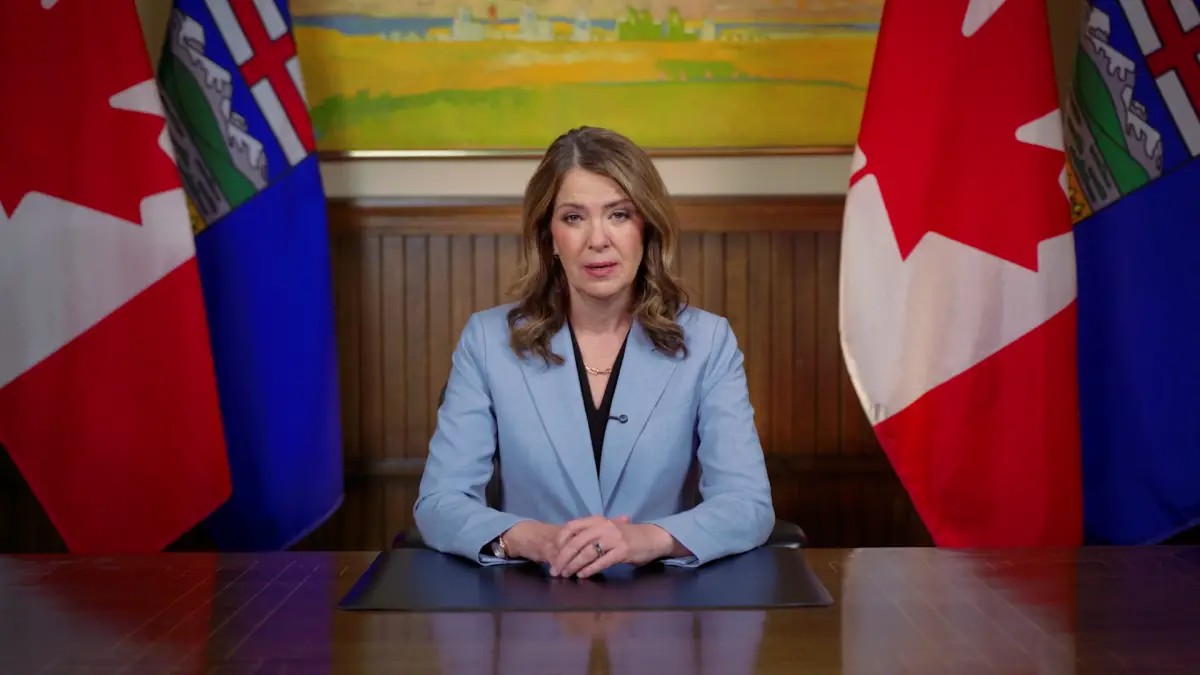
'Does this country actually want us?'
Before becoming emotional, Smith traced western frustration with Ottawa back decades.
"Western frustration with Ottawa is not new. It's not only Albertan," she said, pointing to Manning and the Reform Party's slogan. "The West wants in."
"Many Westerners still feel like we're still waiting. But for Alberta, the last decade has cut especially deep."
Smith listed federal policies her government has opposed, including federal environmental assessment legislation, the proposed oil and gas emissions cap, and electricity regulations she said "would have made it hard to keep the lights on in one of the coldest places in the country."
Those policies and their effects remain politically contested. Smith presented them as examples of why some Albertans believe the province's economic contribution is taken for granted.
Then came the line at the centre of her argument.
"So when a proud, hardworking people feel their contribution is taken for granted, and their livelihood is treated as something to be phased out, some begin to ask a painful question."
"Does this country actually want us?"
Smith paused during that section of the speech as she struggled to maintain her composure.
Smith says she supports staying in Canada
Despite defending the decision to hold the vote, Smith has been explicit about her own position.
"I support Alberta remaining in Canada. I also believe Albertans deserve a say," she told the forum.
That's consistent with the position she laid out when announcing the additional referendum question earlier this year.
On Saturday, Smith argued Alberta has made enough recent progress with Ottawa that leaving now would make little sense from her perspective. She pointed to an Alberta-Ottawa energy agreement and work toward a new West Coast pipeline.
"Not long ago the oilsands were treated as a national target. Today they're increasingly seen as a national treasure," she said. "Why walk away from the table when we're finally winning at it?"
But she also warned Albertans who want to remain that, in her view, staying should not mean accepting the status quo.
"A future federal government could undo all this progress that we've made with a stroke of a pen."
Then Smith called the other referendum questions 'my nine'
One of the more revealing moments came after the speech.
During the question period, Smith was asked why she isn't campaigning for the option that could eventually lead to a binding referendum on separation.
Her answer drew a clear line between the separation debate and the nine questions her government proposed.
"This really crystallized for me that my aspiration is to stay in my lane," Smith said. "I got elected because I want to focus on healthcare, education, social services and providing supports for seniors and addiction services and public safety."
Then she used a notable phrase.
"I want to really hunker down and focus on my nine, on addressing the nine questions that I've put forward."
My nine.
The government announced nine referendum questions in February following the Alberta Next process. Those questions deal with immigration, voting requirements and Alberta's constitutional and fiscal relationship with Ottawa.
Two orders in council putting those questions to voters were approved March 31. A third was approved May 28 for the additional Canada question.
The ballot contains 10 questions. Smith is publicly treating nine as her government's agenda and the tenth as a question Albertans pushed onto the political agenda through the rival petition movements.
What the separation question actually does
Albertans will not vote directly on independence on October 19.
The question asks whether Alberta should remain a province of Canada, or whether the Government of Alberta should commence the legal process required under the Canadian Constitution to hold a binding provincial referendum on whether Alberta should separate.
Choosing the second option would not immediately separate Alberta from Canada. It would direct the provincial government to begin the legal process required to hold a subsequent binding referendum.
Smith said when announcing the question that this structure was intended to respect the people who signed both petitions while letting Albertans settle the immediate question at the ballot box.
Not everyone agrees with Smith's framing
The referendum remains deeply contested.
Critics argue that holding a province-wide vote on Alberta's future creates unnecessary uncertainty and gives greater prominence to separation.
Independence supporters have argued that a vote to remain in Canada would not end their campaign for Alberta sovereignty.
First Nations leaders have raised constitutional and treaty-rights concerns. Treaty 8 Grand Chief Trevor Mercredi has argued that discussions affecting Canada's constitutional structure have serious implications for treaty rights and require meaningful engagement with First Nations.
Even the financial argument Smith made Saturday requires context. Claims about how much Alberta sends to Ottawa compared with what it receives depend heavily on what revenues, expenditures, transfers and time periods are included.
The political argument is straightforward. The accounting behind it is considerably more complicated.
October 19 is shaping up to be an enormous vote
The scale of the referendum is already clear.
Elections Alberta says voters will face 10 questions, requiring approximately 45 million individual ballots to be printed. The agency estimates it needs at least 60,000 election workers to complete the unofficial count within 48 hours.
Interest in voting by mail has surged.
As of September 17, Elections Alberta had received almost 520,000 special-ballot applications. More than 330,000 packages had been mailed, and more than 24,000 completed packages had been returned and approved.
Advance voting runs October 13 to 17, with referendum day on Monday, October 19.
Sources
Premier Danielle Smith, remarks to the Alberta and the West Assembly, September 19, 2026
Elections Alberta
2026 Alberta referendums — Government of Alberta

Comments
Conversation