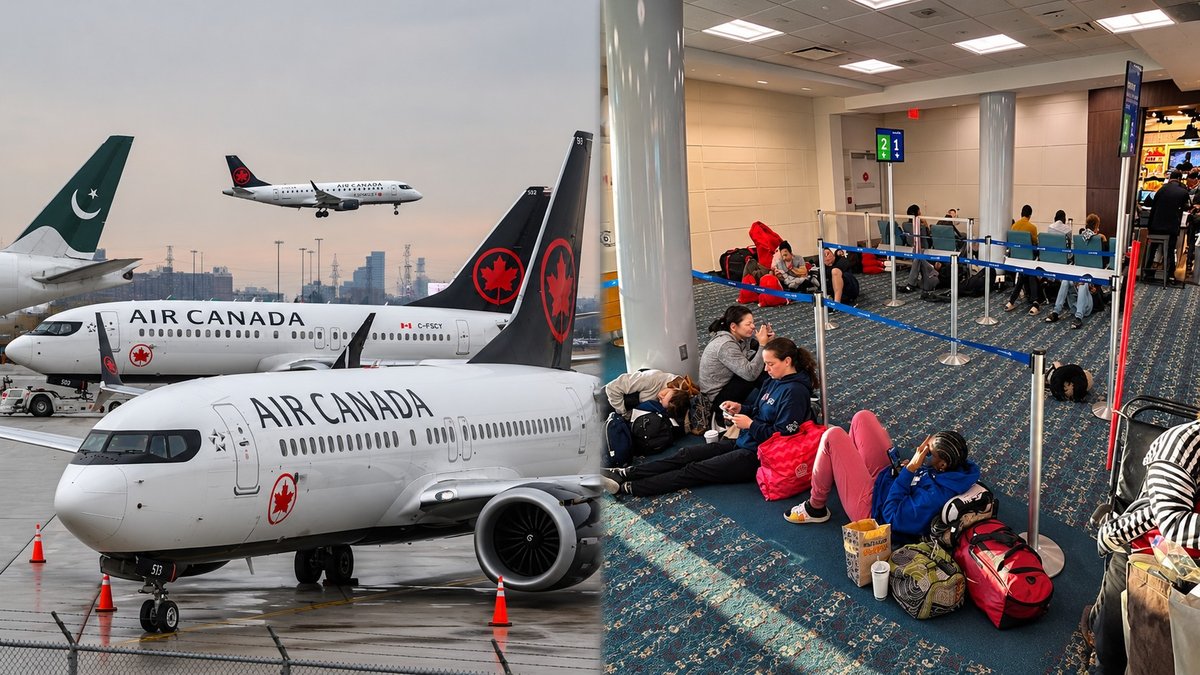
A communications failure in the United States has stopped planes from taking off at airports across the country, and Canadians are caught in it.
The U.S. Federal Aviation Administration ordered a nationwide ground stop at 3:54 p.m. ET Friday, Nov. 13 (2:54 p.m. in Alberta). It cited “extraordinary circumstances” and “reasons of safety.”
Planes already in the air were allowed to land. International flights are being handled case by case. Everything else waiting to depart a U.S. airport is staying put.
In Canada, the effect was immediate. “Departures of all U.S.-bound flights are currently being held at YYC until further notice,” Calgary International Airport said. Toronto Pearson and Montréal-Trudeau suspended all flights to and from the U.S.
This is a developing story. Flight schedules and restrictions can change quickly.
What happened
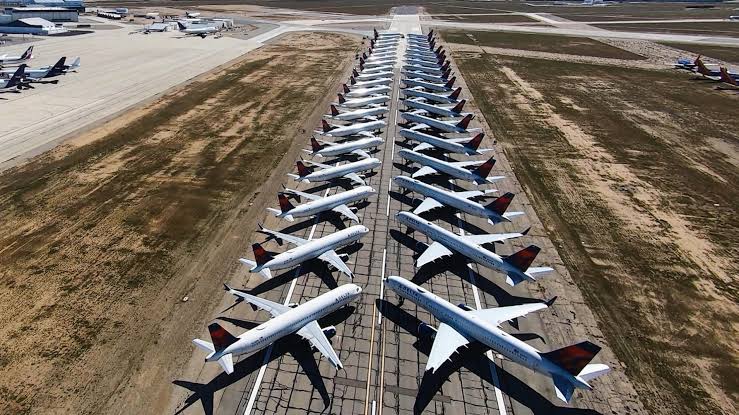
The problem is with the FAA’s Air Route Traffic Control Centers. These 22 regional centres guide planes at cruising altitude between airports. They’re separate from the control towers that handle takeoffs and landings.
“The FAA issued a nationwide ground stop for all U.S. airports following a communication issue impacting all Air Route Traffic Control Centers,” U.S. Transportation Secretary Sean Duffy posted on X just after 4:15 p.m. ET. “FAA technicians are investigating the issue. We will provide immediate updates as we have them.”
Before the order came down, airline crews were already reporting lost radio frequencies across the country.
A ground stop means no more planes are cleared to take off while controllers deal with the problem. It doesn’t mean every terminal is closed, or that every plane in the sky has to land right away.
Nearly 7,000 U.S. flights were delayed or cancelled by Friday evening, according to flight-tracking data, and the number was still rising.
How long will it last?
The FAA hasn’t said.
Its advisory runs into late Friday night, but departures stay grounded “until further notice.” Some West Coast flights were reported to be starting to resume Friday afternoon. That doesn’t mean the restrictions have lifted everywhere.
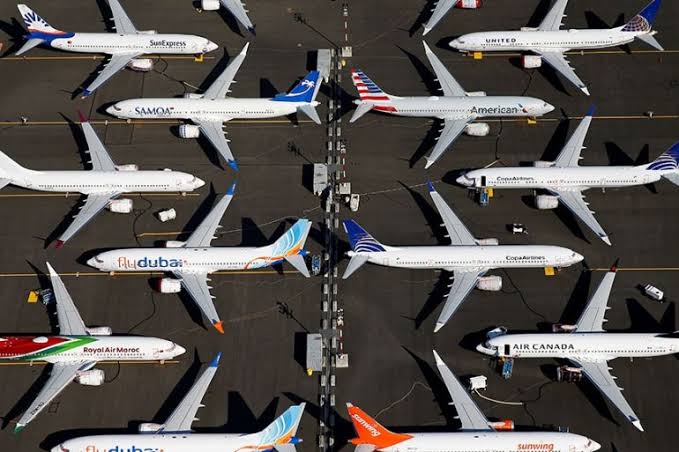
When it does end, the recovery won’t be instant. Airlines will have to find gates, move planes back into position and line up crews whose working hours may have run out. Expect a patchy restart: one flight boards while the one next to it is delayed or cancelled. That could carry into Saturday.
What it means at Canadian airports
Canada’s air traffic system is working normally. Nav Canada, which runs Canada’s civil air navigation system, says its systems are unaffected and domestic flights are still moving.
“Travellers should expect delays and check with their airline,” Nav Canada said. “Our systems are operating normally.”
Nav Canada has put traffic management measures in place at Toronto Pearson, Montréal-Trudeau, Calgary and Vancouver. That lets those airports handle the volume safely, including any planes diverted from the U.S.
Here’s where Canadian airports stand:
Calgary (YYC): Holding all U.S.-bound departures until further notice
Edmonton (YEG): Asking passengers to check with their airline before heading to the airport
Toronto Pearson (YYZ): “There are currently no scheduled U.S.-bound departures or arrivals at this time”
Montréal-Trudeau (YUL): U.S. flights suspended
Vancouver (YVR): Warning that some international flights crossing U.S. airspace could be affected
Ottawa: Reporting affected arrivals and departures, with diversions expected
Victoria and Kelowna: Flights to Seattle affected
Transport Minister Steven MacKinnon said Ottawa is in contact with Nav Canada. “While Canadian systems are operating normally, travel to the United States may be disrupted as a result of the ground stops,” he said.
At Pearson, reporters described confusion outside the U.S. departure gates. Some travellers said they were almost at their gate when they were told the flight wasn’t going and sent back to the main terminal.
Not going to the U.S.? You could still be affected
A trip doesn’t have to end in the U.S. for this to hit you.
Connecting through the U.S.: If your trip to Mexico, the Caribbean or South America changes planes in Denver, Phoenix or Los Angeles, that connection is at risk.
Flying over the U.S.: Some flights from Canada to Mexico, the Caribbean and South America cross U.S. airspace. Air Canada says flights to and from the Caribbean and South America may be affected.
Your return flight: If you’re already in the U.S., your flight home is grounded until the stop lifts.
For a Calgary or Edmonton traveller, check three things: the U.S.-bound flight, any connection, and the return.
Was it a cyberattack?
The cause hasn’t been confirmed.
Homeland Security Secretary Markwayne Mullin called it “just a telecommunication outage as of right now.” He told reporters outside the White House: “This isn’t another 9/11. There should be no fear to the public at all.”
He added, “We’re not ruling anything out at this point.” That’s different from saying a cyberattack has been ruled out.
He also dismissed any link to Microsoft’s global outage, which knocked out Outlook and Teams starting Thursday. “I don’t see any reason to connect those two at all,” he said.
The timing of a new FAA system
On Nov. 10, three days before the outage, the FAA announced it was expanding a system called Strategic Management of Airspace, Routes and Trajectories, or SMART, across the country.
The FAA describes SMART as a cloud-based platform. It combines weather, flight paths, traffic flow and controller staffing to recommend how to schedule flights through busy airspace, and it feeds that information to the same regional centres that went down Friday.
Asked whether it could be connected, Mullin said: “You just can’t rule anything out at this point.” Nothing so far links the system to Friday’s failure.
What to do if your flight is delayed or cancelled
Check your airline’s app or website before you leave home. Look at every flight on your booking and turn on notifications.
Don’t cancel on your own. If you cancel before the airline does, you can lose your right to a refund. Let the airline make the change first.
Ask about rebooking and travel waivers before buying a new ticket yourself.
Check the airport rules. A delay doesn’t automatically change check-in or bag-drop deadlines.
Save everything. Keep cancellation notices, screenshots and receipts for meals and hotels.
Call your insurer before spending big. Some policies need approval in advance or have spending limits.
Already at the airport? Ask what happens to your checked bags before you leave.
Do you get compensation or a refund?
Compensation, rebooking and refunds are three different things.
Compensation: Canada’s air passenger rules separate disruptions an airline can control from ones it can’t. An air traffic control shutdown falls outside an airline’s control, so it generally doesn’t owe you compensation for the inconvenience.
Rebooking: For disruptions outside an airline’s control, the Canadian Transportation Agency says the airline must give you a confirmed seat on its own or a partner’s next available flight leaving within 48 hours of your original departure.
Refund: If the airline can’t do that, it has to offer you a choice between a refund and other travel arrangements. These rules cover flights to, from and within Canada, including connections.
U.S. rules can apply too. The U.S. Department of Transportation’s refund rules cover any airline flying to, from or within the U.S., not just American carriers. If an airline cancels your flight for any reason and you turn down the alternative, you’re entitled to a refund. For international trips, arriving six hours or more late can also qualify as a significant delay.
If you accept a new flight and take it, you generally can’t get a refund for that leg too. Before you accept a voucher, ask whether a refund is available instead.
This almost never happens
The U.S. has stopped flights nationwide only twice in the past 25 years.
The first was Sept. 11, 2001, after the terrorist attacks. The second was Jan. 11, 2023, when the FAA’s Notice to Air Missions system failed. That system sends pilots critical safety alerts. The stop lasted about 90 minutes, but it delayed more than 10,000 flights and cancelled about 1,300. The FAA later said contract workers had accidentally deleted files while syncing the main and backup databases.
That was a different system, and it doesn’t explain Friday’s failure.
“This is not supposed to happen. We have failsafe systems, we have backup systems that have been in place for years,” McGill University aviation management professor John Gradek told CBC News. “It’s not as bad as 9/11, but it’s still a major, major disruption. You’re going to have hundreds of thousands of people whose flights are interrupted tonight.”
An aging system under pressure
Friday’s outage hit a U.S. air traffic system that was already being rebuilt.
Congress approved $12.5 billion to modernize it. Crews have been replacing miles of old copper wire with fibre-optic lines and swapping out old radios at airports. Duffy has said another $30 billion is needed to finish the job.
In September, a regional communications failure in the U.S. Northeast snarled hundreds of flights. Friday’s outage looks like the same kind of problem, only nationwide.
For anyone flying this weekend, the question is simpler: what’s changed on your booking, and what is your airline offering? Check before you leave.
We’ll update this story as flights resume and the cause becomes clearer.
Sources
U.S. Transportation Secretary Sean Duffy (@SecDuffy) on X, Nov. 13, 2026
Federal Aviation Administration: National Airspace System Status
Federal Aviation Administration: General statements (SMART announcement, Nov. 10, 2026)
Federal Aviation Administration: NOTAM statement (Jan. 2023)
Nav Canada, statements, Nov. 13, 2026
Transport Minister Steven MacKinnon, statement, Nov. 13, 2026
Toronto Pearson (@TorontoPearson) on X; Calgary International Airport, statement, Nov. 13, 2026
Canadian Transportation Agency: Air Passenger Protection Regulations








Comments