Your flight is delayed because the airline finds a mechanical problem. You miss your connection, spend hours at the gate and end up needing a hotel for the night.
Under a new U.S. rule, you could be the one paying for it.
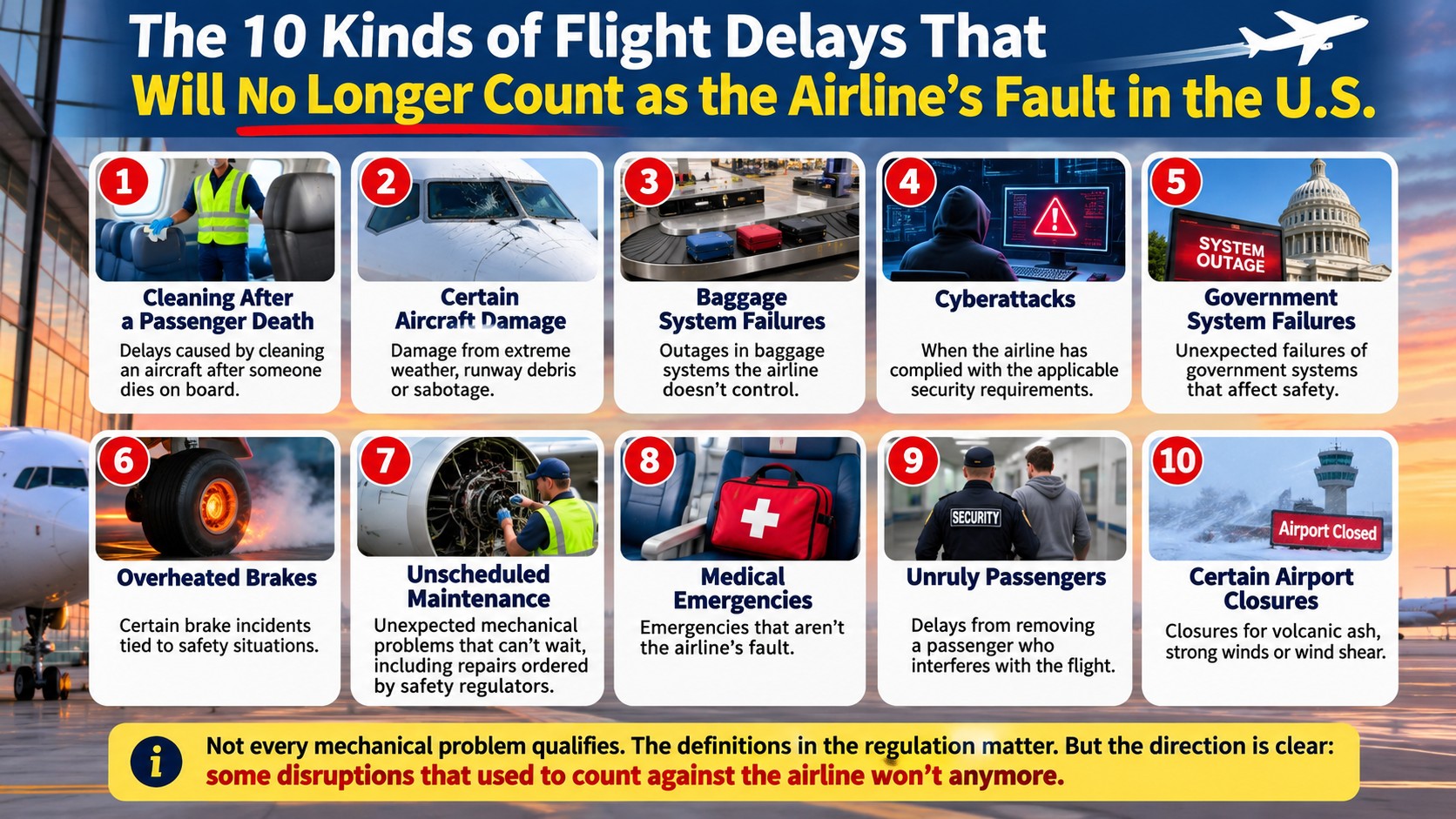
The United States is changing how airlines classify certain flight delays and cancellations. Starting Feb. 1, 2027, 10 kinds of disruptions will no longer count as the airline’s responsibility, including some unexpected maintenance problems, cyberattacks and medical emergencies.
The U.S. Department of Transportation says in the rule itself that “the total value of amenities and compensation currently provided by air carriers to consumers will be reduced.”
For Canadians flying south this winter, it raises a question worth answering before you book: when a flight goes wrong in the U.S., whose rules apply? The answer depends on how you bought your ticket.
Why some passengers could lose meals and hotels
In the United States, airlines generally aren’t required by law to feed you or put you up when a flight is delayed.
What they do have are promises. Most major U.S. airlines have committed to meal vouchers, hotel rooms and ground transportation during long delays, and those commitments are posted on the U.S. Department of Transportation’s airline customer service dashboard.
The catch is that the promises only kick in when the delay is the airline’s fault.
That’s where the new rule bites. By moving 10 kinds of disruptions out of the airline’s-fault category, the government changes how they’re reported. It can also change whether an airline considers you eligible for help under its own commitments.
In plain terms, a passenger who would have gotten a meal voucher or a hotel room during a maintenance delay might not get one anymore.
Airlines can still help voluntarily. Each airline’s policy matters, and some may keep doing what they do now. But the government’s own estimate is that, overall, passengers will get less.
The 10 kinds of delays affected
The rule moves these out of the “air carrier” category:
Cleaning after a passenger death: delays caused by cleaning an aircraft after someone dies on board.
Certain aircraft damage: damage from extreme weather, runway debris or sabotage.
Baggage system failures: outages in baggage systems the airline doesn’t control.
Cyberattacks: when the airline has complied with the applicable security requirements.
Government system failures: unexpected failures of government systems that affect safety.
Overheated brakes: certain brake incidents tied to safety situations.
Unscheduled maintenance: unexpected mechanical problems that can’t wait, including repairs ordered by safety regulators.
Medical emergencies: emergencies that aren’t the airline’s fault.
Unruly passengers: delays from removing a passenger who interferes with the flight.
Certain airport closures: closures for volcanic ash, strong winds or wind shear.
Not every mechanical problem qualifies. The definitions in the regulation matter. But the direction is clear: some disruptions that used to count against the airline won’t anymore.
When the rule takes effect
The U.S. Department of Transportation published the rule on Sept. 3, 2026, without the usual public comment period. It was supposed to take effect Oct. 19.
Then Airlines for America, the industry group for the major U.S. carriers, asked for more time. The department pushed the effective date to Feb. 1, 2027. The new reporting categories apply to delays and cancellations from Jan. 1, 2027 onward.
The department says Congress made it do this. Section 511(b) of the FAA Reauthorization Act of 2024 directed it to exclude these causes from the airline’s-fault category.
Passenger advocates read that law differently.
A passenger rights group is suing
On Oct. 30, FlyersRights, a U.S. passenger advocacy group, announced it had filed a challenge in the U.S. Court of Appeals for the District of Columbia Circuit.
The group argues Congress told the department to change how airlines report delays, not to shrink what airlines owe stranded passengers. It also says the department skipped public comment.
“A change in reporting classifications is not permission to reduce passenger rights,” FlyersRights president Paul Hudson said.
Earlier in October, FlyersRights and other consumer groups asked the department to withdraw the rule. “The rule sneakily transfers costs from airlines back to passengers,” Hudson said then.
The lawsuit doesn’t pause the rule. Unless a court or the government steps in, it takes effect Feb. 1.
What it means for Canadians flying to the U.S.
Canada has its own rules, the Air Passenger Protection Regulations, run by the Canadian Transportation Agency. They cover flights to, from and within Canada, including connecting flights. That’s true whether the airline is Canadian or American.
So a flight from Calgary to Phoenix, or Toronto to Miami, is covered by Canada’s rules, and so is the flight home.
Connections inside the U.S. are where it gets tricky. The agency’s guide says a flight between two U.S. cities is covered only if:
it’s on a single through fare with the flight to or from Canada, and
the same airline operates both flights, or a partner carries you under a commercial agreement like a codeshare.
Buy the U.S. leg on a separate ticket, even through the same booking site, and that leg falls under U.S. rules. That’s exactly where the new change could leave you on your own.
Three common trips:
Calgary to Phoenix, direct. Canada’s rules apply.
Toronto to Los Angeles, connecting to Las Vegas on the same ticket with the same airline. Canada’s rules may apply to the whole trip.
Los Angeles to Las Vegas on a separate ticket. U.S. rules apply.
Canada’s rules aren’t a blank cheque either
Canada’s rules sort disruptions into three bins: within the airline’s control, within its control but required for safety, and outside its control.
What you’re owed changes by bin. A safety-related delay can get you meals and a hotel but no cash compensation. A weather delay can get you rebooked but not much else.
Ottawa has been working on tighter rules. Changes passed in 2023 would scrap the three categories and make airlines pay compensation unless they prove a disruption was out of the ordinary. Proposed regulations were published in December 2025, but they aren’t in force yet. Meanwhile, the agency’s backlog of passenger complaints passed 95,000 this spring.
Refunds don’t change
The U.S. rule doesn’t touch refunds.
If a U.S. airline cancels your flight or makes a significant change and you turn down the alternative, you’re still entitled to your money back, whatever the cause.
A refund isn’t the same as a hotel room, though. Getting the unused part of your ticket back doesn’t mean the airline will cover the night you spent at an airport hotel.
Five things to do before flying south
1. Book the whole trip on one ticket. It’s the single biggest thing you can do to keep Canada’s rules on your side through a U.S. connection.
2. Check the airline’s delay policy. The U.S. Department of Transportation’s dashboard shows what each major airline promises for meals, hotels and rebooking.
3. Look at your credit card and insurance. Many travel cards include trip delay coverage that pays for meals and hotels no matter whose fault it is. Check the waiting period and the limits.
4. Ask for the reason, and keep every receipt. The reason for a delay decides what you’re owed. Save boarding passes, airline messages, hotel bills and meal receipts.
5. Know where to complain. For flights covered by Canada’s rules, go to the airline first, then the Canadian Transportation Agency. For flights under U.S. rules, complain to the U.S. Department of Transportation.
What happens next
The rule is set for Feb. 1, 2027. The lawsuit continues. Airlines may spell out how the new categories change their commitments between now and then.
For Canadians, the lesson isn’t that every delay just got more expensive. It’s that the reason for the delay, the airline’s policy and how you booked can all decide whether the airline pays for your hotel or you do.
Sources
Federal Register: Delay of effective date to Feb. 1, 2027 (Oct. 15, 2026)
Canadian Transportation Agency: Application of the Air Passenger Protection Regulations, a guide
Canadian Transportation Agency: Air passenger protection (2026 briefing)
Canadian Transportation Agency: Strengthening air passenger protection in Canada




Comments