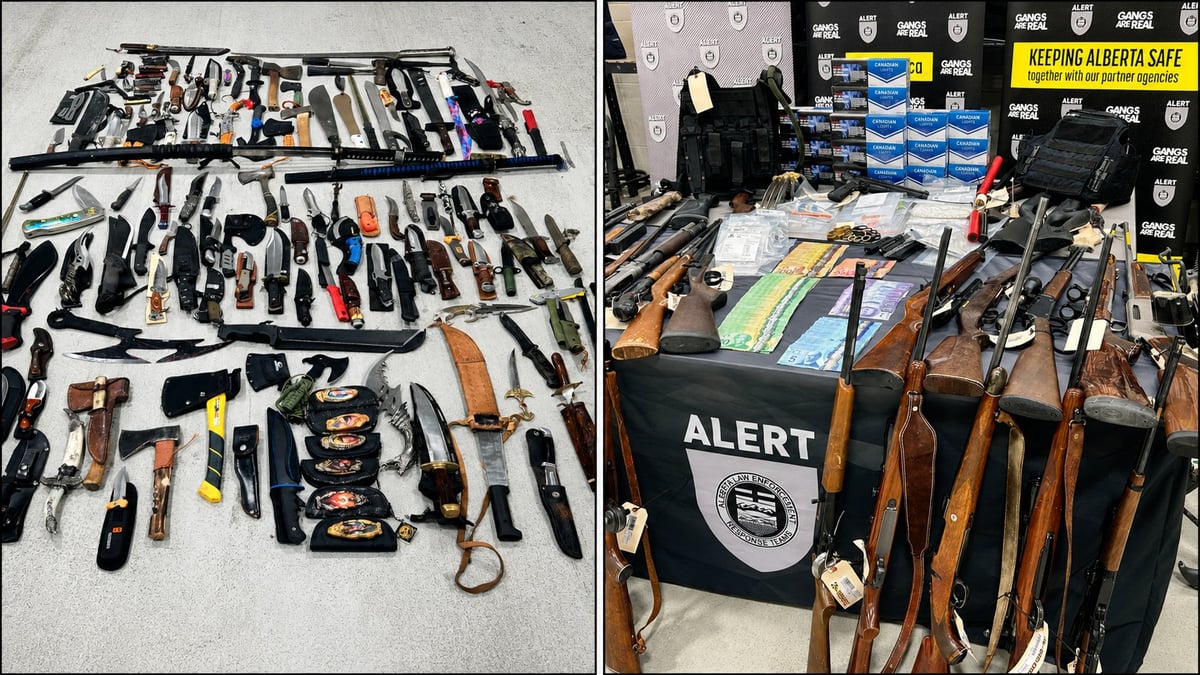
Police seized 23 illegal firearms, 4,700 rounds of ammunition and roughly 170 knives and edged weapons from a home in north Lethbridge, in what the Alberta Law Enforcement Response Teams describes as one of the largest weapons seizures in the agency's history.
ALERT's Lethbridge organized crime team executed a search warrant at a home in the 2000-block of 7 Avenue North on July 15, with help from the Lethbridge Police Service. Two people were arrested. One of them is under a lifetime prohibition on possessing any firearm.
The home had been linked to suspected drug trafficking first reported to police in June.
The full inventory
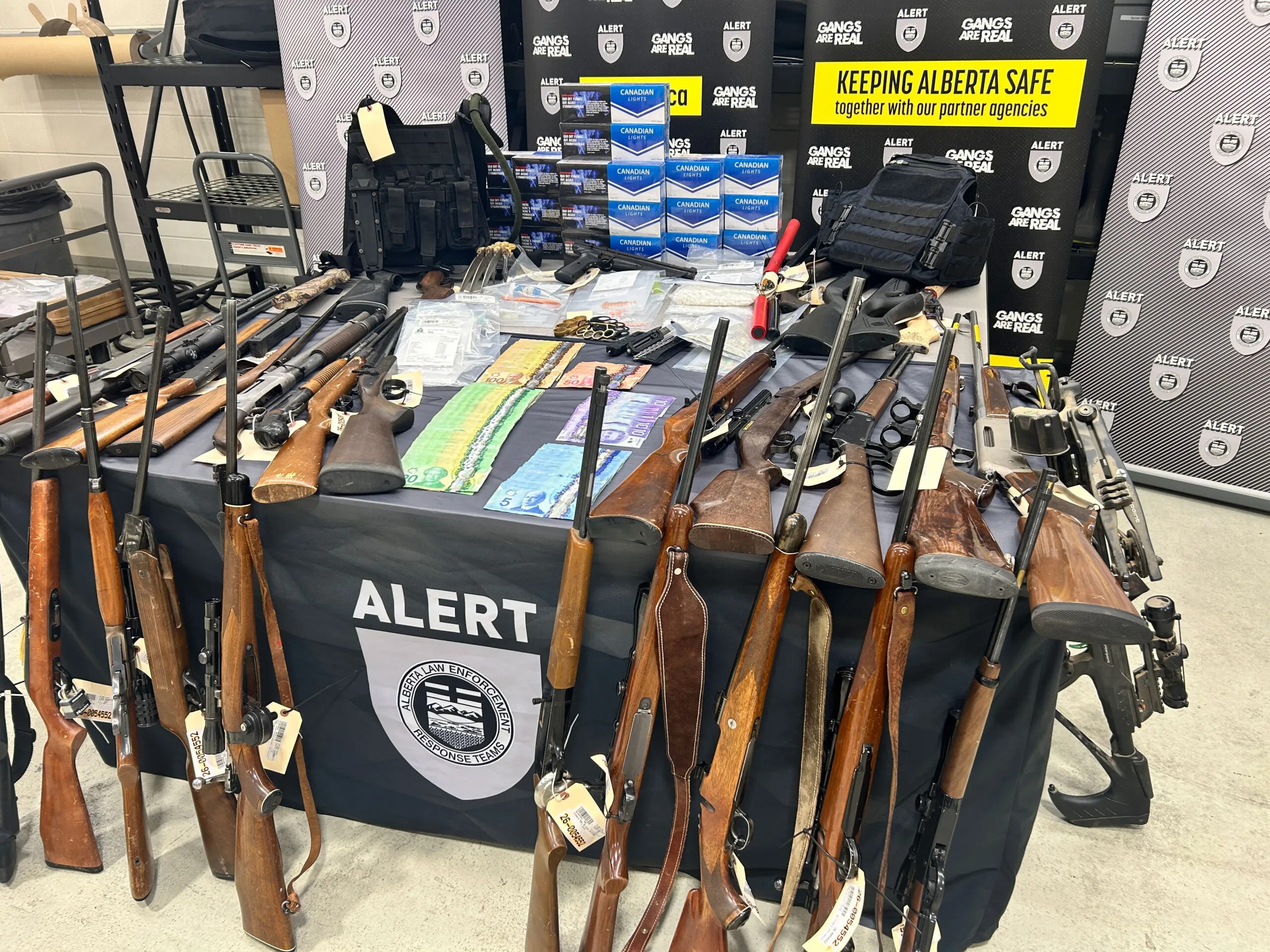
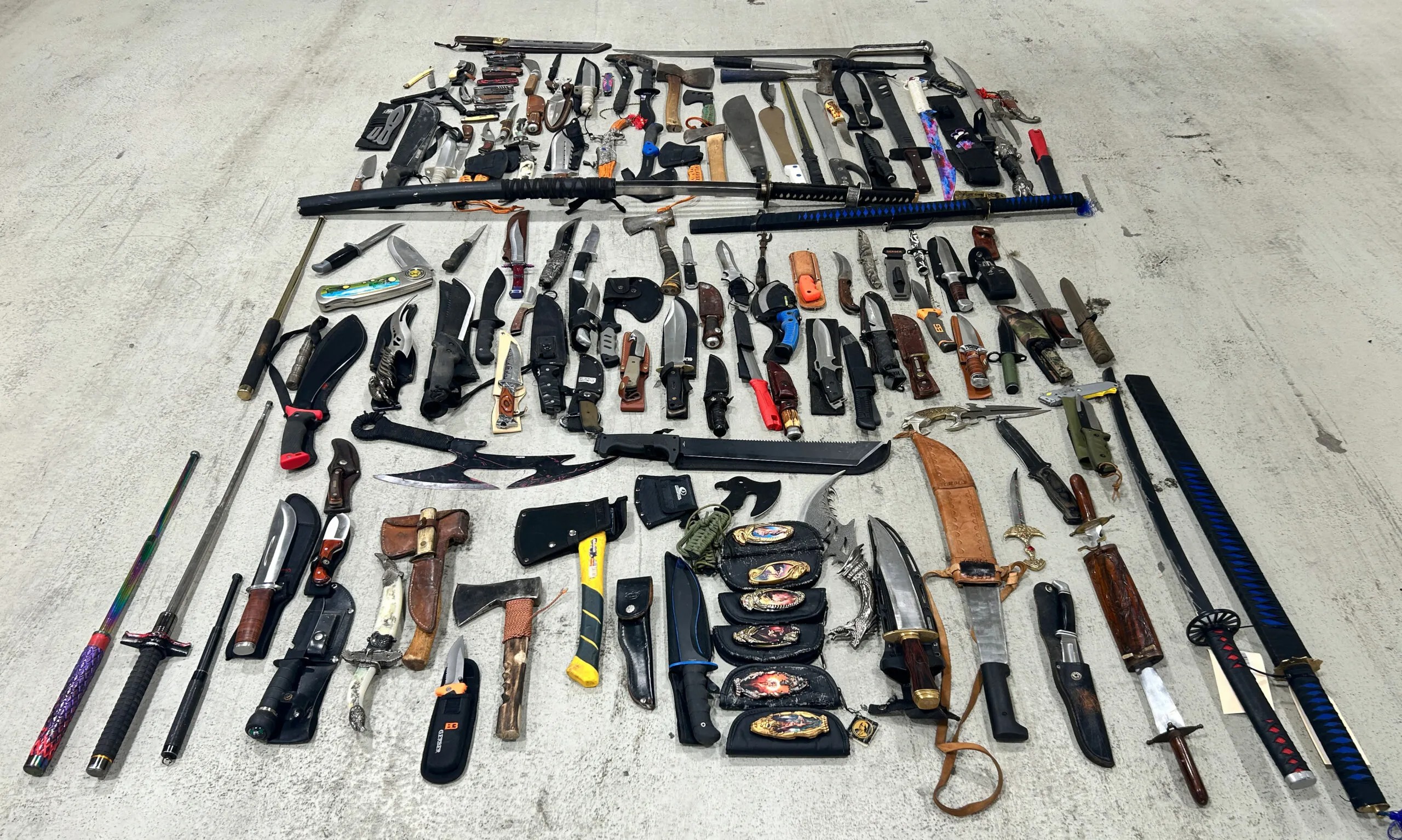
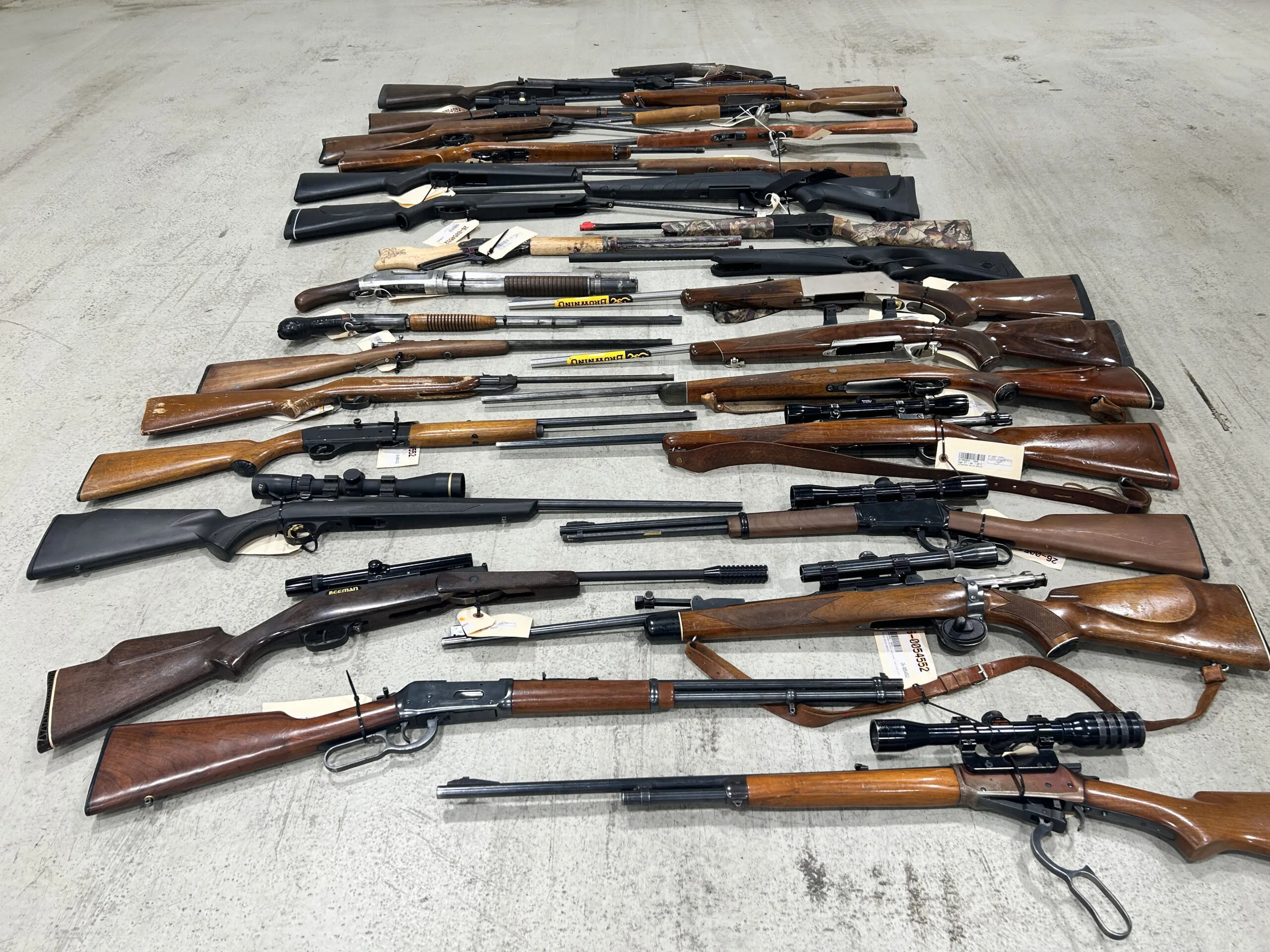
Nineteen rifles, three shotguns and one pistol, plus nine replica firearms. Twelve prohibited weapons. Roughly 170 knives and edged weapons. Two body armour vests. Four thousand seven hundred rounds of ammunition.
The drugs came to approximately $20,000: 53 grams of cocaine, 41 grams of methamphetamine, 538 fentanyl and oxycodone pills, 113 tabs of LSD, and 20 cartons of contraband tobacco products. Investigators also seized $13,649 in cash.
ALERT says it believes many of the weapons were being traded for drugs.
What "one of the largest" actually means
ALERT publishes its own performance figures each year, which makes the claim measurable rather than a matter of adjectives.
In the 2024-25 fiscal year, ALERT's organized crime teams seized 127 firearms across the entire province, working from eight regional hubs between Lethbridge and Fort McMurray. The Lethbridge region accounted for five of them.
This one house held 23.
That is more than four times what the Lethbridge team seized across twelve months, and close to a fifth of ALERT's province-wide total for that year. In fairness, 2024-25 was a quiet year locally, and the Lethbridge region seized 44 firearms the year before. Measured against either, a single residence producing 23 guns sits well outside the pattern.
Those calculations are ours, run against ALERT's published tables, and are not figures the agency has released.
The charges
Louise Sansome, 47, is charged with possession of drugs for the purpose of trafficking, possession of proceeds of crime, possession of body armour, offences under the Tobacco Act, and numerous firearms-related offences. ALERT says Sansome has a lifetime firearms prohibition stemming from previous convictions.
Terry Adamson, 56, is charged with possession of drugs.
None of the allegations have been tested in court.
A lifetime prohibition is what a court imposes when it determines a person should never legally possess a firearm again. It is the most serious weapons restriction available short of custody. On the police account, that order was in force while two dozen guns and 4,700 rounds sat inside the house.
Why body armour is its own charge in Alberta
The possession of body armour charge is one most people outside law enforcement have never heard of, and it exists because of a piece of Alberta legislation that has been on the books since 2012.
Under the Body Armour Control Act, it is an offence in Alberta to possess body armour without a permit. The province brought the Act into force in June 2012, gave people six months to either obtain a permit or dispose of what they had, and made unpermitted possession chargeable as of December 15, 2012. The stated purpose was to make it harder for people involved in gang and drug activity to armour themselves. Alberta is one of a handful of provinces with this kind of law, alongside British Columbia, Manitoba and Nova Scotia.
There are exemptions. Police, corrections staff, sheriffs and security personnel don't need permits. Neither does anyone holding a valid firearms licence, which is the exemption most ordinary Albertans would rely on.
That exemption is unavailable to a person under a lifetime firearms prohibition, because such a person cannot hold a valid licence. The Act also allows the Registrar to refuse a permit to anyone who has been charged with or convicted of a criminal offence.
Under the same legislation, an officer who asks for a permit and doesn't get one can seize the armour on the spot.
Where the guns came from is the real open question
None of the 23 firearms were lawfully possessed, meaning every one of them reached that address from somewhere it should not have.
ALERT is working with the RCMP's National Weapons Enforcement Support Team, the federal unit that traces crime guns to their origin, to establish where they came from. One has been identified so far, a firearm previously reported stolen in Brooks, roughly 170 kilometres northeast of Lethbridge.
That single trace matters more than it appears. Crime guns in Canada arrive by two broad routes, smuggled across the American border or stolen domestically, and which route dominates changes what enforcement should be aimed at. A gun taken in a Brooks theft turning up in a Lethbridge drug house is the domestic route, the one that runs through rural break-ins, unsecured cabinets and acreages emptied while owners are away.
The composition of the haul points the same way. Nineteen rifles and three shotguns is not the profile of an organized gang armoury. It reads much closer to the contents of ordinary Alberta gun cabinets, which is consistent with ALERT's own assessment that many of these items were traded for drugs rather than bought.
The remaining traces will take months. If a pattern emerges from them, it will say something concrete about where southern Alberta's crime guns actually originate.
The blades
The roughly 170 knives and edged weapons included switchblades, swords, nunchakus, collapsible batons, brass knuckles, and clawed gloves resembling those worn by the character Freddy Krueger in the Nightmare on Elm Street films.
"The drug trade is inherently violent and unpredictable," ALERT Staff Sgt. Trevor Sheppard said. "A huge weapons cache such as this demonstrates an unwelcome danger to our community."
The collection is unusual enough that it is the reason this case travelled well beyond Lethbridge. It also illustrates Sheppard's point. A drug house does not assemble weapons the way a collector does. It accumulates whatever comes through the door in the hands of people with something to trade.
Reporting it
Anyone who suspects drug or gang activity in their community can contact local police, or Crime Stoppers at 1-800-222-8477. Crime Stoppers is always anonymous.
ALERT is funded by the Government of Alberta and combines officers from municipal police services and the provincial and federal RCMP into integrated teams operating in eight Alberta communities.
Sources:
ALERT, "Hundreds of weapons seized as part of Lethbridge drug bust," July 30, 2026: https://alert-ab.ca/hundreds-of-weapons-seized-as-part-of-lethbridge-drug-bust/
ALERT, Publications and statistics, 2024-25 and 2023-24 performance measures: https://alert-ab.ca/resources/publications-stats/
Body Armour Control Act, SA 2010 c B-4.8: https://www.canlii.org/en/ab/laws/stat/sa-2010-c-b-4.8/latest/sa-2010-c-b-4.8.html
Government of Alberta, Body Armour Control Act: https://open.alberta.ca/publications/b04p8








Comments
Conversation