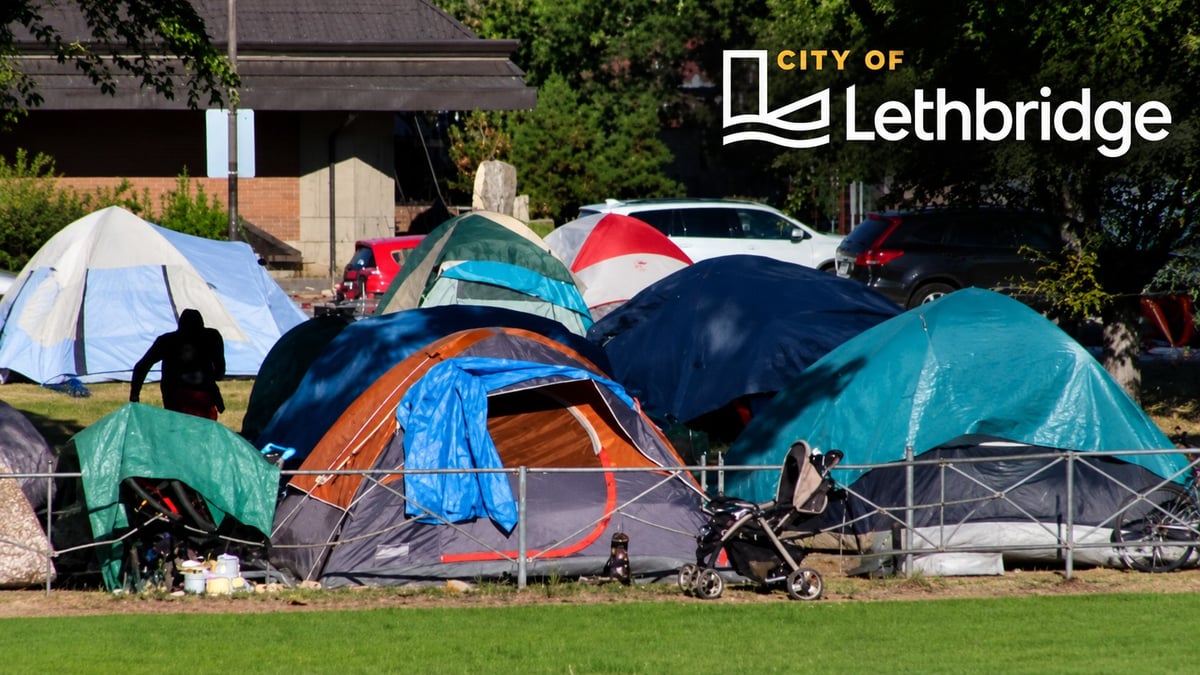
Two summers ago, Lethbridge's encampment reports were climbing so fast the city's own updates led with the increase. This week's update to council led with the opposite: encampment-related 311 calls are down 72 per cent from last summer.
The numbers come from the quarterly Encampment Response Report presented to the Community Issues Committee on Tuesday. There were 159 calls in the second quarter of 2026, against 454 in the same quarter of 2025. That's roughly 300 fewer calls in three months, and the declines run across every category the city tracks. Encampment reports, debris, needles and biohazards all fell.
The report says the total number of encampments continues to decrease too, consistent with what the first quarter showed. Both measures, what the public reports and what the response team counts, point the same direction.
The city's explanation
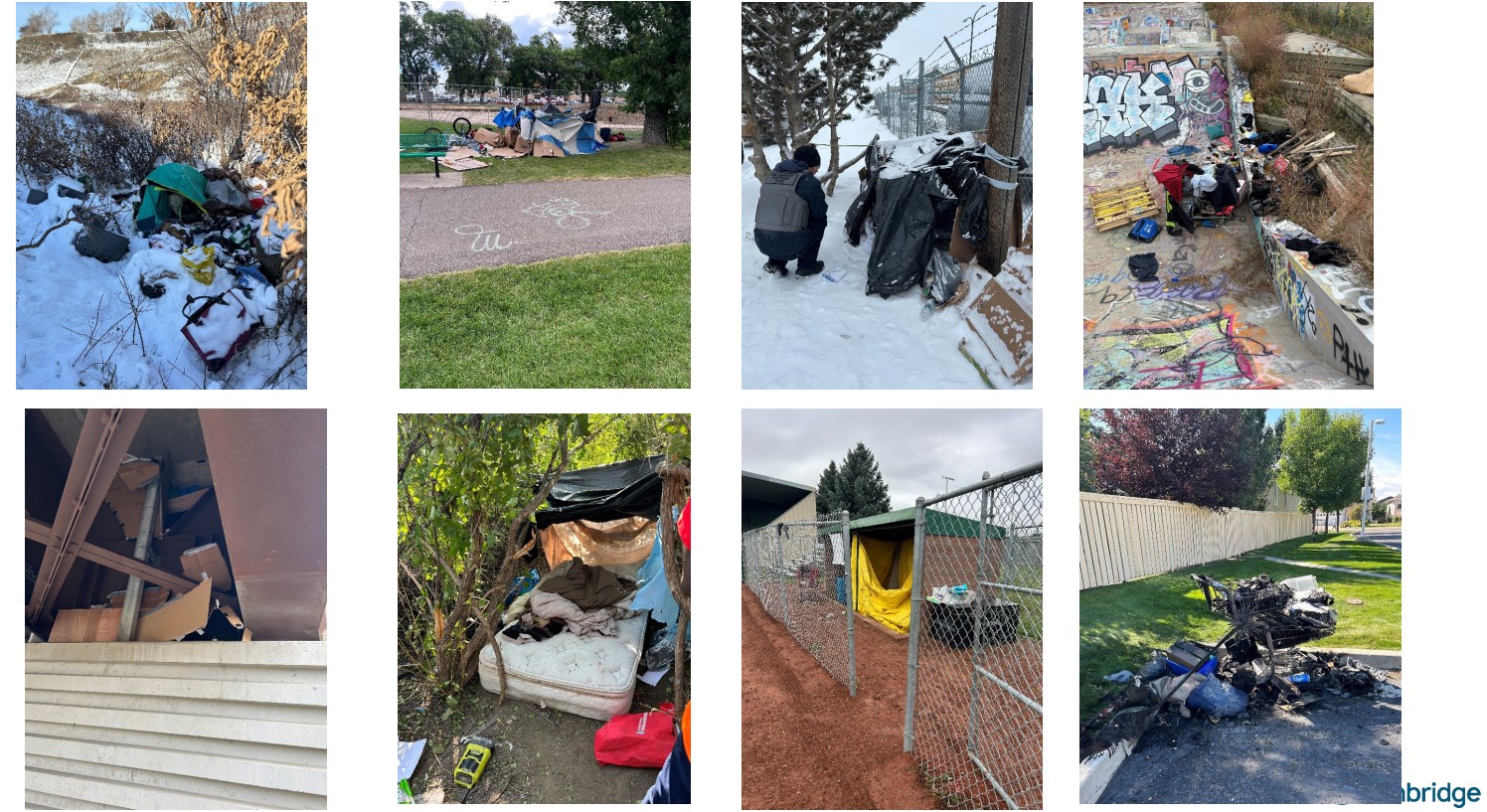
The city's account of why is more careful than a victory lap, and worth quoting precisely: services for vulnerable residents have been centralized, resulting in less public visibility.
Read that twice. The city isn't only claiming fewer people are in crisis. It's saying the crisis is less spread across parks, alleys and storefronts than it was, because the people living it are concentrated where services are. For a downtown business owner or a parent at Galt Gardens, that distinction may not matter much. For understanding what the number means, it matters a lot.
What a 311 call measures, and what it can't
A 311 call measures what the public sees and bothers to report. It moves when encampments move, but it also moves when encampments shift somewhere less visible, when residents get used to what they see, or when people stop reporting because they've decided nothing changes. Call data is a real signal about visible, reported activity. It is not a census of homelessness.
That's why the report's second claim, that the count of actual encampments is also falling, does more work than the 72 per cent does. The response team's own tally doesn't depend on who picks up the phone. With both numbers falling together, the case that something real changed is considerably stronger than either number alone.
What neither number says is whether fewer people in Lethbridge are homeless. Someone who moves from a riverbottom camp into the shelter system stops generating 311 calls without their situation being solved. The city's framing is honest about exactly that.
How Lethbridge got here
The arc behind Tuesday's number is three years long. Council approved the Encampment Strategy in May 2023 and stood up a dedicated response team that June. The early results went the wrong way first. Through 2024, encampment reports more than doubled over 2023, and the summer 2024 update recorded a 27 per cent jump, with 160 structures and more than 10,000 kilograms of debris removed in a single season.
But other lines on the chart were already turning. Even as reports doubled, police calls tied to encampments fell 16 per cent, fire and EMS calls dropped 11 per cent, and outdoor fires, the danger the fire department worries about most, fell 27 per cent. Then the city brought outreach in-house. Its own figures since the change: intakes up 263 per cent, referrals up 318 per cent, and 19 people exiting homelessness between August 2024 and April 2025, compared to none the year before.
Tuesday's 72 per cent is the first summer quarter where the most visible number caught up with the quieter ones.
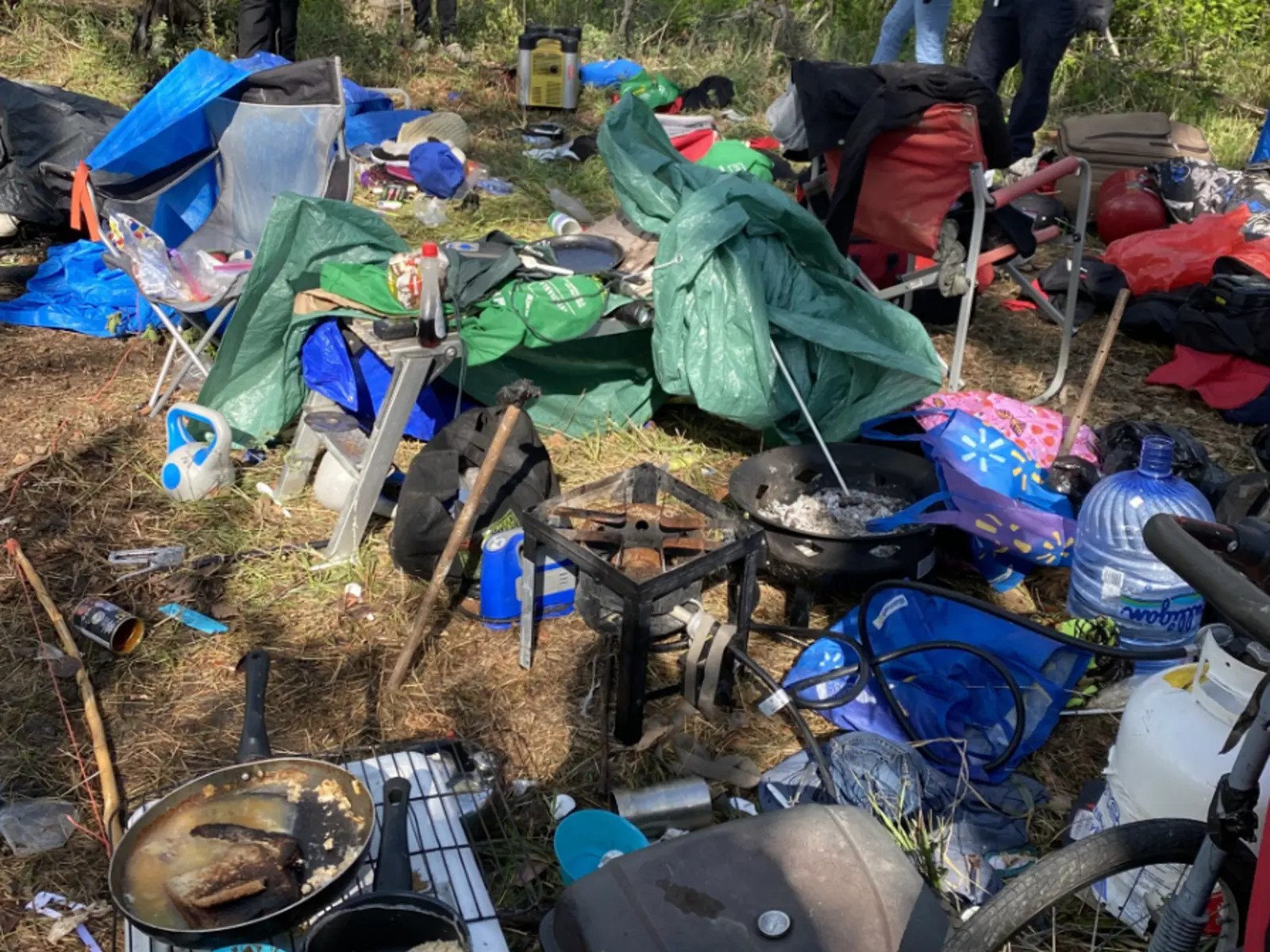
What actually happens when someone reports an encampment
The 311 number gets quoted in every city update, but the machinery behind it rarely gets explained, and it's the part residents actually touch.
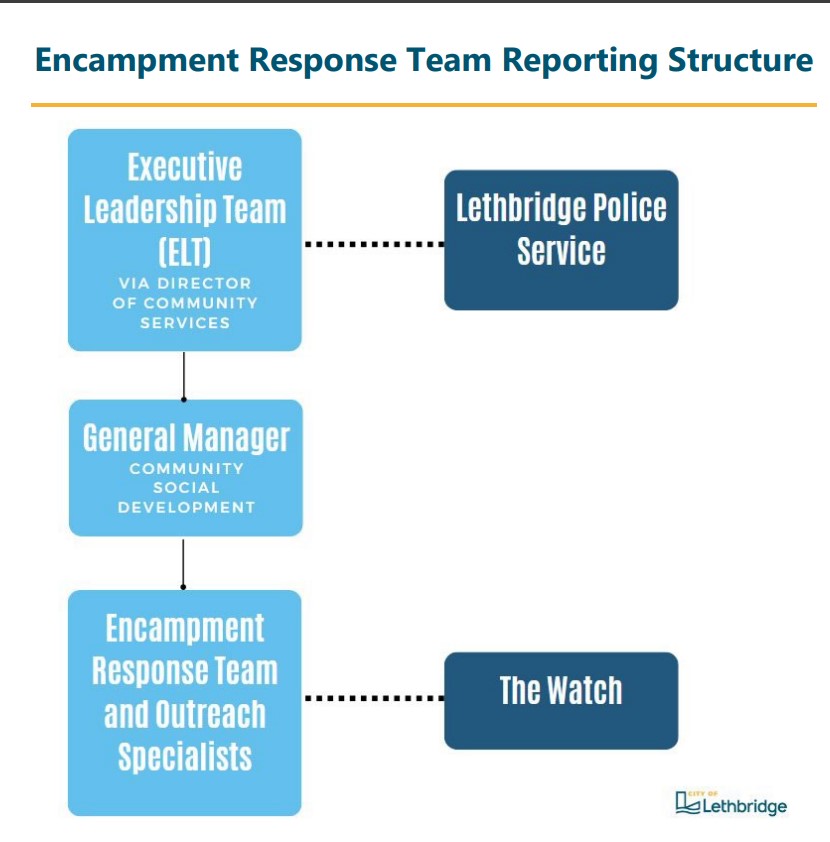
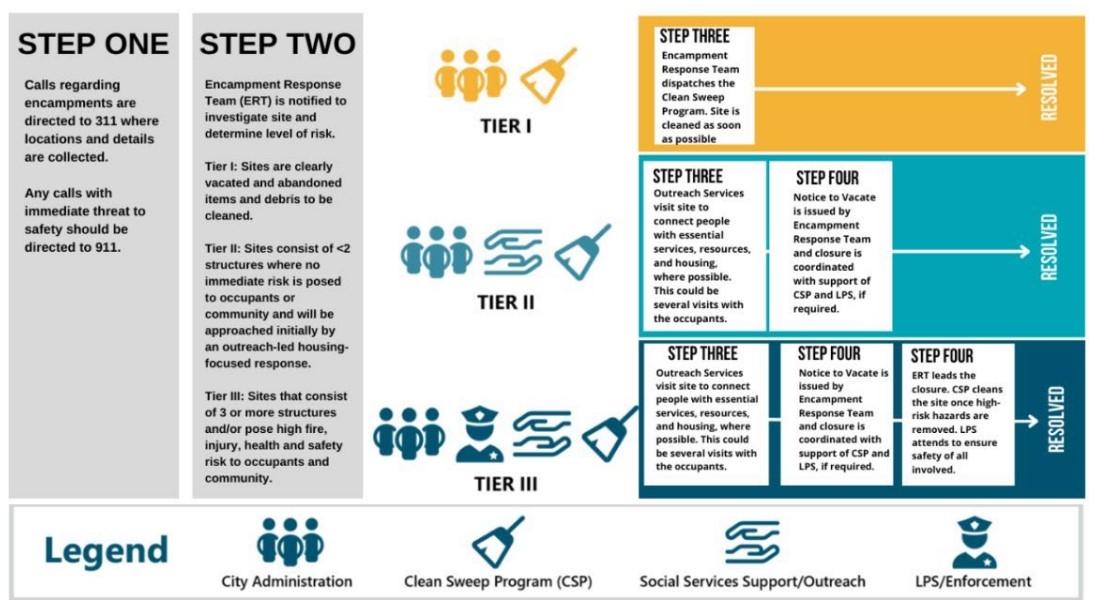
A call or an online public safety report goes to the 311 centre, which routes it into a triage process run jointly by the city and Lethbridge Police Service. Not every report becomes an encampment file. The city sorts calls against a three-tier framework based on size, entrenchment and risk, and past reports show roughly a third of triaged calls qualify as true encampments. The rest land as debris, biohazards or unsightly property complaints that go to different crews. Needle debris has its own stream, and the downtown Clean Sweep program handles part of the core.
What follows depends on the tier: outreach contact first, with the in-house team offering supports and a path toward shelter, then monitoring, and coordinated cleanup where a site is vacated or poses a risk. Connection before removal where possible is the point of the whole strategy, and it's where those outreach numbers come from.
Practically, for a resident: 311 or the city's online form for encampments, debris and needles, and 911 for anything life-threatening, always. A report isn't a request for instant removal. It's the data feeding the triage, which is also why the call counts in these quarterly reports mean something.
What to watch next
Q3 is the test. Summer's back half has always been encampment high season in Lethbridge, and the same July-to-September window produced the worst numbers of 2024. If the fall update shows the drop holding through the hot months, the trend is real and durable. If calls snap back, this quarter starts looking like timing.
The quarterly reports are public on the city's Community Social Development page.
Sources:
City of Lethbridge, Encampment Response Report, Q2 2026 quarterly update to the Community Issues Committee, July 21, 2026
City of Lethbridge, Community Social Development, encampment reports archive: https://www.lethbridge.ca/community-services-supports/community-social-development-csd/
City of Lethbridge, Encampment Strategy updates, 2023–2025







Comments
Conversation