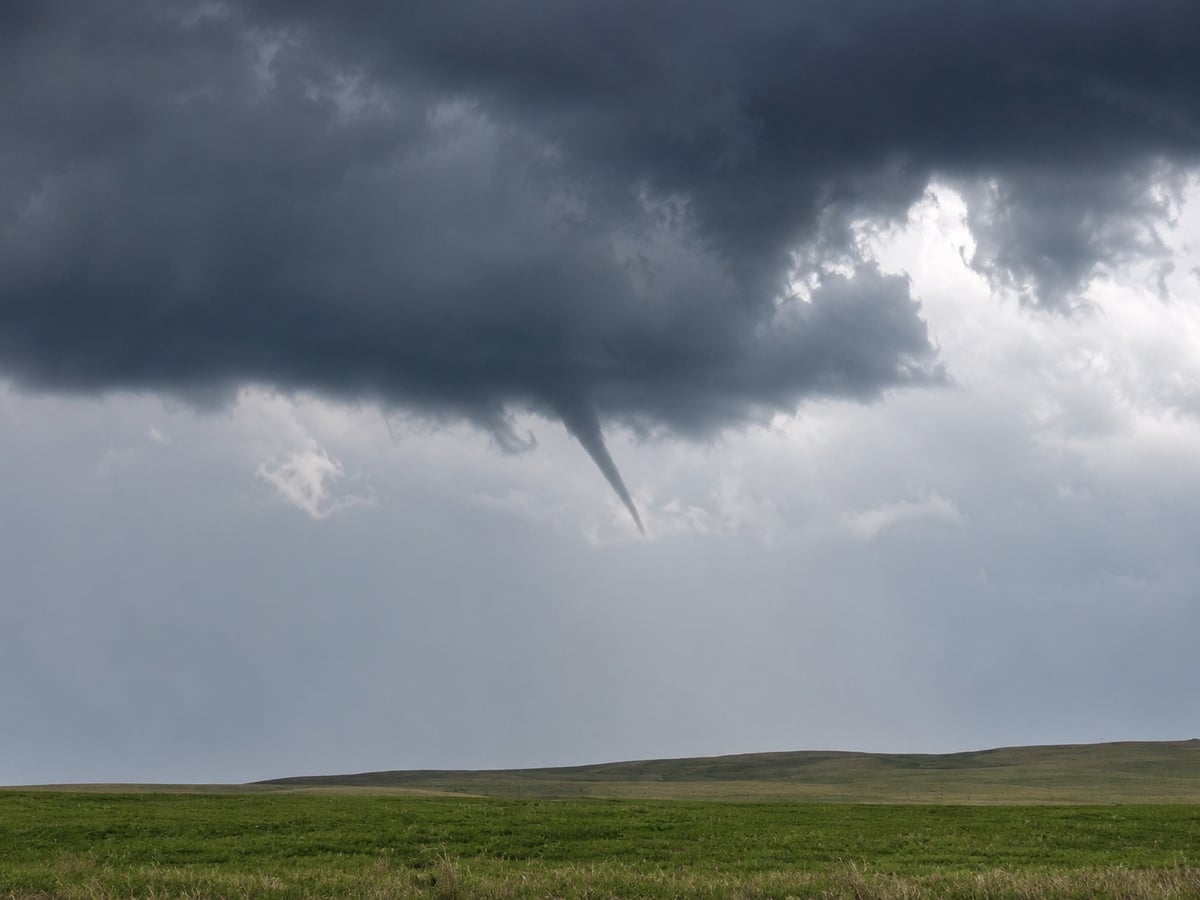
A tornado warning is in effect northwest of Edmonton, and Environment Canada says the storm behind it may already be producing a tornado.
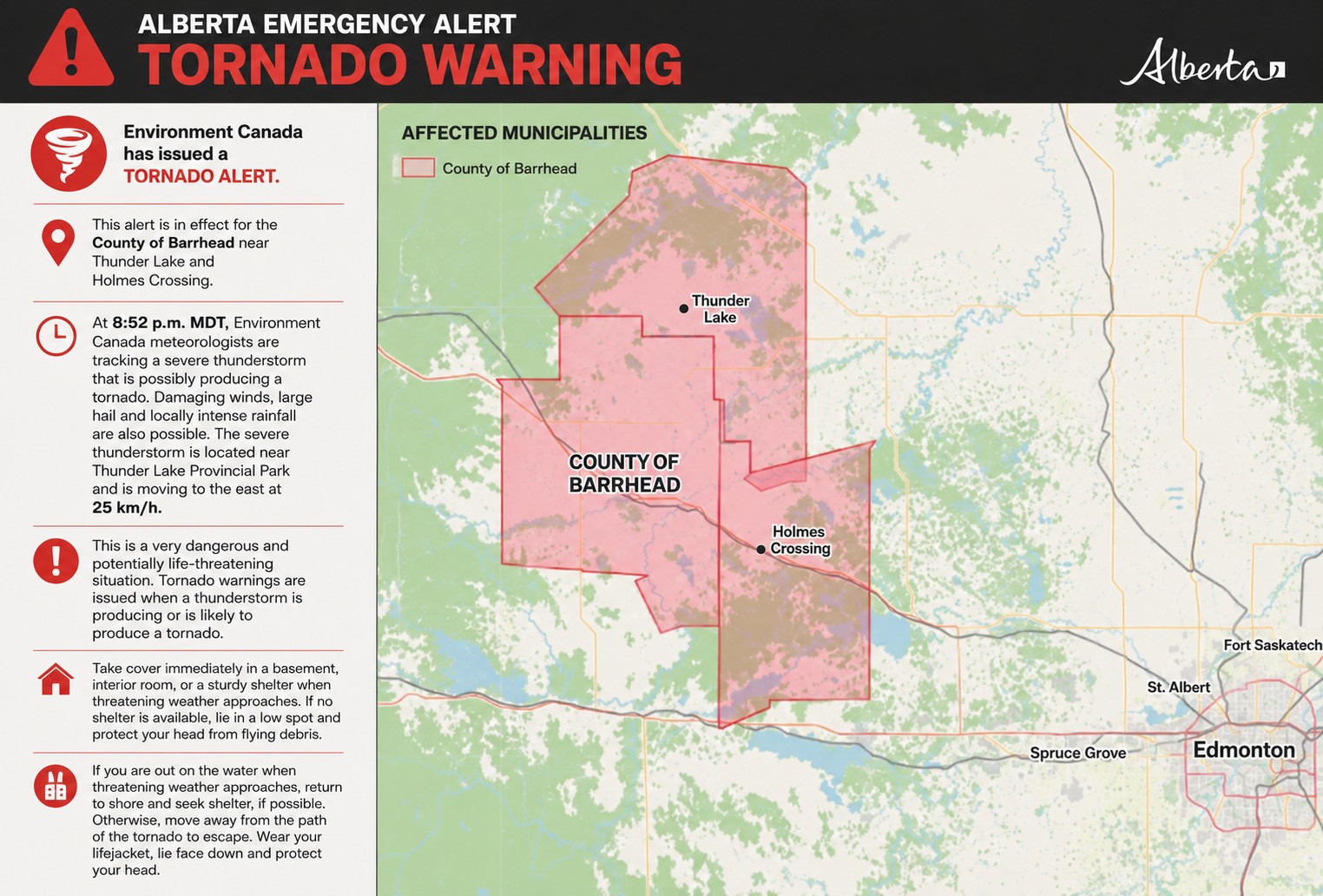
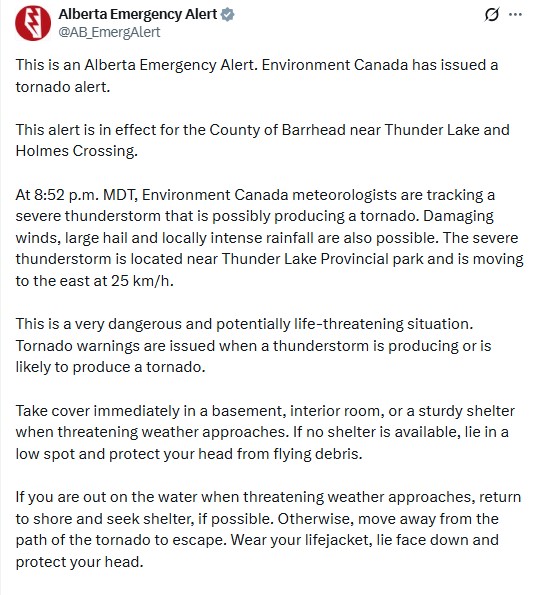
The warning went out at 8:52 p.m. on July 9 through the Alberta Emergency Alert system. It covers the County of Barrhead near Thunder Lake and Holmes Crossing, roughly 120 kilometres northwest of Edmonton. Meteorologists are tracking a severe thunderstorm near Thunder Lake Provincial Park, moving east at about 25 km/h, that could bring damaging winds, large hail, and locally intense rainfall on top of the tornado threat.
If the storm is coming your way, take cover now
Don't wait to see it. Get to a basement, an interior room, or a sturdy shelter. If no shelter is available, lie in a low spot and protect your head from flying debris. If you're on the water, get back to shore and find shelter if you can. Otherwise move away from the tornado's path, wear your lifejacket, lie face down, and cover your head.
A tornado warning means a storm is producing a tornado or is likely to. It's the most urgent category of alert, and the cue to act immediately, not to watch the sky.
Where the storm is, and how close to Edmonton
The warning covers the County of Barrhead near Thunder Lake and Holmes Crossing. Barrhead sits about 120 kilometres northwest of Edmonton, so the warning itself is well outside the city, this is not a warning for Edmonton proper.
But the storm is moving east at 25 km/h, and east of Barrhead is the direction of the Edmonton region. Storms in this stretch of central Alberta routinely track toward the capital region as the evening goes on. Anyone in Edmonton, St. Albert, or the communities northwest of the city should keep an eye on their phone tonight in case new warnings are issued closer in.
Thunder Lake Provincial Park, where the storm is centred, is a popular summer camping spot. On a warm July evening the campground is likely busy, and campers or anyone in a trailer are among the most exposed in a tornado. If the storm approaches, get to a sturdy building or a low-lying area right away.
The third straight day of Alberta tornadoes
This isn't an isolated night. It's the third day in a row of tornado activity in Alberta.
On July 8, two confirmed tornadoes touched down in the east-central part of the province. One tore through the Dillberry Lake campground near the Saskatchewan border, flipping a trailer and sending people to hospital. The days before brought more warnings across central and southern Alberta.
The province is in the middle of an unusually violent stretch. The Northern Tornadoes Project says 57 tornadoes have been recorded across Canada so far this year, 46 of them on the Prairies. Its director says the country hasn't seen a season this active this early since the 1980s. July is Alberta's peak tornado month, when the heat, moisture, and wind shear these storms feed on line up most often.
What to watch for if the storm reaches you
Storms can outrun the alerts. The camper whose trailer was flipped at Dillberry Lake last night said he had maybe 15 minutes between clear skies and disaster, so knowing the warning signs matters as much as the phone alert.
A few to watch for: a greenish or sickly tint to dark storm clouds, which often means a lot of hail. A low, rotating wall of cloud hanging beneath the storm, that rotation is the dangerous one. A sudden dead calm after strong wind, or a loud, continuous roar. And large hail, which tends to fall just ahead of the most violent part of the storm. If you see any of these, get to shelter. Don't wait to spot a funnel, by the time one is visible, you should already be inside.
What to do if you're driving
A lot of people are on the road on a summer evening, and a vehicle is one of the worst places to be in a tornado. If you can clearly see the tornado is far off and you can drive at right angles away from its path to reach a solid building, do that.
If you can't, get out of the vehicle and lie flat in a low spot like a ditch, face down, hands over your head. It feels wrong to leave the car, but a truck or SUV can be tossed or rolled, and low ground gives the flying debris somewhere to pass over you. Do not park under an overpass to hide. It seems like shelter, but an overpass actually funnels and speeds up the wind, making it more dangerous, not less.
How to stay informed
Alberta Emergency Alert pushes tornado warnings straight to phones, and weather.gc.ca has the live watches and warnings for your exact location. If you see severe weather, Environment Canada takes reports at 1-800-239-0484 or on X with the hashtag #ABStorm.
This is a developing situation. We'll update as Environment Canada issues new information or the warning ends.

Sources:
Alberta Emergency Alert, tornado warning for the County of Barrhead near Thunder Lake and Holmes Crossing, issued 8:52 p.m. July 9, 2026 (alberta.ca/aea)
Environment and Climate Change Canada, tornado warning and severe weather statements, July 9, 2026 (weather.gc.ca)
Northern Tornadoes Project, Western University, 2026 season tornado counts








Comments
Conversation