Alberta has been talking about passenger rail since the 1960s. Today the province released the most detailed plan it has ever produced and committed $15 million to take the next steps.
The Passenger Rail Master Plan is the product of more than a year of work by 150 professionals from Alberta, Canada, and around the world. It models ridership, costs, travel times, and economic benefits across the province. It reaches conclusions that cut through decades of vague proposals with actual numbers.
The single most important finding
Conventional rail on existing freight tracks is not worth building.
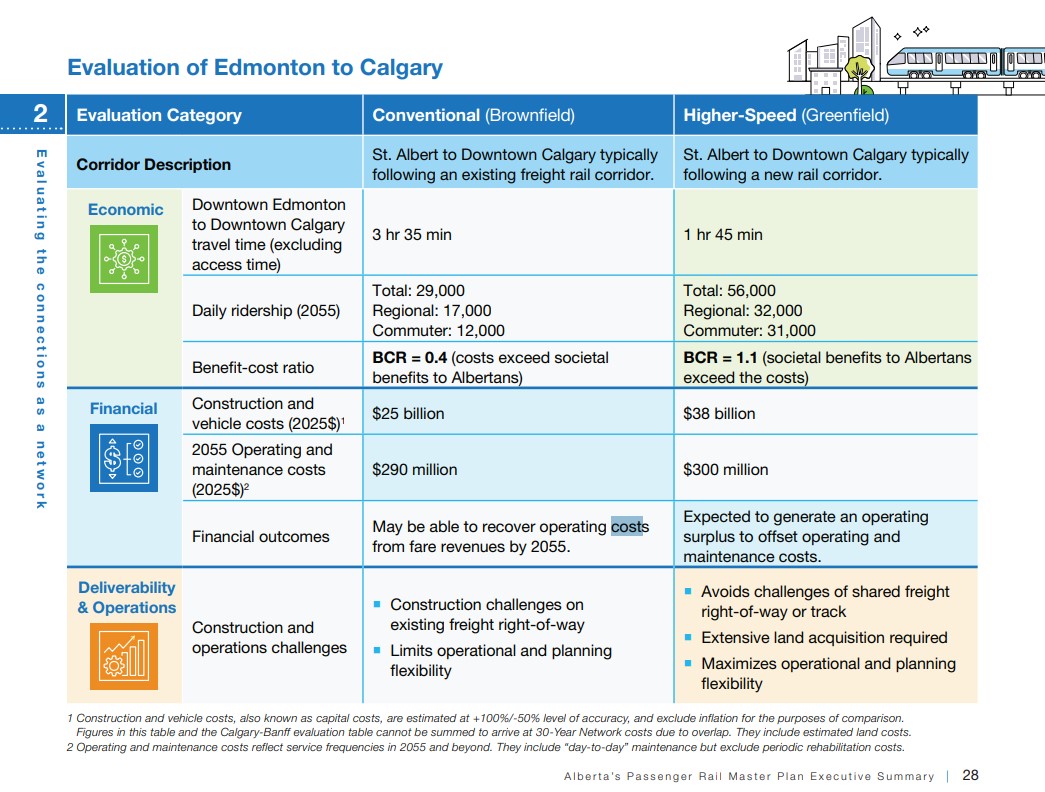
The plan evaluated two options for Calgary-Edmonton. The first uses existing Canadian Pacific freight corridors cheaper upfront, no new land needed. The second builds a completely new corridor for passenger rail more expensive, but allows genuine high-speed operation.
The numbers tell the story clearly:
Conventional rail on existing freight corridors: $25 billion. Calgary-Edmonton travel time 3 hours 35 minutes similar to a bus. 29,000 daily passengers by 2055. Benefit-cost ratio 0.4, meaning for every dollar spent society gets back 40 cents. The plan does not recommend it.
High-speed rail on a new greenfield corridor: $38 billion. Calgary-Edmonton travel time 1 hour 45 minutes. 56,000 daily passengers by 2055. Benefit-cost ratio 1.1, meaning society gets back $1.10 for every dollar spent. This is what the plan recommends.
"A conventional passenger rail network sharing existing rail corridors would not be expected to generate benefits that exceed its costs," the Master Plan states.
Why the existing freight tracks do not work
The CP tracks between Calgary and Edmonton already exist. Why not just use them?
The Edmonton-Jasper corridor carries more than 30 freight trains per day. Calgary-Banff carries more than 20. These are federally regulated private corridors the province would need to negotiate access to. Even with access, existing tracks follow terrain steep grades, tight curves that physically prevent high-speed travel now or ever. Building passenger rail in highway medians does not work either. Existing medians on Highways 1 and 2 are too narrow. High-speed trains travel at up to 320 km/h and require much straighter corridors than Alberta's highways provide.
What the 30-year network covers
The full network spans over 500 kilometres of new passenger rail corridors:
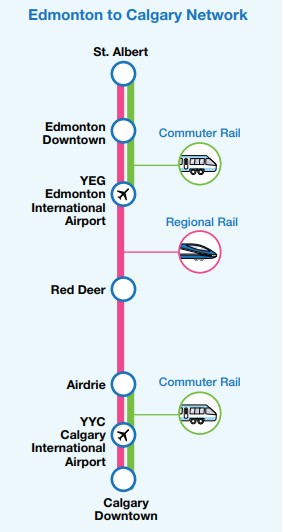
High-speed regional service between Edmonton and Calgary via Red Deer at more than 300 km/h, more than one train per hour. Downtown to downtown in 1 hour 45 minutes. Today that trip takes 3 hours by car, 2.5 to 3 hours by plane including airport time, and 3.5 to 4 hours by bus.
Higher-speed regional service between Calgary and Banff at more than 160 km/h, up to one train per hour. Downtown Calgary to Banff in 1 hour 10 minutes.
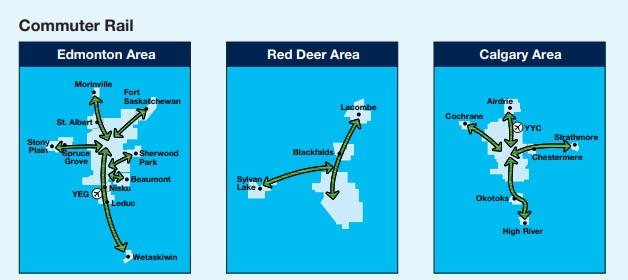
Frequent airport express and commuter service connecting Calgary International Airport, Airdrie, Edmonton International Airport, and St. Albert — all-day service every 20 minutes. Plus commuter-peak services for Cochrane, Okotoks, High River, Spruce Grove, Stony Plain, Chestermere, and Strathmore.
By 2055 the network is projected to carry 80,000 daily one-way trips roughly 30 million annual passengers.
What it costs and what it is worth
Total estimated cost to design, build, and equip the full 30-year network: $60 billion in 2025 dollars. That covers infrastructure, land, stations, trains, maintenance facilities, and governance. It does not include inflation actual costs over 30 years will be higher. The accuracy range on the estimate is plus 100 percent to minus 50 percent, meaning the final number could land anywhere from $30 billion to $120 billion depending on decisions not yet made.
Fare revenue from a fully operational network is projected to exceed operating and maintenance costs and generate a surplus but not enough to repay the capital investment. The $60 billion requires government funding. No federal commitment exists.
The societal benefits projected in the plan: 30 million tonnes of carbon emissions reduced. 13,000 collisions involving fatalities or injuries avoided. Three million Calgary-Edmonton highway trips removed annually. 260,000 person-years of construction jobs. Highway investment deferred by five to ten years. The overall benefit-cost ratio for the complete network exceeds 1.0.
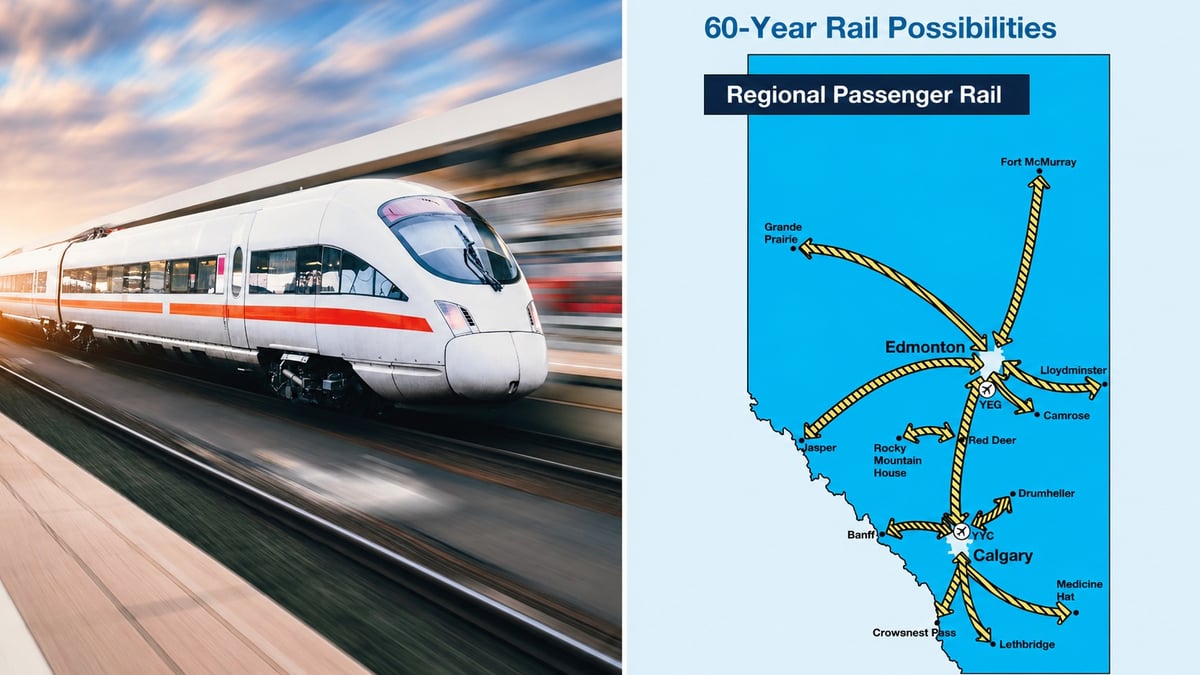
What about Lethbridge, Grande Prairie, Fort McMurray, and Medicine Hat
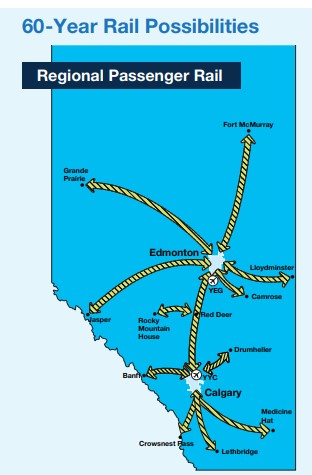
All four cities appear in the plan's 60-year possibilities connections the plan says require population and tourism numbers at least 50 percent higher than current projections before they become financially viable within the 30-year window. They are not off the table. They are waiting for population growth to make them defensible.
What $15 million actually buys
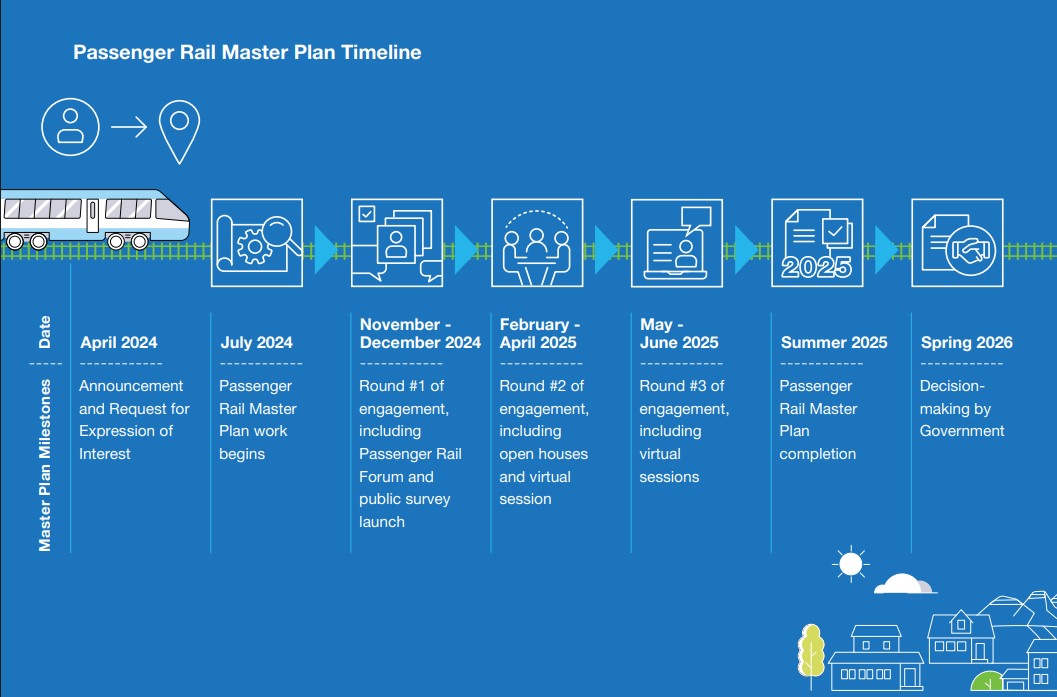
The $15 million committed in Budget 2026 over three years funds detailed planning for the LRT connections to both airports, private sector engagement on financing models, and groundwork for legislation to create an arm's-length agency similar to Ontario's Metrolinx to oversee long-term planning, delivery, and operations.
No technology has been chosen. No route alignments have been confirmed. No construction timeline exists. What exists today is the most rigorous analysis Alberta has ever produced on this question and a government that owns the planning process rather than waiting for private proposals that never materialize.
Whether the next three years produce a construction commitment or another shelf of studies is the question this province has been unable to answer since the 1960s.
What other cities pay for comparison
Most Albertans have no frame of reference for $60 billion. Without context that number is just big. Here is what puts it in perspective:
California's high-speed rail between Los Angeles and San Francisco a comparable distance to Calgary-Edmonton at 560 km versus 300 km was originally budgeted at $33 billion USD in 2008 and is now projected at over $100 billion USD with no completion date. Texas Central Railway, a private high-speed rail proposal between Dallas and Houston at 386 km, was estimated at $30 billion USD before the project stalled in 2023. Japan's original Shinkansen between Tokyo and Osaka opened in 1964 at a cost equivalent to roughly $4 billion USD today but was built on entirely new land in a country that had already decided passenger rail was national infrastructure.
The $60 billion estimate for Alberta's 30-year network is not out of range for a project of this scale. It is consistent with what comparable jurisdictions have spent or estimated. The difference is that Japan built it. California has not. The deciding factor in every case has been sustained political will over multiple governments and decades exactly what Alberta has never demonstrated on passenger rail.
Sources:
Government of Alberta news release, Full steam ahead on passenger rail, June 5, 2026 (alberta.ca)
Alberta's Passenger Rail Master Plan Executive Summary, Spring 2026 (alberta.ca/passenger-rail)
Government of Alberta, Passenger Rail page (alberta.ca/passenger-rail)







Comments
Conversation