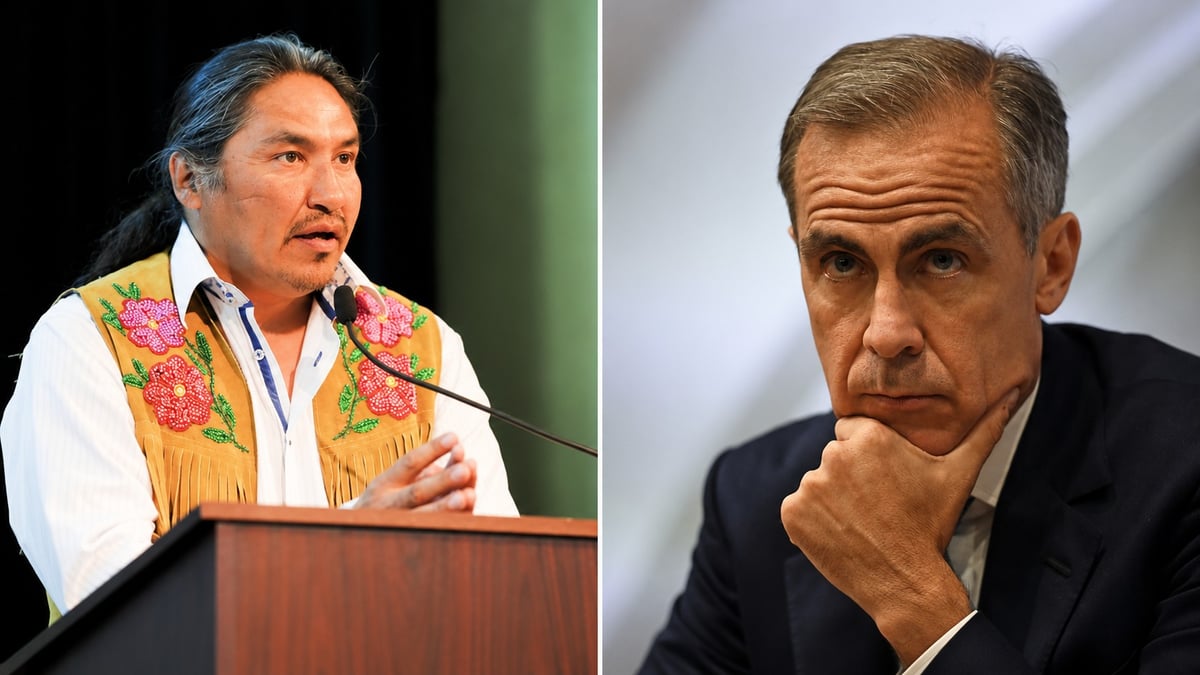
Every year, members of the Athabasca Chipewyan First Nation receive a treaty payment of $5. That amount hasn't changed since 1899.
Now the northern Alberta nation, based near Fort McMurray, is suing the federal government to change it. In a statement of claim filed this week in Edmonton, the First Nation argues the annuity promised under Treaty 8 has lost nearly all its value across 127 years, and asks the court to have it modernized so it means something again.
"Treaty promises must remain meaningful," Chief Allan Adam said, "and it is not meaningful when a promise made in 1899 is still being paid at 1899 values."
The payment goes back to the treaty itself. When the Crown signed the numbered treaties with First Nations across what is now Canada, each one included an annual cash payment to members, called an annuity. It was one of the concrete, ongoing promises made in exchange for the land. Depending on the treaty, it's $4 or $5 a person. It has never once gone up. For Treaty 8, signed in 1899, it's $5.

The ceremony behind the payment
If you've never seen a treaty day, the whole thing can sound abstract. It isn't. Once a year, members line up and a representative of the Crown, historically an RCMP officer in red serge, hands over the annuity in person, counted out by hand, one bill at a time. Five dollars. The same amount their great-great-grandparents received, paid the same way, on the same kind of summer afternoon.
That ceremony is the point, and it's also the problem. Treaty days are supposed to be a living reaffirmation of the relationship, the Crown showing up in person to keep its word. But when the word being kept is a $5 bill that buys almost nothing, the ritual stops honouring the promise and starts exposing how little is left of it.
Here's the math the nation puts in front of the court. In 1899, $5 was real money, and inflation was never mentioned when the payment was set. Since then the dollar figure held still while everything a dollar could buy moved. By one calculation cited in reporting on the claim, that original $5 would be worth around $200 today. What was meant as ongoing assistance has thinned into a token.

A deliberately narrow ask
This is where the case gets interesting, and where its strategy shows.
The Athabasca Chipewyan First Nation is not asking for 127 years of back pay. It could have. The accumulated gap between $5 and what the payment arguably should have been, compounded across more than a century, would be a staggering number, and a claim for it would have made headlines on the dollar figure alone. The nation left it on the table.
What it's asking for instead is narrow: modernize the annuity going forward, so the payment does what it was meant to do. "This case is about keeping promises," Adam said. "Treaties are sacred agreements. The benefits promised under Treaty 8 must have real value for First Nations people today and for generations to come." That framing, forward-looking rather than backward, casts the lawsuit as being about honouring a deal, not cashing in on it.

The precedent that changes everything
A lawsuit over $5 might sound like a long shot, until you look at Ontario.
In 2023, Ottawa and the Ontario government settled with 21 First Nations over the Robinson Huron Treaty for $10 billion. That annuity had been frozen for generations too, at $4 a person, and the settlement effectively established something big: a Crown promise to pay an annuity can carry a duty to keep it meaningful, not just keep it frozen at the original figure.
That's the shadow this claim is filed under. Treaty 8 alone runs across roughly 840,000 square kilometres and dozens of signatory nations, and every numbered treaty in the country carries the same kind of stuck payment. A ruling that the annuity has to mean something wouldn't stay contained to one nation near Fort McMurray. It would travel.
Part of a broader push
The Athabasca Chipewyan claim doesn't stand alone. First Nations across the country have brought similar annuity challenges in recent years, and the pace has picked up since the Robinson Huron settlement showed the argument can succeed. Each case tests the same basic question from a different treaty: is the Crown allowed to leave a payment frozen at a number that made sense in the 1800s and means almost nothing now?
For a lot of people, the treaty annuity stays an abstraction until it's attached to a figure this stark. That's part of why this case cuts through. It reduces a sprawling legal and historical argument to something anyone can hold in their head: a $5 bill, handed over once a year, worth a fraction of what it was when the promise was made.
Where it stands now
For now, the federal government isn't saying much. Crown-Indigenous Relations said it's aware of the lawsuit but won't comment on a matter before the courts, and Minister Rebecca Alty's office wasn't immediately available. The claim is unproven, and Ottawa hasn't filed a response.
Which leaves the number sitting there, doing the arguing. Five dollars, unchanged since 1899, in a case that could decide whether a promise is allowed to quietly expire.
Sources:
Athabasca Chipewyan First Nation, statement of claim filed in Edmonton, and news release, July 2026
Statements from Chief Allan Adam
Crown-Indigenous Relations Canada
2023 Robinson Huron Treaty annuity settlement between Canada, Ontario, and 21 First Nations
Treaty 8 (1899






Comments
Conversation