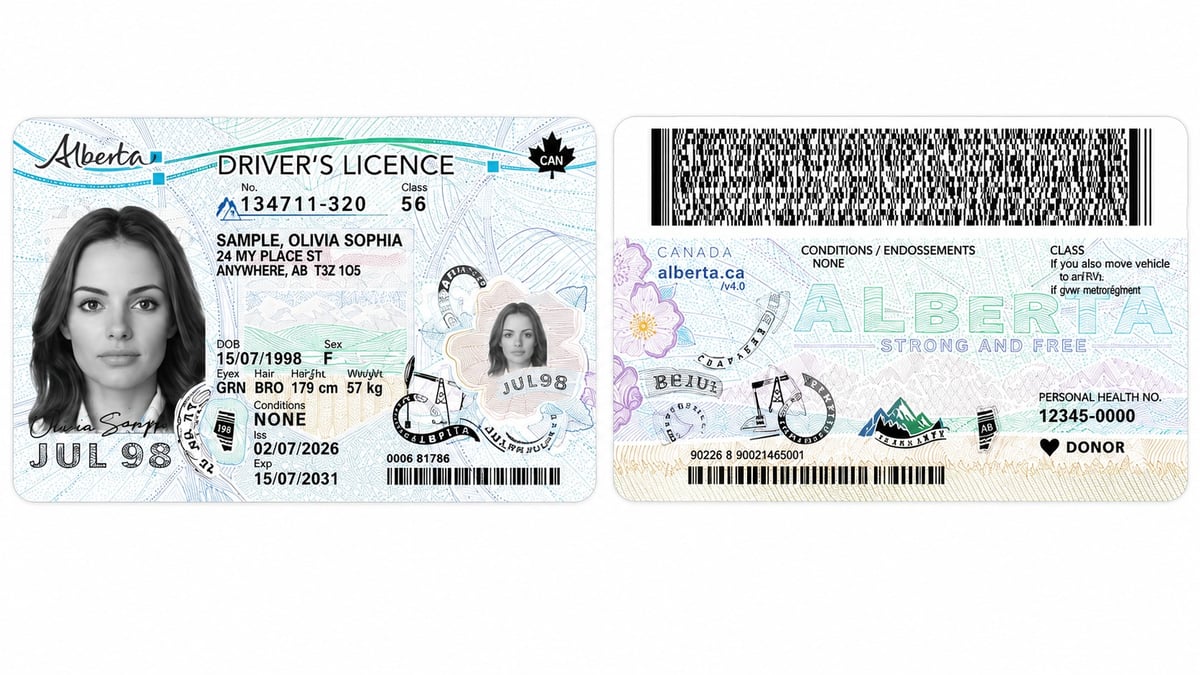
It is live. As of today, July 2, Albertans getting or renewing a driver's licence or ID card will receive a redesigned card that includes their personal health number and a Canadian citizenship marker.
We covered this when it was first announced at culturealberta.com/articles/alberta-is-adding-your-health-number-and-citizenship-status-to-your-drivers-licence-starting-july-2. Here is the practical update now that it is actually in effect.
What is on the new card
The redesigned card includes your personal health number on the back. Eligible Albertans who are citizens or permanent residents with Alberta Health Care Insurance Plan coverage get the health number on their card. Canadian citizens get a "CAN" marker in the top right corner. Non-citizens can still get a driver's licence or ID card, just without the marker.
The card features an Alberta flag-inspired design with the Three Sisters mountain range near Canmore, the bighorn sheep, and the bull trout. The dinosaur from the previous design is gone, replaced with an oil pumpjack. The words "Alberta Strong and Free" appear on the back alongside 54 unique security features.
Do you have to get a new one right now
No. Your existing card stays valid until your renewal date. The new card comes automatically when you next renew. If you want it sooner, you can visit a registry agent to discuss options, but there is no requirement to go in early.
Will you pay a fee
No. The fee for getting or renewing your licence or ID card is unchanged. The province is absorbing approximately $1 million per year in additional costs. Nothing extra comes out of your pocket.
What you need to bring when you renew
Three things: valid identification, proof of legal entitlement to be in Canada (a Canadian birth certificate, Canadian passport, NEXUS card, or Permanent Residency card all qualify), and your Alberta health card. If you do not have your paper health card, bring your mobile health card. The registry agent uses it to revalidate your AHCIP eligibility and confirm your account is current.
The 60-day grace period
If you do not have all required documents at renewal, a one-time 60-day grace period may be available. You still need to visit a registry agent first. If you qualify, you get a temporary card that expires 60 days after being issued.
What you can actually do to protect yourself
The privacy commissioner published guidance for the public today, the same day the cards launched.
If a business asks to copy your licence, you can ask why and request their authority under privacy law. In most cases private-sector organizations do not have authority under Alberta's Personal Information Protection Act to collect your health number or citizenship marker at all.
You can physically cover your health number or citizenship marker before showing your card, as long as you do not damage it. You are generally only required to show the card, not hand it over for copying.
You also have the right under the Health Information Act to refuse to provide your health number when an organization makes a voluntary request.
Travelling outside Alberta? Alberta privacy laws do not apply there. Take extra care.
Full guidance at oipc.ab.ca.
What the commissioner actually recommended before this launched
In a December 1, 2025 letter to the government, before the legislation passed, commissioner Diane McLeod recommended against putting health numbers on ID cards entirely.
"I am of the view that adding this number to identity cards that are used in a number of settings beyond healthcare creates risks including of fraud," she wrote. She flagged that personal health numbers are sought after on the dark web. "Use of someone's PHN to access medical care could result in the wrong health information appearing in their record, which could cause them harm."
The government proceeded anyway. The Health Information Act was amended through Bill 11 to permit it.
Privacy lawyer David Fraser raised concerns that a licence without the CAN marker effectively signals non-citizenship to whoever is checking it, at a traffic stop, buying alcohol, or a government office, a discrimination risk the government has dismissed.

What the government says and why Alberta is doing this
Service Alberta Minister Dale Nally pointed to a real fraud problem as the core justification. Alberta Health found more than 530,000 health care numbers in circulation than there are people in the province. "There won't be half a million fake ones, which opens up the door for abuses," he said.
On the citizenship marker, Premier Danielle Smith said it is about ensuring programs are accessed by people entitled to them. "I would say that there is absolutely an overwhelming need for us to be able to ensure that the programs that we offer are being accessed by Canadian citizens, and that we can demonstrate that to the auditor general," she said. The government says the marker will also simplify access to programs where citizenship affects eligibility, including student aid, health benefits, and disability supports.
The province has committed that non-health ministries will not be authorized to use health number information for other purposes.

Could the citizenship marker lead to profiling
When someone shows ID in Alberta, the absence of a "CAN" marker now visibly indicates they are not a Canadian citizen — information that was never on a driver's licence before. Privacy lawyer David Fraser and commissioner McLeod have both raised concerns about what happens when police, liquor stores, or government offices see a licence without the marker and what assumptions get made. A missing marker does not tell you why it is missing. The person could be a permanent resident, a temporary worker, or an international student.
Canada Border Services Agency handles immigration enforcement in Canada, not local police. Alberta RCMP and municipal police do not have immigration enforcement powers and cannot detain someone solely based on citizenship status. But critics argue a marker on a document police routinely check creates conditions where immigration status enters everyday interactions it never did before. The government has dismissed the discrimination concern and has not announced any changes to how police are expected to handle the marker during routine stops.
Is Alberta the first province to do this
Yes. Alberta is the first province in Canada to make citizenship markers mandatory on driver's licences and ID cards. Ontario, Quebec, Manitoba, and British Columbia all once had optional enhanced driver's licences that included citizenship information, primarily designed to speed up US border crossings. All four discontinued them. Alberta's version is mandatory and for domestic use.
For more information visit alberta.ca/new-drivers-licence-and-identification-cards.
Sources:
Government of Alberta, One card, that's it!, July 2, 2026 (alberta.ca)
Government of Alberta, New driver's licence and identification cards (alberta.ca/new-drivers-licence-and-identification-cards)
Office of the Information and Privacy Commissioner of Alberta, guidance documents published July 2, 2026 (oipc.ab.ca)
Alberta Information and Privacy Commissioner Diane McLeod, December 1, 2025 letter to government and July 2, 2026 statements
David Fraser, privacy and civil liberties lawyer, statements to CBC News, September 2025
Dale Nally, Service Alberta Minister, statements to CBC News, September 2025
Premier Danielle Smith, statements to reporters, September 2025







Comments
Conversation