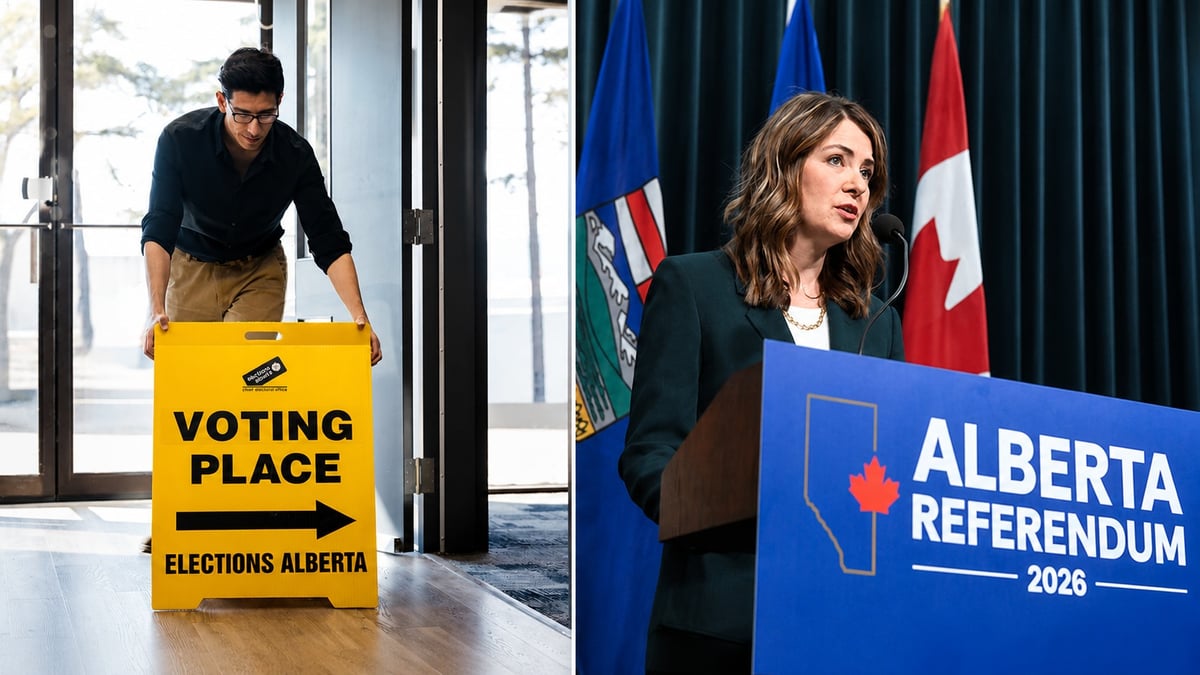
Elections Alberta is hiring at least 60,000 people this fall, and applications close October 10.
It's the largest electoral worker recruitment campaign in the province's history. A normal provincial general election needs about 20,000 people. This one needs three times that.
The reason is the ballots. Albertans vote on ten separate questions on October 19, each on its own colour-coded ballot dropped into its own colour-coded box. Elections Alberta is printing 45 million of them, against 1.8 million cast in the 2023 provincial election. Provincial law now requires hand counting rather than machines, with unofficial results reported within 48 hours of polls closing.
Ten questions, counted by hand, at every voting place in 87 electoral divisions at once. That's what 60,000 people are for. We've covered what the referendum involves and what it's costing separately.
Who can apply
Alberta residents 16 or older who are eligible to work in Canada. Some positions require you to be 18.
You don't need to be a Canadian citizen. You do need to pass a criminal record check.
One condition matters more here than in most jobs. You can't take part in any political activity while employed, and every worker signs an oath upholding the non-partisan mandate of the office. With ten questions being actively campaigned on this fall, that covers more ground than usual, including lawn signs, canvassing and public advocacy on any of the ten.
The roles
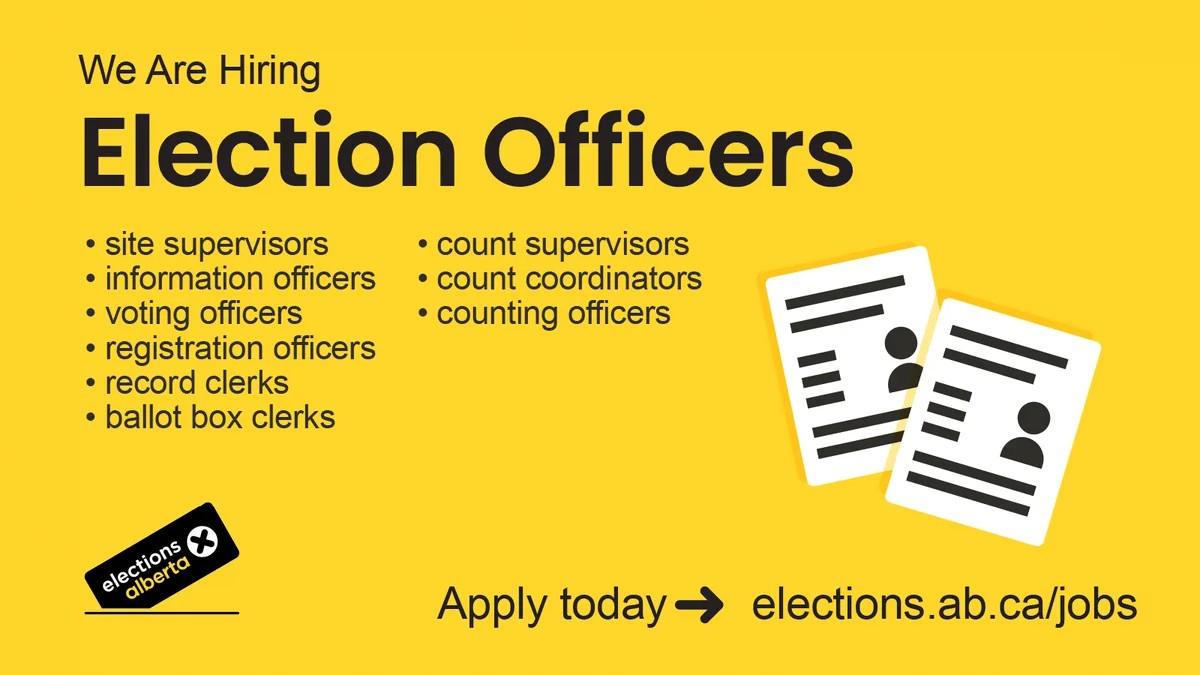
Election officers staff the voting places. Largest category, and where most applicants end up.
Counting officers count ballots after polls close. Ten hand-counted questions is why this group is so big, and it carries the tightest, most defined commitment.
Elections Alberta also hires returning officers, service agents, administrative assistants and IT support staff.
The application lets you select every position you'd consider and every voting day you can work. Selecting more improves your odds.
The dates
Paid training runs in early October, part online and part in person depending on the role.
Some positions begin October 13.
Counting runs October 19 to 21.
Commitment varies by role, which is worth understanding before you apply. Counting is a defined block starting on voting day. Some administrative and returning office roles run for weeks beforehand.
What it pays
Every position is paid, and so is the training.
Elections Alberta hasn't published its rate card. In past Alberta provincial elections, election officer roles paid roughly $18 to $28 an hour depending on position. Confirm current rates during the hiring process rather than relying on that range.
For a sense of total earnings, Calgary paid $210 to $450 per position for its 2018 Olympic plebiscite. That was one question. This is ten.
Where you live decides who hires you
This is the part people get wrong.
You don't apply to Calgary or Edmonton. Every application is automatically forwarded to the returning office for your electoral division, and that office does the hiring.
Alberta has 87 divisions. Calgary contains 26, Edmonton 20, and the other 41 cover the rest of the province. Which one you're in depends on your address, not your postal city. Applicants may also be asked to work in an adjacent division.
Elections Alberta hasn't published a division-by-division target. On the arithmetic, 60,000 across 87 divisions averages roughly 690 per division, weighted by population and voting places. That puts Calgary near 18,000 positions and Edmonton around 14,000. Those are our calculations, not Elections Alberta's.
Most Alberta cities sit across two divisions. Grande Prairie and Grande Prairie-Wapiti. Fort McMurray-Wood Buffalo and Fort McMurray-Lac La Biche. Lethbridge-East and Lethbridge-West. Red Deer-North and Red Deer-South. Brooks-Medicine Hat and Cypress-Medicine Hat. Sherwood Park and Strathcona-Sherwood Park. St. Albert and Morinville-St. Albert. Airdrie-Cochrane and Airdrie-East. Spruce Grove-Stony Plain and Fort Saskatchewan-Vegreville are single divisions.
We'll be publishing city-by-city guides over the coming weeks covering Edmonton, Calgary, Grande Prairie, Fort McMurray, Lethbridge and Medicine Hat, each listing the electoral divisions in that community and how the local hiring works.
Rural applicants have better odds
Elections Alberta has specifically encouraged applications from rural Albertans.
The reason is simple. A rural division still needs full staffing at every voting place but draws from a much smaller population. Lorne Gibson, a former Alberta chief electoral officer, has said finding enough people is the hardest part of running any election, and that's before tripling the requirement.
Outside Calgary and Edmonton, you're competing against far fewer applicants than the provincial number suggests.
How to apply, step by step
1. Start with the listings. Every Elections Alberta role we have is collected on one page: Elections Alberta jobs on Culture Alberta. Requirements, dates, locations and the direct application link, without digging through a government site to work out which role is which.
2. Find your electoral division. Your address determines it, not your city. Knowing it tells you which returning office reviews your application.
3. Open the application. The listing links straight through to Elections Alberta's official form, which is the only place applications are accepted.
4. Select every position you'd consider. Multiple roles, multiple voting days. More options, better odds.
5. Set your availability honestly. Counting is October 19 to 21. Some roles start October 13. Administrative and returning office positions run for weeks beforehand.
6. Wait for a phone call. Successful applicants are contacted by phone. Not everyone hears back, and Elections Alberta has asked people not to call about status given the volume.
7. Complete the training. Online plus an in-person session, both paid.
All the listings in one place
We've collected every Elections Alberta posting on a single page: culturealberta.com/jobs/company/elections-alberta. Worth bookmarking, since roles get added as returning offices work through their staffing, and city-specific postings appear there first.
If the referendum work doesn't fit your schedule, our full board at culturealberta.com/jobs carries openings across Edmonton, Calgary, Lethbridge, Medicine Hat, Grande Prairie and Fort McMurray, from seasonal and part-time through to full-time. Free to browse, no account needed.
Employers post free as well. If you're hiring in Alberta, the listing reaches readers in the city you're hiring in rather than a national audience that mostly isn't local.
Who this suits
Students, since training and work land in October around a schedule that's usually flexible.
Anyone between jobs, since the commitment is short and defined rather than open-ended.
Retirees, who have historically made up a large share of election workers.
Community groups and teams, which Elections Alberta named directly in its recruitment call. Groups can apply together.
Anyone in a rural community, for the reasons above.
Sources:
Elections Alberta, Election Officer Recruitment: https://www.elections.ab.ca/jobs/election-officer-recruitment/
Elections Alberta, "Elections Alberta Launches Largest Recruitment Drive in Alberta's History," June 8, 2026: https://www.elections.ab.ca/resources/media/news-releases/ea-launches-largest-recruitment-drive-in-ab-history/
Elections Alberta, Provincial Electoral Divisions of Alberta, Electoral Divisions Act 2017




Comments
Conversation