
Edmonton is adding people faster than any other big city in Canada. It isn’t selling homes like it.
Home sales across the Greater Edmonton Area fell to 1,959 in September, down 10.3% from a year ago and 8.8% from August, according to the Realtors Association of Edmonton.
Sellers kept listing. New listings rose 11.3% from last year to 3,864, and total inventory is now 16.7% higher than September 2025.
That leaves buyers with more choice and less competition than they’ve had in years.
“Sales activity has slowed with the arrival of the new school year,” said RAE board chair Darlene Reid. She said sales likely won’t pick up until after year end, and warned rising inventory could soften price growth further.
September at a glance
September 2026 | vs. September 2025 | |
|---|---|---|
Sales | 1,959 | -10.3% |
New listings | 3,864 | +11.3% |
Inventory | +16.7% | |
Average price | $466,080 | +2.9% |
Benchmark price | $423,100 | -0.3% |
Inventory barely moved from August, up 0.1%. Supply isn’t spiking month to month. It’s been building all year: RAE’s year-over-year inventory gain was 17.9% in July and 15.1% in August.
What homes cost in Edmonton right now
Home type | Average price | Price vs. last year | Sales vs. last year |
|---|---|---|---|
Detached | $569,820 | +2.9% | -6.5% |
Semi-detached | $412,974 | -4.8% | -10.9% |
Row/townhouse | $289,640 | -4.5% | -20.1% |
Apartment condo | $208,672 | +0.6% | -15.4% |
All homes | $466,080 | +2.9% | -10.3% |
The overall average is still up from last year, mostly because detached homes are carrying it.
Detached homes are holding. Prices are up 2.9%, and sales fell the least of any type.
Townhouses are slowing fastest. Sales dropped 20.1%, the biggest decline of any home type, while new listings rose 12.5%. The average price is down 4.5%.
Semi-detached homes are close behind. New listings jumped 25.4% from last year, sales fell 10.9% and prices dropped 4.8%.
Condos are up 0.6% from last year, but fell 3.1% from August alone.
The average price reflects whatever happened to sell that month. The benchmark price tracks a typical home, so it isn’t skewed by the mix. Edmonton’s benchmark, $423,100, is down slightly from last year.
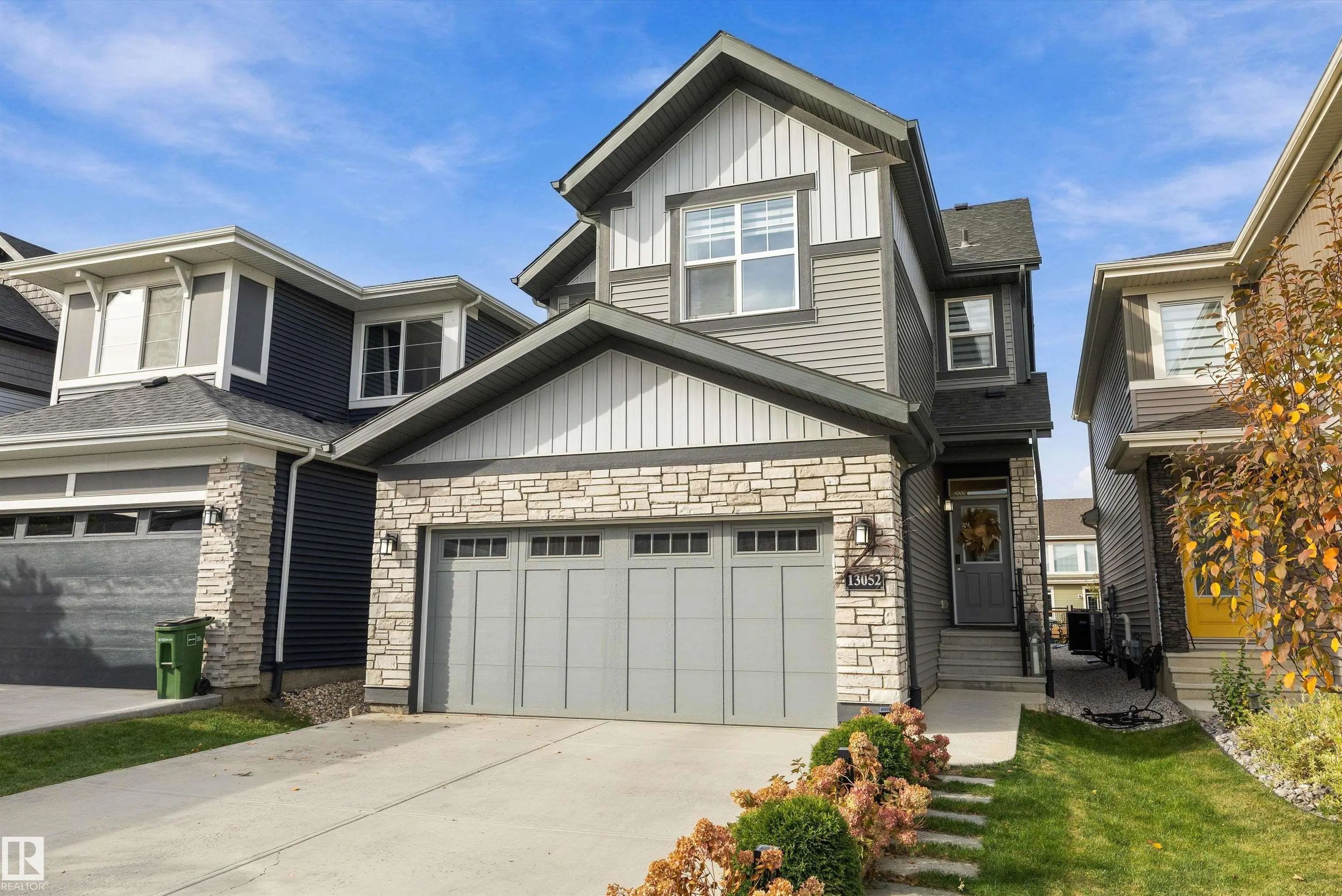
Canada’s fastest-growing metro, with slowing sales
This is the part that doesn’t seem to add up.
The Edmonton region grew by 50,717 people between July 2024 and July 2025, or 3%, the fastest of any metro in Canada. It was the third straight year the region added more than 50,000. For the first time in a decade, it drew more people from other provinces than any other Canadian metro.
Last month, Oxford Economics named Edmonton the only Canadian city on its new Cities to Watch list. It expects Edmonton’s population and workforce to grow at the second-fastest rate of any city in Canada or the U.S. over the next five years, and pointed to affordability as a big reason people are coming. Here’s what Oxford said about Edmonton.
So why are sales falling?
Partly because new supply is keeping up. CMHC counted more than 18,500 homes under construction in Edmonton in August. And many newcomers rent first. More people doesn’t automatically mean more buyers this month.
It’s also why Oxford listed “high housing expenditure” as one of Edmonton’s weaknesses, in the same report that praised its affordability. Edmonton is cheap next to Toronto or Vancouver. For a first-time buyer here, it still takes a big share of the budget.
The infill rollback
There’s a bigger change coming for Edmonton’s housing supply.
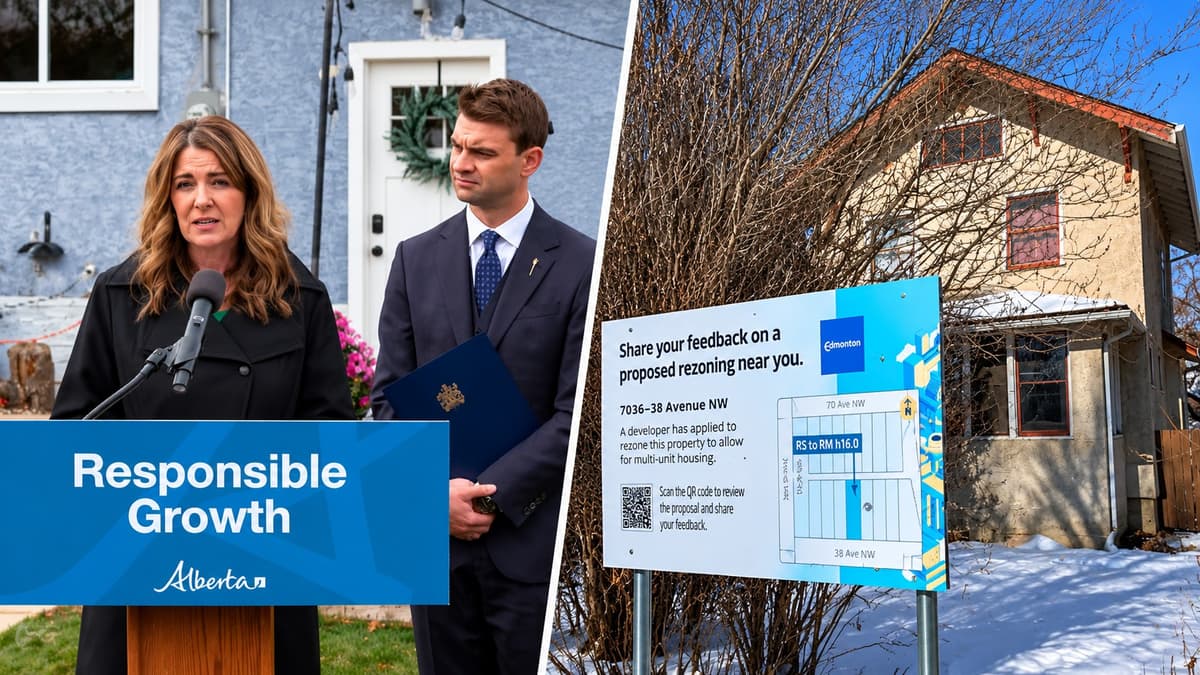
On Oct. 8, Premier Danielle Smith and Municipal Affairs Minister Dan Williams ordered Edmonton to go back to its pre-2024 rules for what types of homes can be built on a lot, how many and how tall. The city also has to bring back minimum parking requirements, which it dropped in 2020. It has until about Jan. 8, 2027, followed by an 18-month review of its land use rules.
Edmonton’s 2024 zoning bylaw made it easier to replace a single house with duplexes, rowhouses and small apartment buildings. Under the current small-scale residential zone, up to eight homes can go on an interior lot.
Notice which home types are softening most right now: semis and townhouses. Those are the kinds the 2024 rules made easier to build. The sales data doesn’t show the rules caused the drop. But it’s the part of the market the rollback will touch most.
What could change:
Fewer new infill homes. Going back to the old rules would likely mean fewer duplexes, rowhouses and multiplexes in established neighbourhoods. Over time, that limits the supply of the cheaper home types first-time buyers often start with.
Higher building costs. The City has estimated one parking stall costs $7,000 to $60,000 to build, and that cost tends to end up in home prices and rents.
Property values. Smith said the current rules are hurting some homeowners’ property values. Supporters of infill argue limiting most streets to detached houses makes it harder for young families to get in.
Projects already approved. The province hasn’t said how permits already issued or projects under construction will be handled.
There’s also money at stake. Edmonton has a $202-million Housing Accelerator Fund deal with Ottawa and has received three of its four payments. To get the rest, it has to hit housing permit targets by November 2026. Neither Ottawa nor the province has said whether the order affects that final payment. Here’s everything the zoning order changes.
Is it a buyer’s market?
Not yet. It’s balanced, and tilting toward buyers.
In September, about one home sold for every two new listings. CREA generally treats that range as balanced. But sales are falling, supply is rising, and two home types are already cheaper than a year ago.
If you’re shopping for a townhouse or semi-detached home, you likely have the most room to negotiate. If you’re competing for a well-priced detached house in a popular neighbourhood, don’t expect the same.
If you’re selling a townhouse or semi, price it right from the start. With more listings to compare against, buyers can skip an overpriced home.
Edmonton vs. Calgary
Both markets slowed in September. They’re headed in opposite directions on supply.
Edmonton area | Calgary | |
|---|---|---|
September sales | 1,959 | 1,650 |
Sales vs. last year | -10.3% | -3.8% |
New listings vs. last year | +11.3% | -11.3% |
Inventory vs. last year | +16.7% | -6.3% |
Benchmark price | $423,100 | $566,700 |
Calgary is losing listings. Edmonton is gaining them. And Edmonton sold 309 more homes than Calgary in September.
That doesn’t make Calgary a seller’s market. Its benchmark slipped 0.8% from last year, and higher-density homes are taking the hit: apartments are down 8.3% to $291,400 and townhouses 5.5% to $412,400, after a building boom added thousands of them.
Calgary has already gone through its own zoning reversal. Council repealed its 2024 blanket rezoning, effective Aug. 4, and the province has ordered it to keep the repeal in place.
Calgary buyers are negotiating, too. About 85% of Greater Calgary homes sold below asking in August, by a typical 2.29%, or about $11,900. Here’s how much Calgary buyers are saving.
How much cheaper is Edmonton?
By benchmark price, Calgary’s typical home costs $143,600 more than Edmonton’s, about 34% more.
The gap shows up across home types. Calgary’s detached benchmark is $739,400; Edmonton’s detached homes averaged $569,820. Calgary’s apartment benchmark is $291,400; Edmonton condos averaged $208,672. Those use different measures, and the two boards cover different areas, so treat them as a rough guide.
Compare more than housing with our Calgary vs. Edmonton cost of living calculator.
How Edmonton compares with Canada
National September figures come out Oct. 16. As of August, the average Canadian home sold for $668,219, according to the Canadian Real Estate Association. That’s about $202,000 more than Edmonton’s September average.
The national benchmark was down 3% from a year earlier. Edmonton’s is down 0.3%. Edmonton is cooling, but more slowly than the country.
The data centre factor
One more thing the monthly numbers don’t capture yet.
An Arizona-based land company, Walton Global, has asked the City to open part of the Edmonton Energy and Technology Park, in the far northeast, to large data centres and power plants. It hasn’t published a cost, power figure or jobs estimate, and no data centre has been approved. The City is taking public feedback until Oct. 25.
Next door in Sturgeon County, Meta is building a $13-billion data centre and a $4.6-billion power plant, which it says will support about 3,000 construction jobs and 300 permanent positions.
Projects that size bring workers who need somewhere to live. Whether that shows up in northeast Edmonton home prices is too early to say. Here’s what’s proposed in northeast Edmonton.
What happens next
RAE doesn’t expect sales to recover until the new year.
Watch four things through the winter: whether inventory keeps climbing, whether sales recover, whether the benchmark price starts falling faster, and how Edmonton rewrites its zoning rules by January.
For now, prices aren’t collapsing. Detached homes are still up from last year. But buyers have more choice than they’ve had in years, and in townhouses and semis, prices are already coming down.
Sources
New inventory is still being added, but sales have slowed for fall, Realtors Association of Edmonton, October 2, 2026
Late summer slow-down continues for Edmonton housing activity, Realtors Association of Edmonton, September 2, 2026
2026 Global Cities Index, Oxford Economics
Canada’s fastest-growing metro: the Edmonton region, Edmonton Global
Calgary Real Estate Board monthly statistics, September 2026
Canadian Real Estate Association national statistics, August 2026








Comments
Conversation