
Mark Carney spent Monday morning at an affordable housing announcement in suburban Ottawa. Reporters weren't there to ask about housing.
Speaking to the press, Canada's Prime Minister made his sharpest comments yet on Alberta's October 19 referendum, calling the separation push a "dangerous bluff" and drawing a direct comparison to Brexit the 2016 UK vote that Carney watched unfold from his position as Governor of the Bank of England.
"Is it helpful to ask these fundamental questions? No, it's not helpful," Carney said. "That is a very dangerous bluff."
He repeated the phrase twice.
Why the Brexit comparison is more pointed than it sounds
Carney isn't reaching for a random historical analogy. He was inside the room when Brexit happened. As Bank of England Governor from July 2013 to March 2020, he oversaw monetary policy through the referendum campaign, the Leave victory, the years of economic turbulence that followed, and the UK's formal departure from the EU in 2020.
His specific warning to Albertans mirrors almost exactly what happened in the UK. The Leave campaign told British voters that a Yes vote was essentially a free option a way to send a message and strengthen Britain's negotiating hand with Brussels. Voters could always pull back from the brink, the argument went. The EU would offer better terms once it saw how serious Britain was.
That's not what happened. The vote was treated as binding. The negotiations that followed were politically and economically turbulent. A decade later, the UK is still managing the consequences of a decision many voters say they didn't fully understand.
"They're still, 10 years later, trying to undo what people didn't think they were voting for," Carney said Monday.
The parallel to Alberta is direct. A significant portion of Albertans who might vote Yes in October aren't committed separatists they're frustrated federalists who want Ottawa to pay attention. Carney's warning is that using a separation referendum as a bargaining chip is the same logic that drove Brexit, and it carries the same risk of consequences nobody intended.

The Clarity Act is now part of the conversation
Carney didn't just draw historical parallels he raised a legal one. The federal government is now reviewing Smith's referendum question against the Clarity Act, a federal law passed in 2000 following the 1995 Quebec referendum that established the legal conditions under which a province can negotiate secession from Canada.
Under that law, the House of Commons decides whether a provincial referendum question is sufficiently clear before it can be treated as a mandate for separation negotiations. If Parliament determines the question is unclear, Ottawa is not legally obligated to respond to a Yes vote as though it carries constitutional weight.
"We have an obligation as a federal government to look at the question and decide whether it's consistent," Carney said. "That is underway. If there are questions about the clarity of the question, that will be a role for Parliament."
This matters. Smith's October question doesn't ask whether Alberta should separate it asks whether Alberta should begin a legal process to potentially hold a binding referendum on separation at a later date. Whether that two-step structure satisfies the Clarity Act's threshold for a clear question is genuinely unresolved, and Parliament will apparently be the one to decide.

Poilievre is campaigning No. Scott Moe is staying out of it.
The federal political landscape around the referendum is taking shape. Conservative Leader Pierre Poilievre, who represents an Alberta riding in the House of Commons, said last week he and his caucus will be in Alberta campaigning for the province to stay. "I'm a proud Albertan and a proud Canadian," he said.
Saskatchewan Premier Scott Moe told reporters Monday he won't be telling Albertans how to vote, but urged the province to look forward rather than backward.
Federal NDP Leader Avi Lewis accused Smith of using the referendum as a distraction and called on her to stop fanning the flames of what he called a divisive movement.
Smith's response to Carney was measured. She said she looks forward to continuing to work with the Prime Minister. When Carney was asked whether he had tried to dissuade her from calling the vote, his answer was dry: "The premier doesn't always take my advice."

What Albertans are actually saying
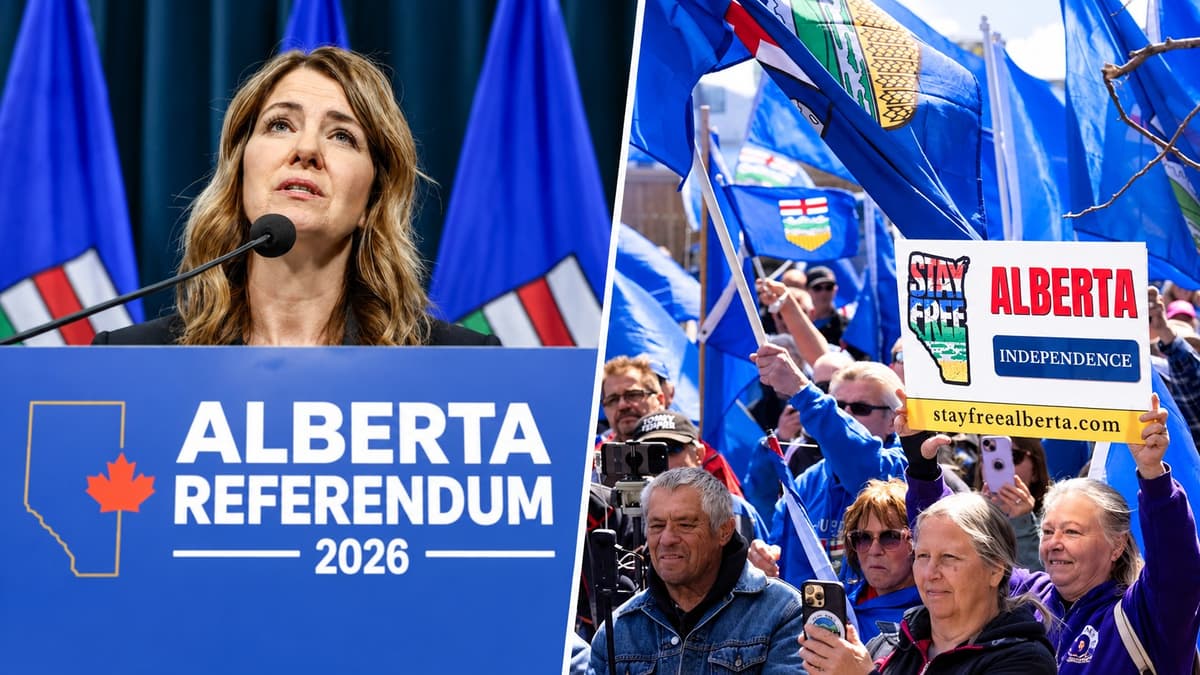
A new Angus Reid Institute poll released Sunday the day before Carney's remarks found 60% of Albertans would vote No on the October question. Sixty-seven percent would choose to stay in a straight leave-or-stay scenario. But 35% would vote Yes, rural Alberta is split 48-48, and UCP voters back the separation process 64-30.
Carney's Brexit warning is aimed squarely at the gap between those numbers the Albertans who might vote Yes not because they want to leave Canada, but because they want to make a point.
His argument is that in a referendum, making a point and making a decision are the same thing.
The ballot doesn't have a "send a message" option.
Sources:
Prime Minister Mark Carney, remarks to reporters, Ottawa, May 25, 2026
Angus Reid Institute — Alberta Separation: Three-in-five say they'd vote in October to stay, May 24, 2026 (angusreid.org)
Clarity Act, S.C. 2000, c. 26

Comments
Conversation