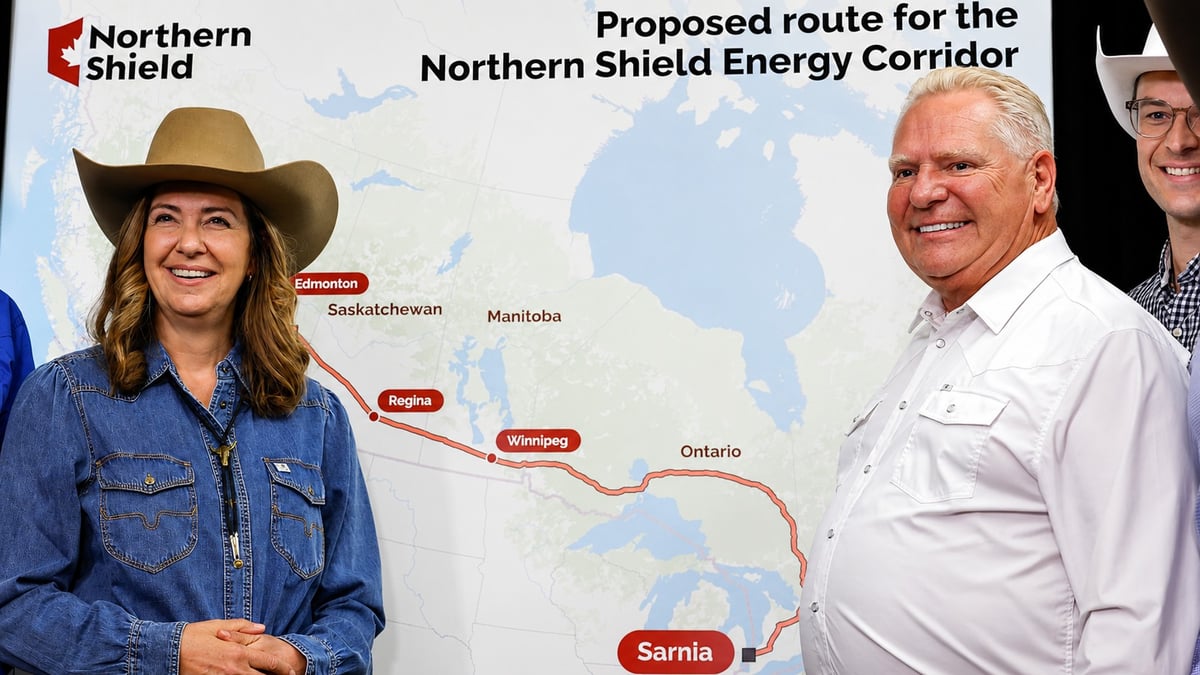
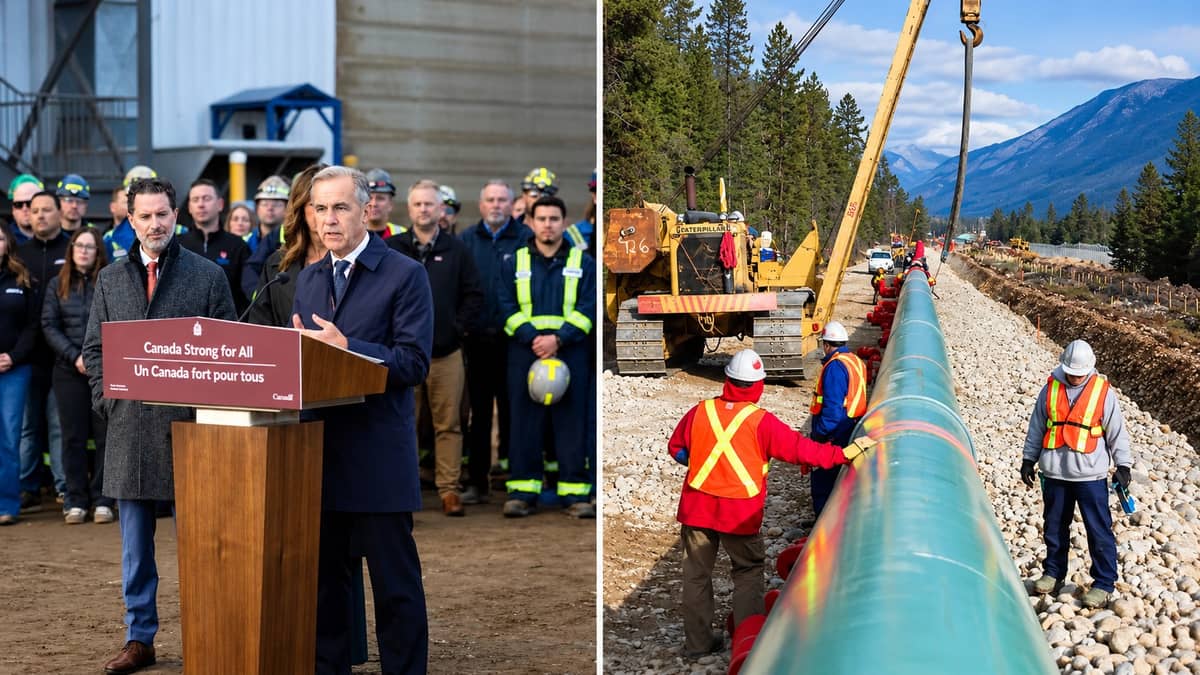
Two premiers stood together in Calgary on Monday morning and announced a proposed pipeline that would run the full width of Canada.
Alberta Premier Danielle Smith and Ontario Premier Doug Ford unveiled the proposed route for the Northern Shield Energy Corridor a 3,300-kilometre crude oil pipeline running from Hardisty, Alberta east through Regina and Winnipeg before ending at Sarnia, Ontario. The announcement was made during Stampede week at a news conference in Calgary.
The pipeline, if built, would carry an estimated 500,000 barrels of oil per day, with expansion to 800,000 barrels per day possible depending on demand. No cost or construction timeline has been approved. The project is currently in the feasibility stage, with results expected by end of 2026.
What is confirmed right now
The route is confirmed. Hardisty to Sarnia, running near Regina and Winnipeg, built entirely within Canada using Canadian steel. The Ontario government's official Northern Shield Energy Corridor page confirms the primary route and capacity figures.
The advisory team conducting the feasibility study is also confirmed: GHD Limited, Ernst & Young LLP (EY Canada), Mokwateh, AtkinsRéalis Group Inc., Wood PLC, and Turner & Townsend Limited. Infrastructure Ontario is the commercial adviser overseeing the team. The study will examine project costs, commercial models, grid upgrades, and potential strategic petroleum reserves.
What is not confirmed: final cost, construction timeline, federal involvement, regulatory approval, or private sector proponents.
What Smith and Ford actually said
Smith framed it as an energy sovereignty argument. "Eastern Canadian refineries should be powered by Western Canadian energy not from overseas," she said. "Alberta has the energy Canada and the world needs. Now it's time to build the infrastructure to deliver it."
Ford framed it as a jobs and national security play. "Our plan to build the Northern Shield Energy Corridor is a plan to protect workers in Ontario, Alberta and every part of the country. We're going to keep working to build a more secure, united and resilient Canadian economy."
Both premiers emphasized this is a Canada-only project built with Canadian steel, running through Canadian territory, reducing dependence on American pipeline infrastructure that has been used as leverage in trade disputes. A route that stays entirely within Canada changes the political calculus that has complicated Alberta's pipeline ambitions for years.
Why Hardisty and why Sarnia
Hardisty in east-central Alberta is already one of Canada's most significant crude oil hubs the delivery point for several major pipelines including Enbridge's Mainline system and a major storage and distribution centre for oilsands crude.
Sarnia in southwestern Ontario is home to a cluster of refineries that process crude oil into gasoline, diesel, and other products for the Ontario market. It sits near Lake Huron with access to Great Lakes shipping routes. The pipeline would give Alberta producers direct access to those refineries without routing through the United States which has been a vulnerability exposed repeatedly during trade disputes with Washington.
The Port of Churchill possibility
The announcement includes a specific note about Manitoba. The proposed route would give the Government of Manitoba and the Manitoba-Crown Indigenous Corporation an opportunity to explore a pipeline extension to the Port of Churchill on Hudson Bay a deep-water port with direct access to Atlantic shipping routes. A spur line to Churchill would allow Alberta oil to reach European and Atlantic markets by a route entirely within Canada. That is speculative at this stage but geopolitically significant.
Cost, consultation, and the provinces that are not on board
No price tag exists yet. The feasibility study is tasked with determining costs and the two premiers announced a proposed route without knowing what it will cost to build. Ford did not rule out Ontario taxpayers funding construction. "Let's take a look at all options. I think it's a great investment," he said.
Saskatchewan Premier Scott Moe backed the project Monday. Manitoba Premier Wab Kinew did not — saying Manitoba will only pursue large-scale projects that begin with Indigenous partnership rather than consultation after the fact. The proposed route runs through Manitoba and the Churchill extension would require Manitoba's involvement. "He has to consult a little more with his folks in Manitoba, but we'll work something out," Ford said.
How this fits into Alberta's bigger picture
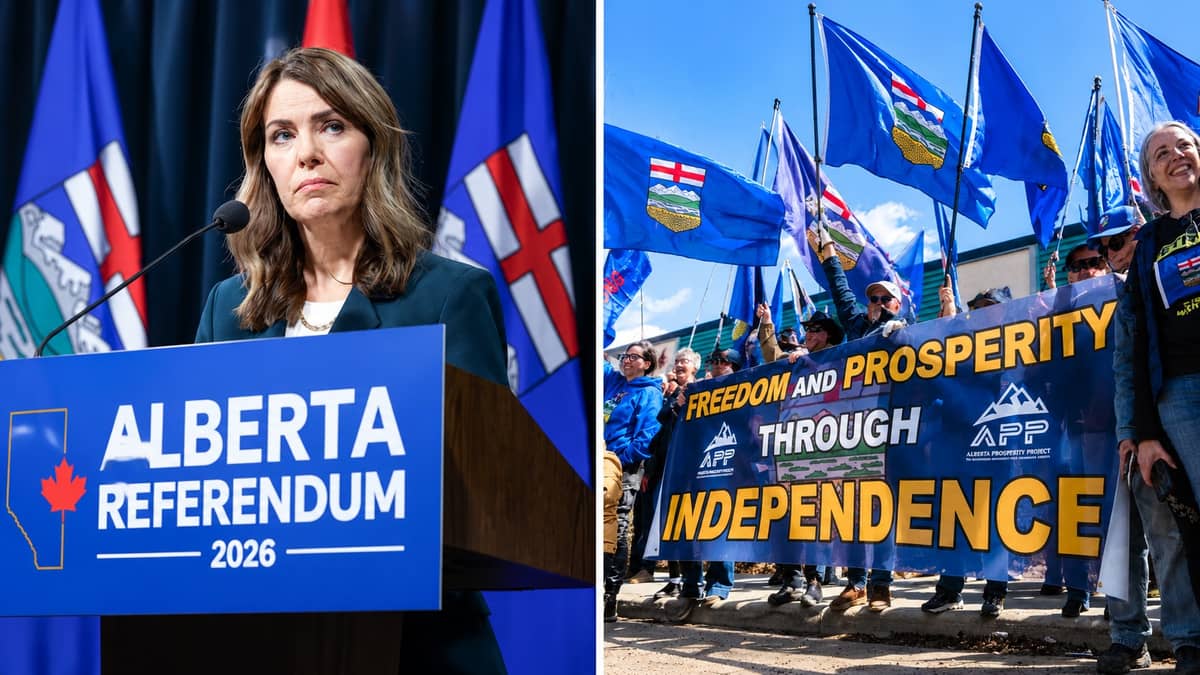
Monday's announcement comes days after Smith formally proposed a separate West Coast pipeline a Bruderheim to southwestern British Columbia route in partnership with Trans Mountain Corp. and Pembina Pipeline Corp. That proposal was submitted to the federal Major Projects Office and a federal decision is expected October 1, eighteen days before Alberta's separation referendum on October 19.
Alberta is now formally pursuing two major new pipeline routes simultaneously east to Ontario and west to British Columbia. Both are in early stages. Neither has federal approval. But the direction is clear: Alberta is building a political and commercial case for significantly expanding its pipeline capacity in both directions, using trade pressure from the United States as justification and provincial partnerships as the mechanism.
Indigenous involvement
Ontario says it has initiated its duty to consult with Indigenous partners and communities along the proposed route, and has referenced historic funding to help Indigenous communities become equity partners. No details about specific First Nations engagement, equity structures, or consent processes have been publicly released.
The critics
Not everyone is celebrating. Environmental groups and several Indigenous organizations have raised concerns about committing political momentum to new fossil fuel infrastructure while Canada's net-zero targets for 2050 remain legislated policy.
No environmental assessment has been initiated. No Indigenous consent has been obtained along the route. Both premiers have declined to rule out public funding — meaning taxpayers could be asked to finance a pipeline that private industry has not yet committed to building on its own.
What comes next
The feasibility study is expected by end of 2026. Once complete, Ontario and Alberta will have confirmed cost estimates and a clearer picture of what regulatory and federal processes would be required. Construction would require federal approval under the Impact Assessment Act and National Energy Board oversight — neither of which has been initiated.
For updates visit ontario.ca/page/northern-shield-energy-corridor.
Sources:
Government of Ontario, Northern Shield Energy Corridor page (ontario.ca/page/northern-shield-energy-corridor)
Government of Ontario, Northern Shield Energy Corridor news release, July 6, 2026
Premier Doug Ford, statement July 6, 2026
Premier Danielle Smith, statement July 6, 2026



Comments
Conversation