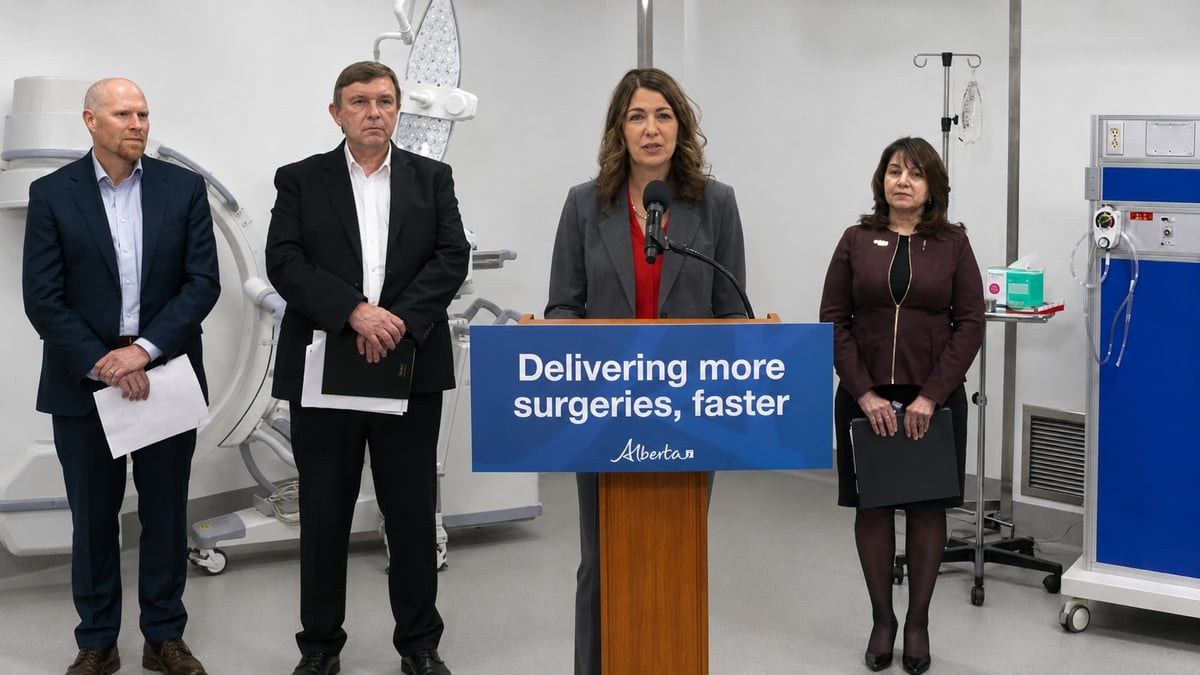
Alberta has changed how hospitals get paid for surgery.
Last month the province began implementing patient-focused funding across 12 public hospitals including Rockyview General in Calgary and the Royal Alexandra in Edmonton. Instead of receiving a fixed annual budget regardless of how many patients they treat, hospitals are now paid per procedure at rates the province has set for each surgery type and complexity level.
The funding shift is the centrepiece of a broader $809 million investment in surgical care announced June 1, covering expanded operating room capacity, hospital infrastructure upgrades, and increased use of private surgical clinics for lower-complexity cases.
What the province is now paying per surgery
The province has published fixed rates for each procedure in the first phase:
Hip surgery: Day surgery $8,900. No comorbidity $9,420. Low comorbidity $15,700. High comorbidity $33,440.
Knee surgery: Day surgery $8,530. No comorbidity $9,030. Low comorbidity $15,850. High comorbidity $24,790.
Cataract surgery: Unilateral $880. Bilateral $1,600.
Shoulder surgery: $6,800.
To put that in practical terms: an otherwise healthy 68-year-old who needs a hip replacement and goes home the same day generates $8,900 for the hospital. The same surgery on a 72-year-old with diabetes, heart disease, and chronic kidney disease who requires longer recovery, more nursing care, and closer monitoring generates $33,440. The pricing structure is designed so hospitals are not financially better off avoiding complicated patients.
Some rates have been set below historical cost averages deliberately, to create pressure on hospitals to find efficiencies. The province says complexity-weighted pricing protects against hospitals cherry-picking simpler cases. A high-comorbidity hip replacement pays $33,440 nearly four times the day surgery rate meaning hospitals are not financially penalized for taking on difficult patients.
Acute Care Alberta has designated the first year of implementation a learning year, tracking readmission rates and other quality measures to assess whether the funding change affects care quality alongside volume.
How this changes the incentive structure
Under the previous block funding model, Alberta hospitals received a set budget regardless of how many patients they treated. More surgeries did not mean more money. Fewer surgeries did not mean less.
Patient-focused funding inverts that. Performing more procedures now generates more revenue. The intention is to give hospitals a direct financial incentive to increase throughput and reduce wait times rather than managing within a fixed ceiling.
The model will eventually apply to future contract negotiations with private chartered surgical facilities though the current rollout is limited to public hospitals. The UK, Germany, Australia, and Norway have all implemented versions of this model. In each case it was rolled out in stages over several years. Alberta says it is following the same approach, with future phases introduced after reviewing early results.
Where Alberta's surgical wait times actually stand
The investment is responding to a persistent problem.
Canada's national benchmark for a hip or knee replacement is 26 weeks. For cataract surgery it is 16 weeks. The goal is to have at least 90 percent of patients receive their procedure within those timelines.
In 2023, only 61 percent of cataract surgeries in Alberta were completed within the 16-week benchmark. Hip and knee replacement performance has improved but has not consistently reached the 90 percent target. Emergency hip fracture repair, where the benchmark is 48 hours, was completed within benchmark 77 percent of the time in 2023 down from 87 percent in 2019.
Radiation therapy is the only surgical category currently meeting the 90 percent benchmark in Alberta.
Alberta performed a record 332,847 surgeries in fiscal 2025. March 2026 set a monthly record with 24,676 procedures. The province says the new model and investment will build on that momentum while keeping the system publicly funded.
What the $809 million actually covers
The Acute Care Action Plan receives $525 million over three years through Budget 2026 to support up to 50,000 additional surgeries. This includes expanding operating room hours in public hospitals and increasing the use of chartered surgical facilities privately owned clinics that perform publicly funded procedures for lower-complexity cases. The intent is to shift simpler surgeries to those facilities and free up hospital operating rooms for more complex cases.
The Alberta Surgical Initiative Capital Program receives $284 million over three years to renovate operating rooms, upgrade surgical infrastructure, and purchase new equipment in publicly owned hospitals across the province.
In fiscal 2025, 264,823 surgeries 79.6 percent were performed in acute care facilities. The remaining 68,024 — 20.4 percent were completed in chartered surgical facilities. That split is expected to shift as the new capacity comes online.
The NDP response
The opposition NDP is calling the funding model a step toward privatization of surgical care.
"Activity-based funding pushes hospitals towards quicker, less complex procedures at the expense of comprehensive care, proper follow-up and better health outcomes," said NDP shadow minister Sarah Hoffman.
"If this government truly wanted to fix health care, it would invest in public surgical capacity, address bottlenecks across the system, and work with patients, providers, and communities on real solutions."

The concern Hoffman is raising is documented in the international research on activity-based funding when hospitals are paid per procedure, there is a structural incentive to prioritize volume and speed. The province's comorbidity-weighted pricing is designed to counteract that. Whether it does in practice is what the first year of data will show.
The province has not published a projected timeline for when Alberta expects to reach the 90 percent wait time benchmark in any procedure category.
Sources:
Government of Alberta news release — Strengthening surgical care in Alberta, June 1, 2026 (alberta.ca)
Government of Alberta — Patient-focused funding rates, June 2026 (alberta.ca)
Canadian Institute for Health Information — Wait Times for Priority Procedures in Canada, 2024 (cihi.ca)
Government of Alberta — Acute Care Action Plan (alberta.ca)
Government of Alberta — Alberta Surgical Initiative (alberta.ca)









Comments
Conversation