
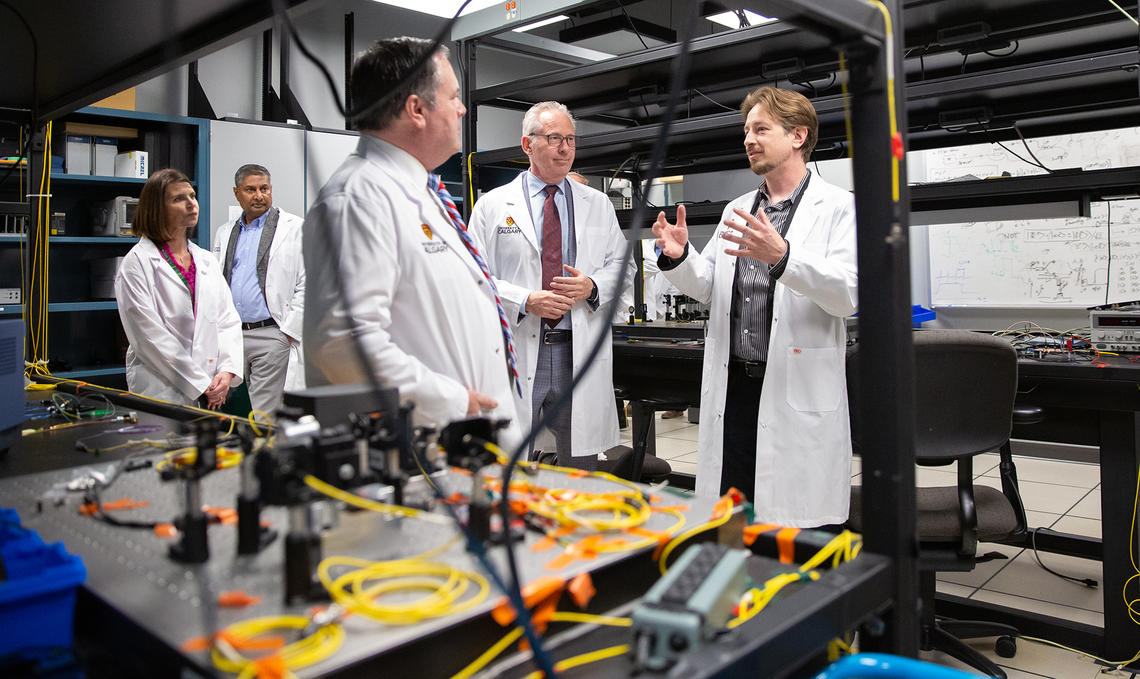
Defence Minister David McGuinty stood at the University of Calgary on Thursday and made an argument about GPS.
"They will redefine navigation when GPS is denied, communications when networks are contested, sensing when adversaries seek to remain invisible, and computing at speeds that will transform what is possible across defence, security, and industry," he said of quantum technologies.
Ottawa is putting $20.3 million over two years into a University of Calgary-led consortium to build the Quantum Defence Innovation Secure Hub, or Quantum DISH.
Why GPS keeps coming up
The DISH is meant to be a secure environment where government, industry, academia and independent innovators can develop, test, validate and move quantum technology into operational use by the Canadian Armed Forces. The focus areas are quantum sensing, communications, algorithms and hardware.
McGuinty's pitch was about navigation, and it's worth understanding why a defence department funds physics.
Modern navigation depends on satellite signals that can be jammed or spoofed. Some quantum-sensing systems are being developed to measure motion, gravity or magnetic fields with enough precision to support navigation when satellite signals are unavailable or unreliable. Those capabilities could also improve detection of objects or infrastructure that are difficult to locate with conventional sensors.
The government's stated aim is to strengthen Canada's technological advantage and reduce vulnerabilities in contested environments, with GPS denial named specifically.

Where it sits, and why Calgary
The hub falls under the Bureau of Research, Engineering and Advanced Leadership in Innovation and Science, the defence department's research arm.
Calgary is the third announced DISH, but the first dedicated to quantum technology. The Halifax hub works on maritime security and the Montreal one on drones. Some coverage has described Calgary simply as the third of these, which is accurate as far as it goes and misses what the federal release is claiming.
Industry Minister Mélanie Joly was named in the announcement alongside McGuinty, which places this as economic policy as much as defence policy. The consortium behind the hub brings together organizations from Canada's quantum, defence and innovation sectors, and the government says the investment will create high-value jobs.
McGuinty framed the broader shift plainly. Critical minerals have become instruments of geopolitical influence, he said, data has become infrastructure, and artificial intelligence is transforming military capability.
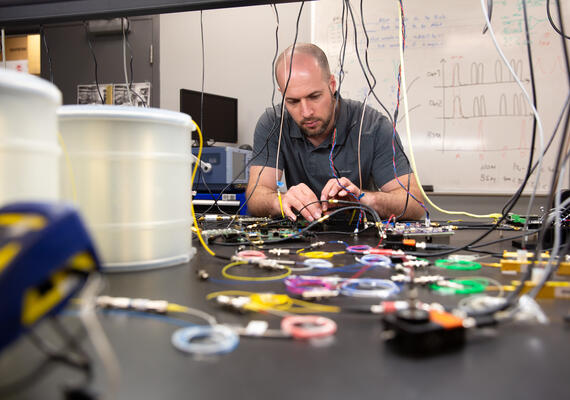
The University of Calgary has run quantum research for over two decades, and Calgary has spent recent years building a quantum sector rather than just a quantum department. It also arrives while the province is attracting billions in AI data centre capital. The two investments represent different parts of Alberta's technology economy: large-scale computing infrastructure on one side, university-led research aimed at defence applications on the other.
What Canada is behind on
Canada has quantum researchers and comparatively little money behind them.
The National Quantum Strategy committed $360 million in 2021. Britain pledged £270 million back in 2013 and built a network of quantum technology hubs on top of it. The United States, China and the EU have all committed sums in the billions.
That gap is the context for a $20.3 million, two-year commitment. It's real money for a university consortium and a rounding error against what other countries are spending, which is why the interesting question isn't whether the hub gets built but whether the people it trains stay in the country afterward.
Calgary has been dealing with a version of that problem for years. The researchers the university produces have historically had better-funded options elsewhere.
What comes next
The funding runs two years. Neither the government nor the university has published a timeline for when the hub becomes operational, how many people it will employ, or what happens after the two years are up.
Sources:
Department of National Defence, "Minister McGuinty launches Canada's first Quantum Defence Innovation Secure Hub to strengthen defence capabilities," August 6, 2026
The Canadian Press, reporting from the University of Calgary, August 6, 2026
Bureau of Research, Engineering and Advanced Leadership in Innovation and Science (BOREALIS)
Government of Canada, National Quantum Strategy









Comments
Conversation