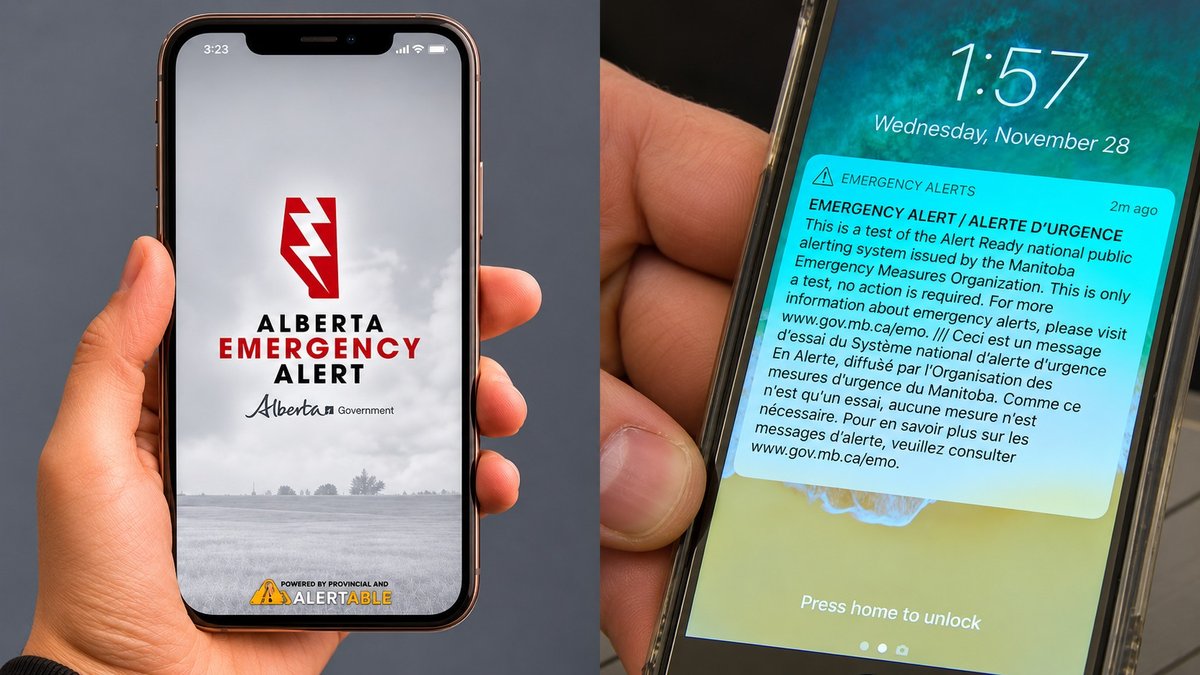
That loud, unmistakable tone is coming back on Wednesday.
Canada’s emergency alert system will be tested on Wednesday, Nov. 18, 2026, on TV, radio and compatible cellphones in all 10 provinces and three territories.
It won’t happen everywhere at once. Each province and territory sends its own test, so some Canadians will get it in the morning and others in the afternoon.
The message will say clearly that it’s a test. No action is required.
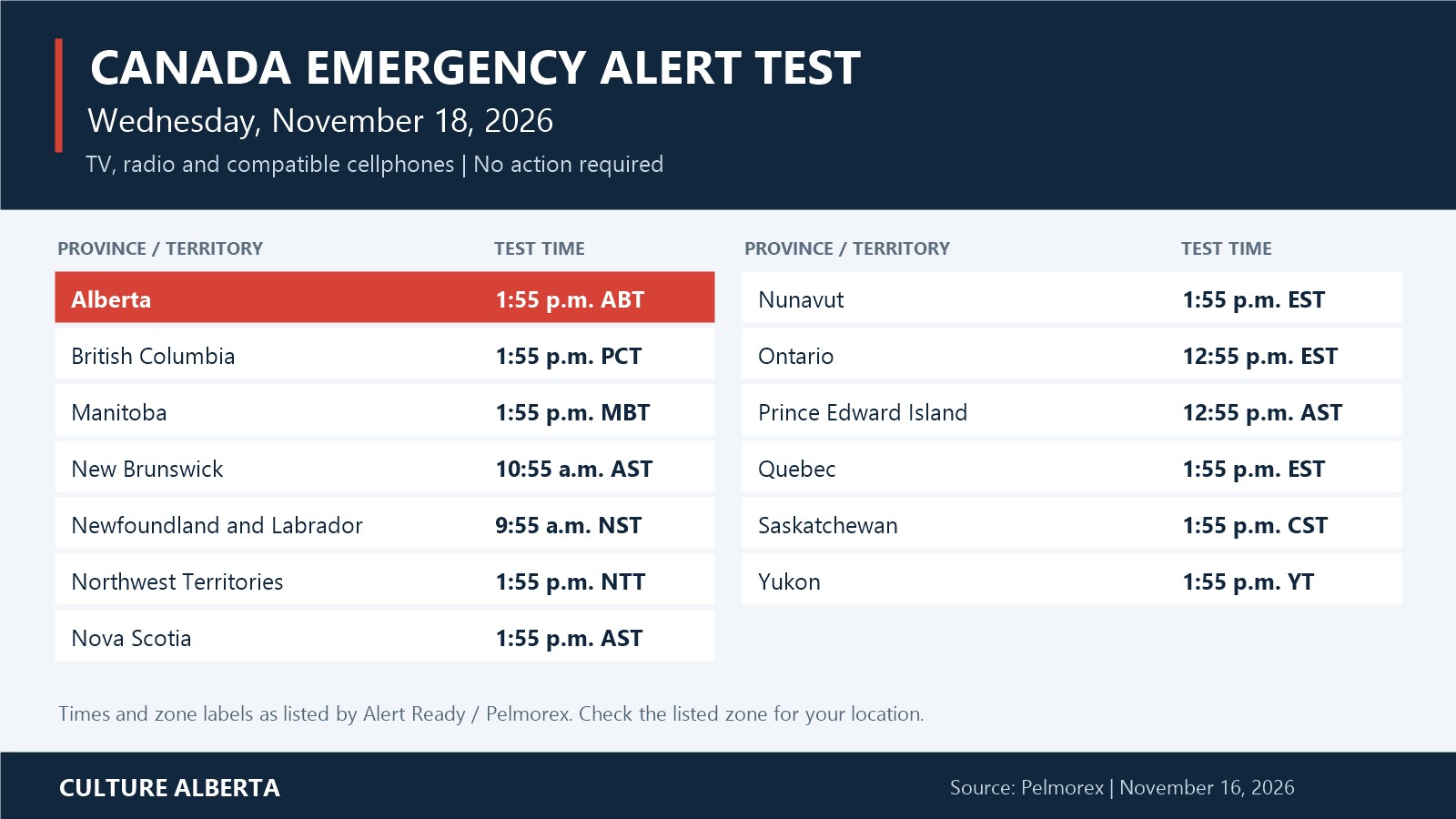
Emergency alert test times across Canada
Pelmorex, which operates Alert Ready, lists this schedule for Nov. 18. The time zone labels are the ones it uses.
| Province or territory | Scheduled test time |
|---|---|
| Alberta | 1:55 p.m. ABT |
| British Columbia | 1:55 p.m. PCT |
| Manitoba | 1:55 p.m. MBT |
| New Brunswick | 10:55 a.m. AST |
| Newfoundland and Labrador | 9:55 a.m. NST |
| Northwest Territories | 1:55 p.m. NTT |
| Nova Scotia | 1:55 p.m. AST |
| Nunavut | 1:55 p.m. EST |
| Ontario | 12:55 p.m. EST |
| Prince Edward Island | 12:55 p.m. AST |
| Quebec | 1:55 p.m. EST |
| Saskatchewan | 1:55 p.m. CST |
| Yukon | 1:55 p.m. YT |
In short:
Morning: Newfoundland and Labrador, then New Brunswick
Lunchtime: Ontario and P.E.I.
1:55 p.m. local: everywhere else
If you live in a province or territory with more than one time zone, check the zone listed above or your local emergency management office.
What time is the emergency alert test in Alberta?
1:55 p.m. Wednesday. That covers Edmonton, Calgary, Red Deer, Lethbridge, Medicine Hat, Grande Prairie, Fort McMurray and communities across the province.
The “ABT” label reflects Alberta’s move to permanent Alberta Time on Nov. 1. The province no longer turns its clocks back in the fall and now stays at UTC-6 all year. Your clock will simply say 1:55.
Rocky View County says residents may get the test on their phones or hear it on TV or radio. There’s no need to call 911 or take any protective action.
What will the alert look and sound like?
The message starts with the Canadian Alert Attention Signal, the harsh tone designed to get your attention even in a noisy room. It will say it’s a test and that no action is needed.
On most phones, it appears as a full-screen message. On TV and radio, regular programming is interrupted briefly.
Why didn’t my phone get the test?
A quiet phone doesn’t mean the system failed.
The CRTC says a phone has to support wireless public alerting and be connected to an LTE or 5G network when the alert is sent. That means:
Wi-Fi only won’t work. A device on Wi-Fi alone won’t receive the wireless test.
Poor reception can block it, for example in an underground parkade.
Older or imported phones may not be compatible.
Alert Ready recommends checking compatibility with your wireless provider and installing software updates. Its wireless device guide is at alertready.ca/wireless.
Will it sound on silent or Do Not Disturb?
It might. CRTC testing found phones handle alerts differently on silent or Do Not Disturb. Depending on your device and settings, the alert may sound, vibrate, or just appear on screen.
If you’ll be in a classroom, meeting or other quiet setting at test time, assume your phone could make noise.
Can Canadians opt out of emergency alerts?
No. Alert Ready says Canadians can’t opt out of receiving emergency alerts on compatible phones connected to LTE or 5G in the targeted area.
There’s no subscription and no cost. Alberta also says alert issuers don’t collect, access or keep your personal contact information when they send an alert.
Why does Canada test the system?
Tests check that the system works and get people used to the alert before they hear it in a real emergency.
The alerts get plenty of real use. Alert Ready says more than 1,215 emergency alerts have been sent across Canada so far in 2026, for wildfires, floods, tornadoes, Amber Alerts and more.
Phone alerts are still fairly new. Mandatory wireless emergency alerts began in Canada on April 6, 2018.
Getting the process right matters. In January 2020, Ontario mistakenly sent a public alert about the Pickering Nuclear Generating Station during a training exercise. Ontario’s investigation found a test message had gone out through the live system. There was no nuclear emergency, but the alert caused widespread alarm.
Alberta runs provincewide tests twice a year, in May and November.
What should you do when the alert arrives?
Read it and confirm it’s the scheduled test. Nothing else is needed.
In a real emergency, read the location and instructions carefully. In Alberta:
Critical alerts mean take action immediately.
Advisories mean be ready to act.
Albertans can also follow alerts through the Alberta Emergency Alert website and app.
Sources
Pelmorex: Alert Ready to issue nationwide test on November 18, 2026
Alert Ready: Wireless device compatibility guide
CRTC: Wireless public alerting information
Government of Alberta: Alberta Time
Rocky View County: Emergency alert test notice, Nov. 2026









Comments