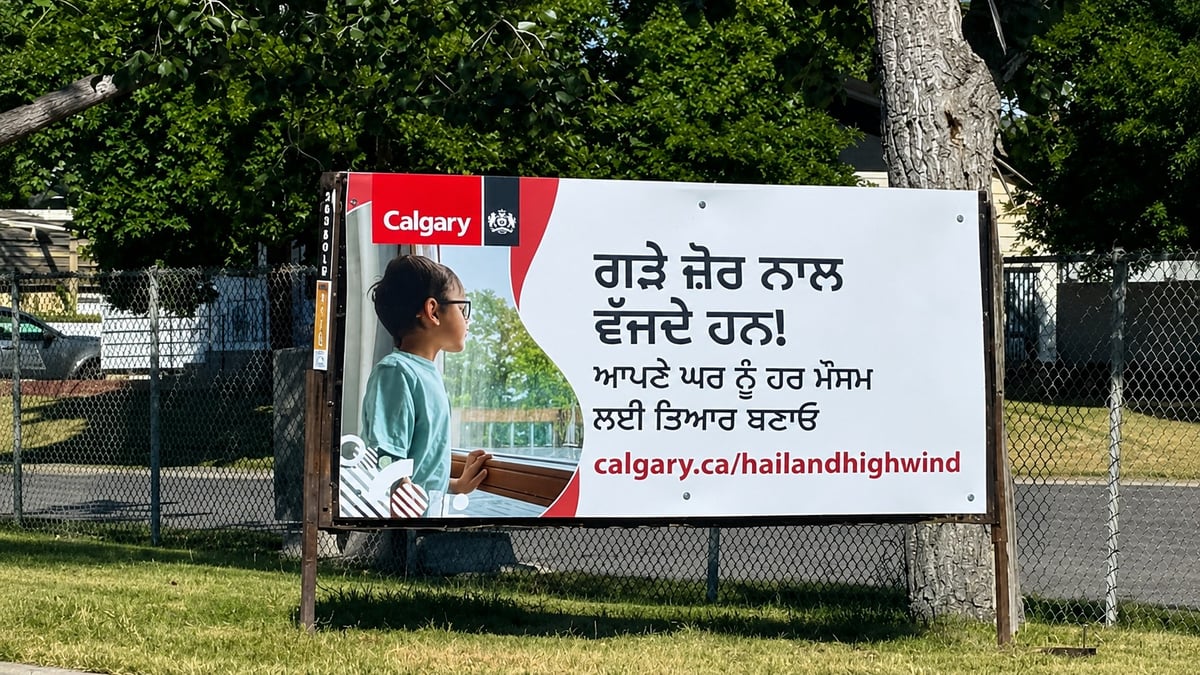
The sign reads "Hail hits hard!" in Punjabi, above a line about getting your home ready for every season, and a URL: calgary.ca/hailandhighwind.
A photo of it has been circulating with complaints that city signage should be in English, and that people can't read what it says.
It's the second time this year Calgary has had this argument.
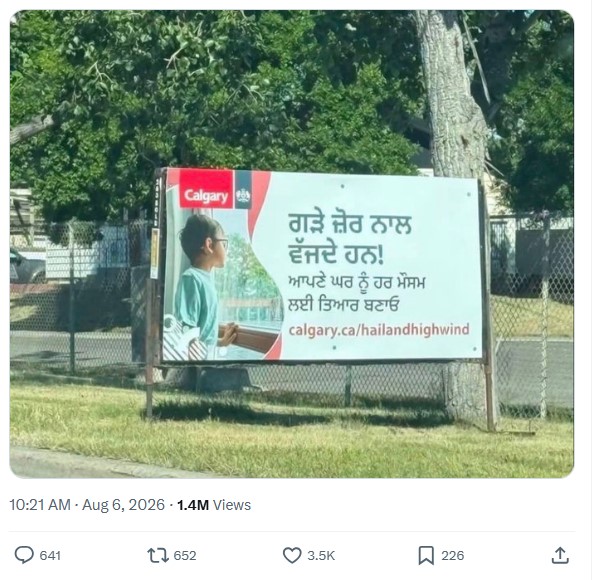
The last time was in May
Calgary police posted temporary signs in Punjabi in the northeast as part of an effort to combat extortion crimes targeting the South Asian community. The signs drew criticism online, some of it about immigration rather than about the signs.
CPS defended them publicly, on the basis that a warning only works if the people being targeted can read it.
What the campaign is for
On August 5, 2024, a supercell thunderstorm crossed northern Calgary. Hailstones the size of hen eggs. More than 130,000 insurance claims. Roughly $2.8 billion in insured losses, the second-costliest disaster in Canadian history after the Fort McMurray wildfire.
The damage swath was more than 120 kilometres long and 12 wide. About 35,000 buildings were hit. Nearly one in five Calgary homes was affected. WestJet pulled 16 aircraft from service.
That storm came four years after a June 2020 hailstorm that caused over $1.2 billion in insured damage in northeast Calgary, and there was another in 2021 at over $700 million.
Calgary sits in Hailstorm Alley and is described by climatologists as the hail capital of Canada. The city's own climate page says projections point to more severe thunderstorms and larger hailstones.
The hail and high wind campaign tells people to secure outdoor items, maintain roofs, trim trees, check what their insurance actually covers, and know where to shelter.
Where the hail keeps landing
The 2020 storm hit northeast Calgary. The 2024 storm hit northern Calgary. Northeast Calgary homeowners were still struggling to find home insurance a year later.
Those are also the parts of the city with Calgary's largest South Asian population, and where Punjabi is most widely spoken at home.
A preparedness campaign that puts its message in Punjabi in those communities isn't a statement about language policy. It's advertising placed where the hail falls.
What the objection is, and what it isn't
The complaint that people can't read the sign is accurate on its face. Anyone who doesn't read Punjabi cannot read that sign.
The city runs the same campaign in English across its website, its emergency pages, its social channels and its other signage. The Punjabi version is an addition rather than a replacement, and the URL on it is the same one every other version carries.
Canada has two official languages and neither is Punjabi. Municipalities aren't restricted to them. Cities routinely communicate in whatever languages their residents actually speak, and Calgary has done it before with health information, transit information and police warnings.
The harder question underneath, and the one that surfaced in May as well, is whether public communication in a language other than English is a service to residents or a signal about who a city is for. That's a real disagreement and it isn't going to be settled by pointing at a sign.
The practical test
There's a version of this argument that can actually be answered.
If the point of an emergency preparedness campaign is to get people to secure their patio furniture and check their insurance before the next storm, then it works if more people do those things. A household that reads the Punjabi sign, visits the page and clears the deck is the campaign functioning exactly as designed.
A household that can't read it loses nothing, because the same message is on every English channel the city runs.
The page itself
calgary.ca/hailandhighwind, in English, covers what to do before, during and after a storm.
Before: secure outdoor items, maintain your roof and trim trees, review what your home insurance covers, build an emergency kit, make a household plan.
During: get inside, bring pets in, close windows and doors, stay away from glass and skylights, draw curtains so a shattered window is contained. If you're driving, pull over and stay in the vehicle. Watch for flooding, since hail plus heavy rain blocks storm drains.
The city also points to hail-smart.com and the Institute for Catastrophic Loss Reduction, and notes that hip roofs and steeper pitches take less hail damage, which matters for anyone rebuilding.
Sources:
City of Calgary, Climate hazards: Hail and high wind: https://www.calgary.ca/environment/resources/climate-hazards--hail-and-high-wind.html
City of Calgary, What to do during a hail storm: https://www.calgary.ca/emergencies/hail-storm.html
Insurance Bureau of Canada, August hailstorm insured damage, September 11, 2024
Western University Northern Hail Project, damage survey, 2024
Calgary Police Service statements on Punjabi-language extortion signage, May 2026









Comments
Conversation