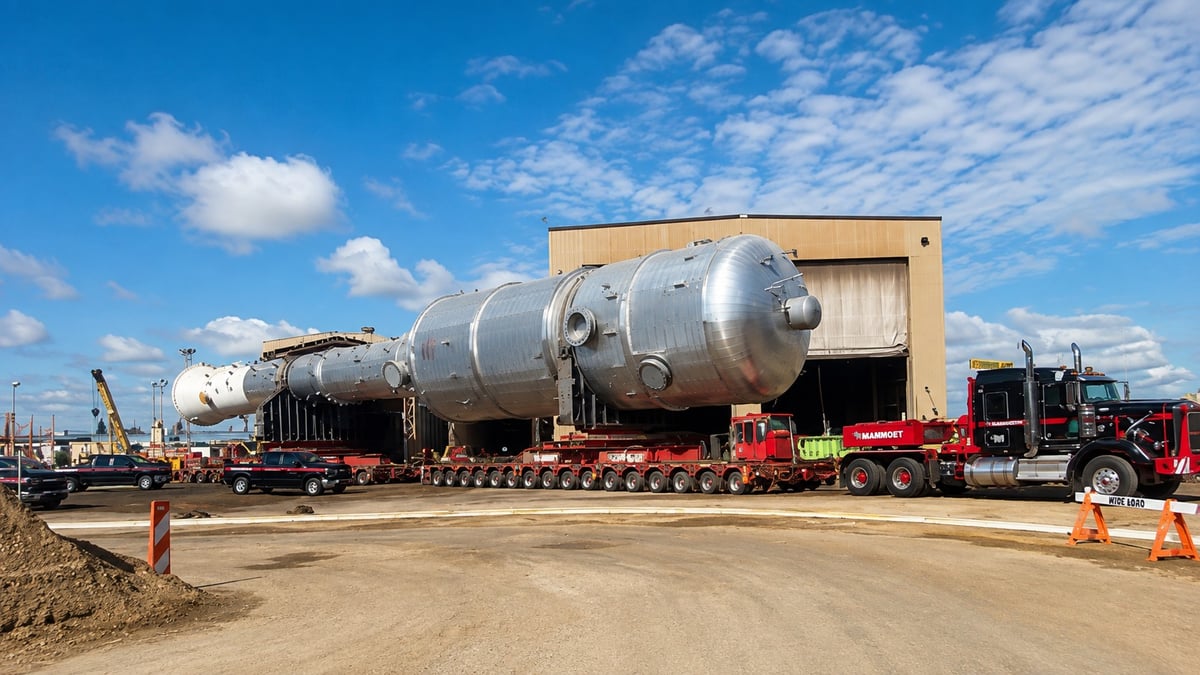
At 11 p.m. Wednesday, a module 96.6 metres long will pull out of a yard in south Edmonton and drive the wrong way down Whitemud Drive.
That isn't a mistake. It's the plan.
The province issued a travel advisory for a super-heavy load moving from Edmonton to Fort Saskatchewan starting Wednesday, August 12. The cargo is a de-ethanizer, and three of the four highways on its first leg will be run counterflow.
The numbers
The module is 7.7 metres wide, 10.5 metres high and 96.6 metres long. With support equipment it weighs 749,142 kilograms, just under 750 tonnes.
The trailers underneath carry 448 wheels.
Top speed is 30 km/h. It moves with guide vehicles, below posted limits, using the entire width of the highway including the shoulder.
Counterflow, and why it matters tonight
Three legs of Wednesday night's route are counterflow: Whitemud Drive eastbound, Highway 216 southbound, and Highway 14 eastbound.
Counterflow means the load travels against the normal direction of traffic in oncoming lanes, with crews holding and redirecting everything else. It's how you move something 7.7 metres wide through a corridor where the correct-direction lanes won't accommodate it, usually because of median barriers, overpass clearances or ramp geometry.
For anyone driving Whitemud Drive or the Henday late Wednesday into Thursday morning, that's the practical detail. You aren't going around this. You're being held, rerouted, or waiting.
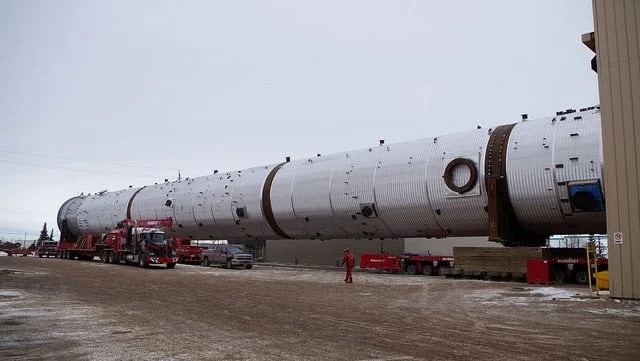
The route and timing
Wednesday, August 12, 11 p.m. departure
Exits 9325 51 Avenue NW in Edmonton, then 51 Avenue NW eastbound, Roper Road NW eastbound, 75 Street NW southbound, Whitemud Drive NW eastbound counterflow, Highway 216 southbound counterflow, Highway 14 eastbound counterflow, then the Highway 14 ramp at Highway 21.
It stages on the east side of Highway 21 at 5 a.m. Thursday.
Thursday, August 13: off duty. The load sits.
Friday, August 14, 2 a.m. departure
Highway 14 eastbound, Highway 834 northbound, Highway 15 westbound, Range Road 220 northbound into the Dow site. Arrival planned for noon.
Live conditions are at 511.alberta.ca, on the 511 app, or by dialling 511 in Alberta.
What a de-ethanizer does
A de-ethanizer is used in natural gas processing to separate ethane from heavier hydrocarbons.
That ethane is the feedstock for ethylene, which becomes polyethylene, which becomes the plastic in shopping bags, pipe, packaging film and food containers. Alberta's petrochemical industry runs on splitting gas streams into their component parts, and this tower is one of the machines that does the splitting.
It moves in one piece because distillation columns are built, tested and sealed as complete units. The internals have to be exact, so the whole tower travels assembled, lying on its side.
The 448 wheels are load distribution. Spread across that many contact points, the weight per axle drops low enough that the pavement survives the trip.
The second one in three weeks
On July 23, a 138-metre C3 splitter weighing nearly 898 tonnes ran from Tofield to the same Dow site on 544 wheels.
That one was longer and heavier. This one is wider and taller, and it's coming out of Edmonton rather than Tofield, which is why it needs the counterflow legs and a three-day schedule instead of a single day.
Alberta Super Load: 138-Metre, 898-Tonne Giant Crawls From Tofield to Fort Saskatchewan
Both moves originate with Dacro. Both end at Dow. That corridor into Alberta's Industrial Heartland sees more of these than almost anywhere in Canada, and the Fort Saskatchewan expansion is why the hardware keeps arriving.
Why 11 p.m., and why the day off
Night moves through a city are about emptiness. Whitemud Drive at 11 p.m. carries a fraction of what it carries at 5 p.m., and every vehicle not on the road is one the guide crews don't have to manage.
The Thursday layover isn't a delay. Staging on Highway 21 and waiting a full day is standard on multi-leg moves, giving crews time to reset escorts, confirm the next segment and work around whatever the permit specifies for daylight hours on rural highways.
If you want to see it
Plenty of people will. A 96.6-metre load at 30 km/h is easy to catch, and Friday's daylight leg on Highways 14, 834 and 15 is the one to watch.
Watch from well off the highway. Don't stop on the shoulder, because that's part of the load's lane. Give the guide vehicles room.
Sources
Super-heavy load affects travel in central Alberta — Government of Alberta, August 12, 2026
Alberta 511








Comments
Conversation