Our condolences to his family and friends.
A 33-year-old man was killed early Saturday morning in the northern Alberta hamlet of Calling Lake after being struck by a UTV side-by-side that drove away.
Athabasca RCMP were called to Corner Drive at around 4 a.m. EMS declared the man deceased at the scene.
After speaking to witnesses, officers located and seized the UTV involved. Police say they are now investigating its driver and the circumstances that led to the death.
Anyone with information is asked to contact Athabasca RCMP, or to submit an anonymous report to Crime Stoppers at 1-800-222-8477.
Where this happened
Calling Lake is a hamlet in Athabasca County, on Highway 813 roughly 55 kilometres north of the town of Athabasca and more than 200 kilometres north of Edmonton. It sits next to Bigstone Cree Nation and the lake it takes its name from.
The investigation is ongoing. No charges have been announced.
If you were in Calling Lake early Saturday
Anything from the hours around 4 a.m. is useful, including details that seem too small to report.
Who was out. Which machines were running. What was heard, and when. A side-by-side is loud, and in a hamlet at that hour it carries.
Anyone with a camera facing a road or driveway in Calling Lake should check Saturday morning's footage now. Most home systems record on a loop and overwrite within days.
What a side-by-side is
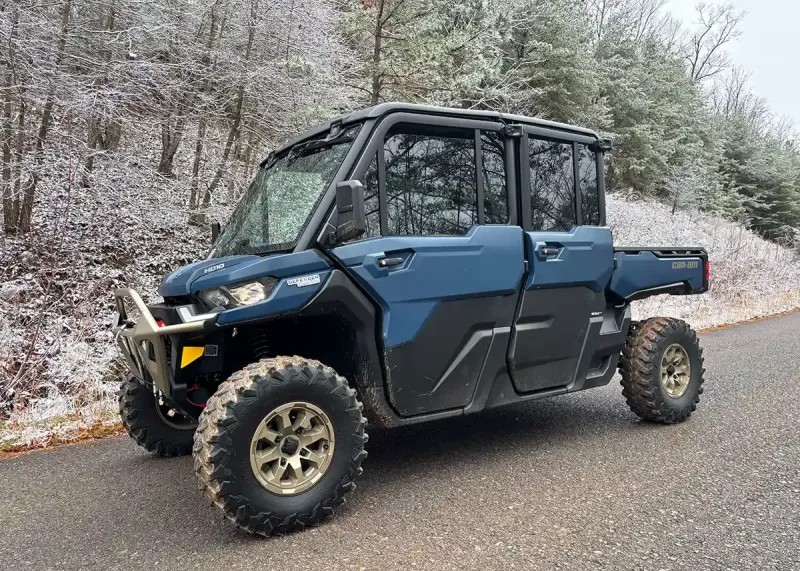
A side-by-side, also called a UTV, is an off-road machine with side-by-side bucket seats, a steering wheel and pedals, usually with seat belts and a roll cage. It looks like a small open-cab vehicle and can reach highway speeds.
The difference from a quad is the seating. A quad has a straddle seat and handlebars. A side-by-side has a cab and a wheel, which is why people often assume it's road legal.
It isn't.
Side-by-sides generally aren't allowed on roads
Alberta's Traffic Safety Act classifies side-by-sides as off-highway vehicles, the same category as quads, dirt bikes and snowmobiles.
Under Section 120, an off-highway vehicle may not be operated on any highway, road or ditch unless permission has been expressly granted, whether by a ministerial order, a permit, or a municipal bylaw allowing it.
The only provincial ministerial order permits four-wheeled all-terrain vehicles on three-digit highways during daylight hours, for farming operations or emergencies.
Municipalities can pass their own bylaws, and many rural counties allow limited road use under set conditions. Whether a side-by-side could legally be on Corner Drive depends on Athabasca County's bylaw.
Here's the consequence that matters. When an off-highway vehicle is operated on a road, the rules that apply to any vehicle apply to it. Registration and insurance requirements. Impaired driving law. The duty to remain at the scene of a collision.
Operators are also prohibited from driving carelessly, on public land or private.
Why seizing the vehicle matters
Police have the UTV, and that's significant this early.
A seized machine can be examined for damage consistent with the collision, establishing a physical link to the scene in a way witness accounts alone cannot. It also indicates police believe they've identified the machine involved rather than still looking for one.
What they say they're still investigating is the driver, which is a separate question. Ownership and operation aren't the same thing, and at 4 a.m. establishing who was behind the wheel usually comes down to witnesses.
That's why the appeal is out.
Sources
Athabasca RCMP
Alberta Traffic Safety Act, Section 120, off-highway vehicle provisions
Off-highway vehicle helmet law — Government of Alberta


Comments
Conversation