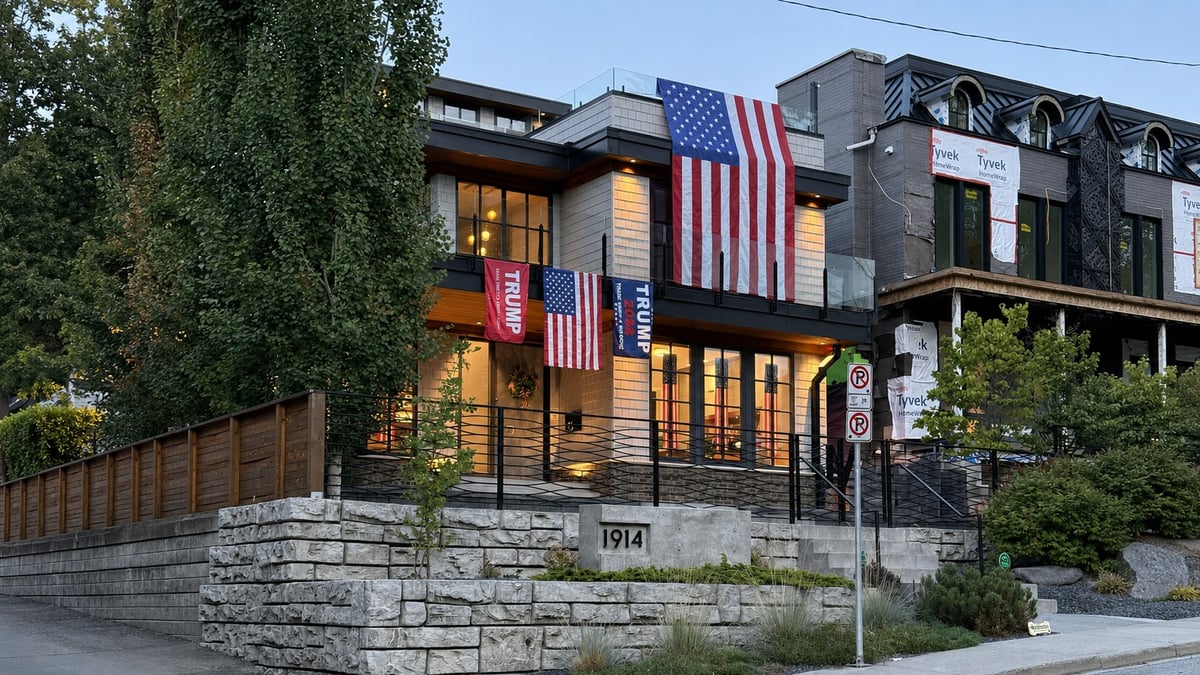
A home in Calgary's Mount Royal has been going viral after photos circulated showing it covered in massive American flags and Trump 2028 banners.
The display includes oversized flags hung across the upper storey and the front of the house, with more visible through the windows.
It's drawing attention in a week when Canadians are paying close attention to anything involving the United States.
What's happening with the tariffs
At midnight Friday, after trade negotiations collapsed, the United States imposed 50 per cent tariffs on roughly $20 billion worth of Canadian goods.
That covers about five per cent of everything Canada ships south each year. The list includes wine, furniture, dairy, cement, clothing, fishing rods and hockey equipment.
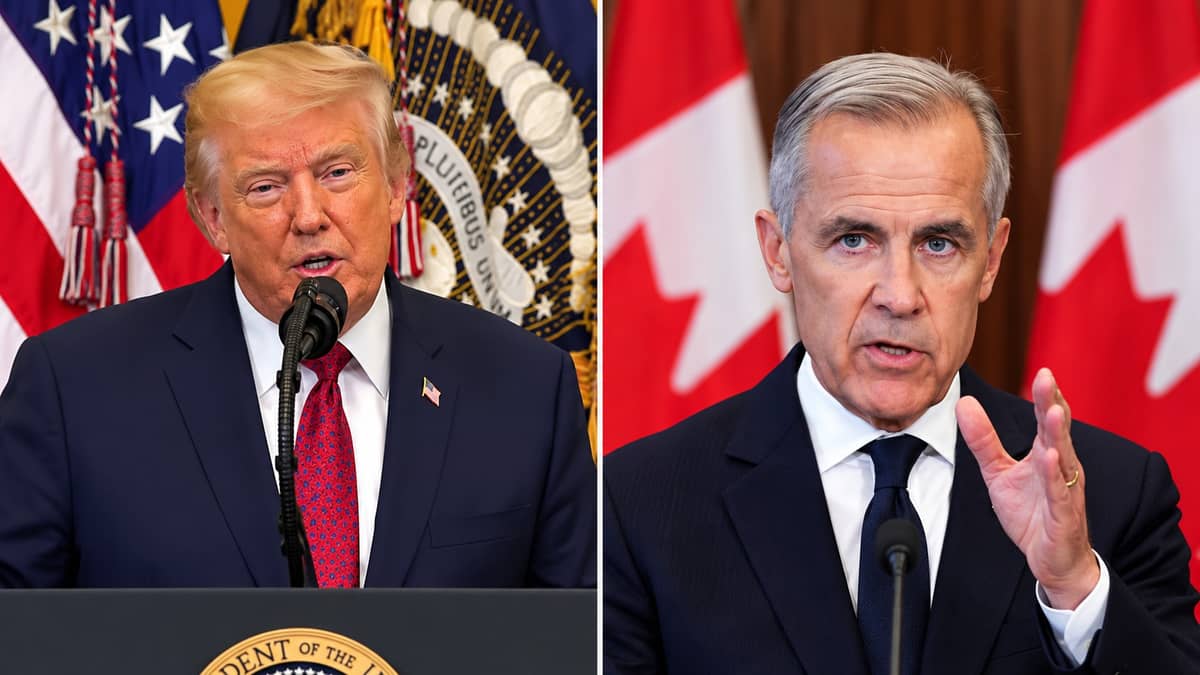
Prime Minister Mark Carney announced Saturday that Canada will respond dollar for dollar, with retaliatory tariffs beginning Tuesday, September 8.
The Canadian measures will target American steel, dairy, appliances, agricultural equipment, pulp and paper, and electronics.
"Canada will match Washington's new tariffs dollar for dollar in order to protect Canadian workers, farmers, families, and businesses," Carney said.
He was direct about what it will cost here. "Let me be clear: we take this step reluctantly. Reluctantly because we recognize that some of these measures will raise costs and reduce choice for Canadians."
Asked about the state of the relationship, he didn't soften it. "You're at war when you get attacked. We got attacked."
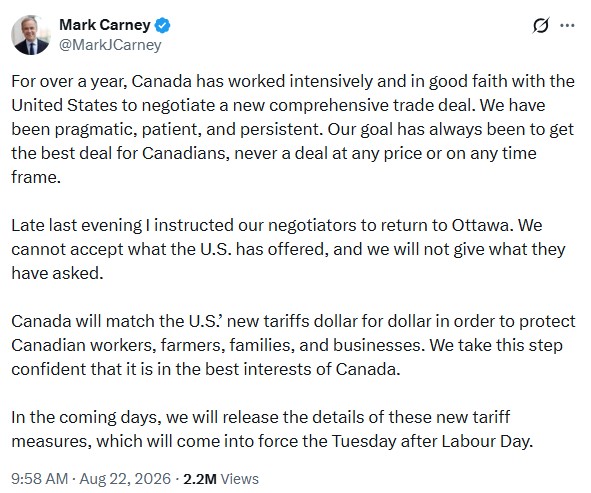
How the talks fell apart
The tariffs were originally scheduled for August 19.
Hours before the deadline, Trump paused them for three days, posting that Canada and the US had reached a deal subject to finalizing documents.
Three days of negotiations followed and failed Friday night. Carney said Canada walked away because the US "asked too much and they offered too little."
He disclosed that Canada had been willing to drop its remaining retaliatory tariffs on steel, aluminum and autos if the US substantially lowered its own, and to encourage provinces to return American products to liquor store shelves.
On Sunday, Trump posted: "Canada wants the benefits of being a State, without being one!!!"
The law hasn't been used since 1949
Trump invoked Section 338 of the Tariff Act of 1930, which lets the president impose tariffs of up to 50 per cent on countries found to be discriminating against the United States.
That act is Smoot-Hawley, the tariff law widely blamed by economists for deepening the Great Depression. Section 338 has never before been used to impose tariffs, and hasn't been invoked at all since 1949.
Trump announced the measures on July 20, accusing Canada of discriminatory treatment involving motor vehicles, alcohol and dairy.
What it means in Alberta
The Canadian list is the one that lands closest to home.
Agricultural equipment matters across the province, and September is not a convenient month for machinery costs to rise. Steel feeds construction and energy services. Appliances and electronics reach every household eventually.
Energy isn't on either list in this round. That doesn't insulate Alberta so much as mean this particular escalation didn't touch what the province sells most of.
The USMCA, which governs the vast majority of cross-border trade, was not renewed in July over the same disputes. That's the larger question underneath all of it.
Smith's response, and the October 19 vote
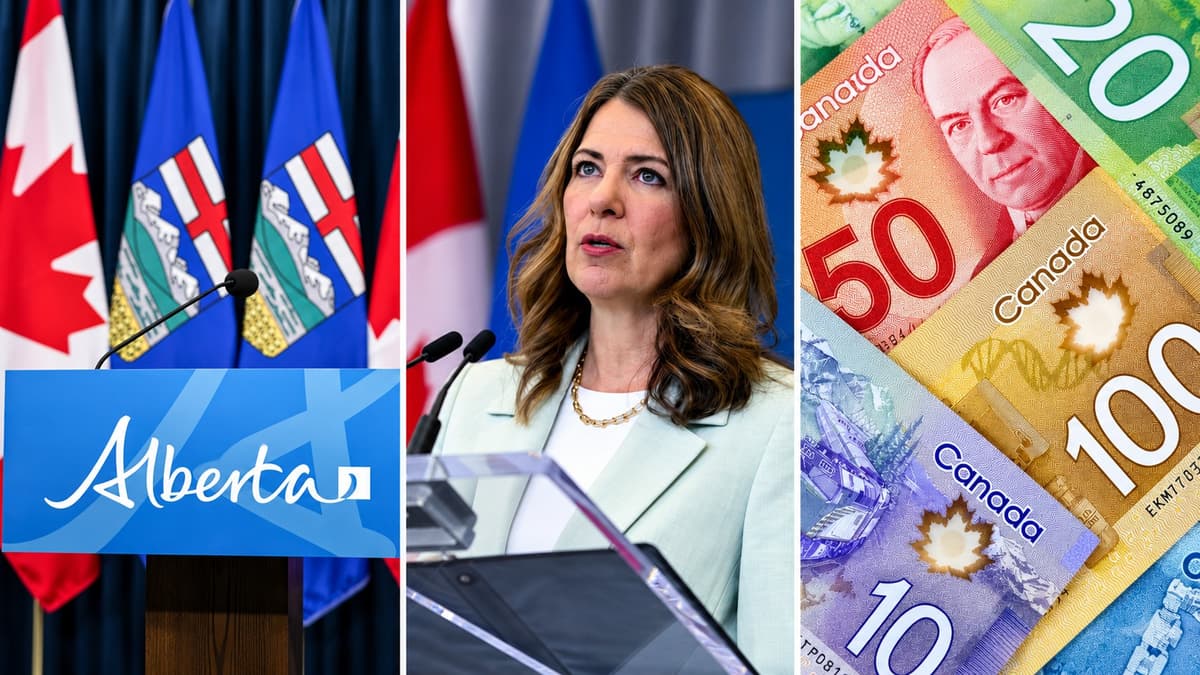
Premier Danielle Smith agreed Carney was right to walk away, calling the last-minute American demands "untenable" and "too painful" for Canada to accept.
"No one benefits from a trade war," she wrote on X. "Alberta will continue to advocate for a strong tariff free relationship between Canada and the U.S."
She's less supportive of the retaliation. "I know, emotionally, it feels good to retaliate. I get that," she said on her Saturday radio show. "But let's remember what happens when we retaliate."
Agricultural equipment is the one she returned to. "We shouldn't be cheering if our farmers have to pay 50 per cent more for all the equipment that they need to produce our food."
Smith has consistently opposed counter tariffs, including on energy exports, and Alberta declined to ban American alcohol this round.
Asked whether the trade war is reason to delay Alberta's separation referendum, she said no. The vote is October 19, seven weeks after the counter-tariffs take effect.
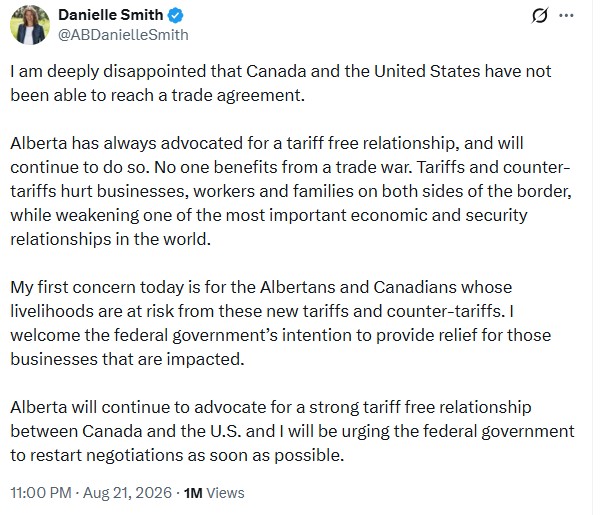
What's next
Ottawa says full details of the counter-tariffs will be released in the coming days, ahead of September 8.
Watch for whether the US adds sectors. Energy, autos and lumber are the ones that would matter most here, and none are in this round.
Sources
Prime Minister Mark Carney, news conference, Ottawa, August 22, 2026
Office of the United States Trade Representative, tariff proclamations under Section 338 of the Tariff Act of 1930
Tariff details and negotiation timeline as reported by The Associated Press, Reuters and Al Jazeera.




Comments
Conversation