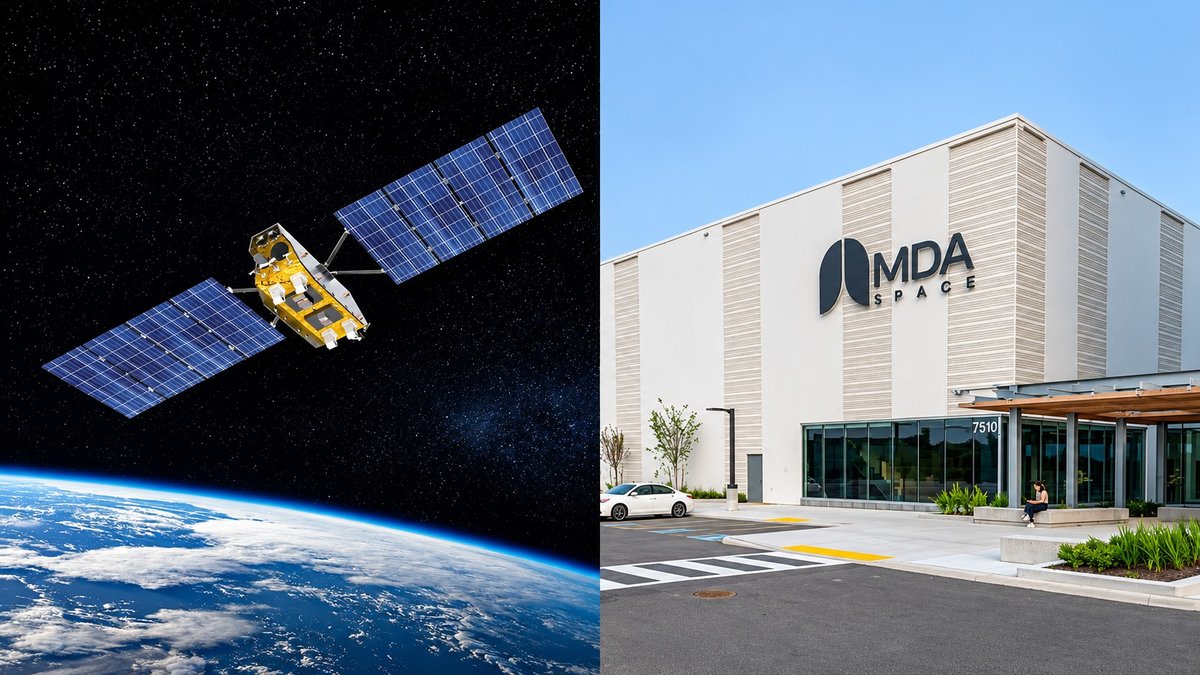
Europe is building its own satellite network so it doesn’t have to depend on Starlink. A Canadian company is making the antennas.
MDA Space, headquartered in Brampton, Ont., has signed an agreement worth more than $100 million with Thales Alenia Space, the French-Italian satellite maker, to supply antennas for the first 66 satellites of IRIS², the European Union’s planned secure communications network. MDA will design, build and test them at its facility near Montreal.
CEO Mike Greenley called it “a landmark moment for MDA Space.”

What MDA is building
The deal covers MDA’s AURORA digital phased-array antennas and the controller that runs them.
A regular satellite dish has to physically turn to point at something. A phased-array antenna doesn’t move. It steers its signal electronically, changing direction in a fraction of a second. That lets a satellite crossing the sky at thousands of kilometres an hour hold a steady connection with people on the ground.
The antennas go into the communications payloads Thales Alenia Space is building. Airbus Defence and Space is building the satellites.

The fine print
The $100 million-plus is an “authorization to proceed.” It lets MDA start work now while the full contract is still being negotiated. MDA’s latest quarterly report says the definitive contract for its full scope of work “is subject to contract finalization,” and the company expects to add the deal to its order backlog by the end of its fiscal year.
So the final value could be higher. But it isn’t signed yet.
What IRIS² is
IRIS² stands for Infrastructure for Resilience, Interconnectivity and Security by Satellite. It’s a partnership between the European Commission and SpaceRISE, a group of three European satellite operators: SES, Eutelsat and Hispasat.
When it was signed in December 2024, the plan called for 290 satellites at about €10.55 billion. In August, the EU made it bigger. The network will now have 348 satellites, 330 in low Earth orbit and 18 in medium Earth orbit, at an estimated €15.6 billion. That includes a new layer of 66 satellites dedicated to defence, security and emergency services, which the EU says will raise secure government capacity inside the EU by 60 per cent.
About €11.6 billion of the cost is public money from the European Commission and the European Space Agency. The three operators are putting in about €4 billion.
The first launches are targeted for 2029.
“Today we are taking a decisive step forward for Europe’s security and digital sovereignty,” EU Commissioner for Defence and Space Andrius Kubilius said when the expansion was signed.
Why Europe wants its own
Starlink, owned by Elon Musk’s SpaceX, has thousands of satellites in orbit and dominates satellite internet. Governments and militaries use it, including Ukraine’s.
That’s the risk as Europe sees it: a network that European militaries and emergency services increasingly rely on is controlled by one private American company. IRIS² is meant to give EU governments a network they control themselves.
It’s also built for a different job. Starlink is mainly consumer internet. IRIS² is mainly secure communications for governments, militaries and emergency services, with commercial service on top.

Who MDA is
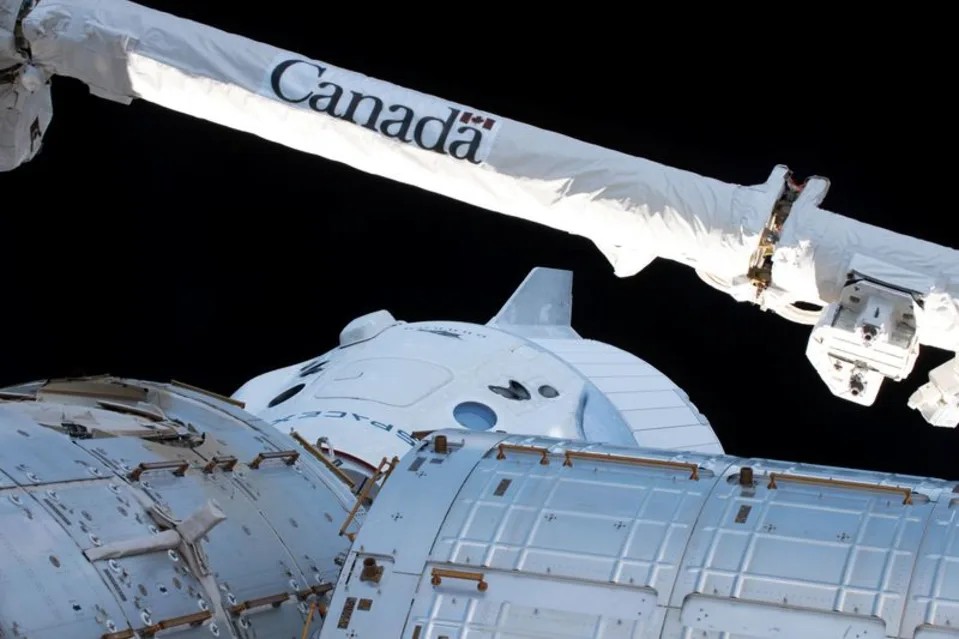
If the name sounds familiar, there’s a reason. MDA started in 1969 in a Vancouver basement as MacDonald, Dettwiler and Associates. It built Canadarm2, the robotic arm on the International Space Station, and the RADARSAT-2 radar satellite. It’s now building Canadarm3 for NASA’s planned Lunar Gateway space station.
It’s also the prime contractor for Telesat Lightspeed, the Ottawa company’s 198-satellite low-orbit network, Canada’s own answer to Starlink. To keep up with orders, MDA built a 185,000-square-foot expansion of its satellite plant in Sainte-Anne-de-Bellevue, on the western tip of Montreal island. The company says it can turn out up to two satellites a day and announced 600 new jobs there when the expansion was unveiled in 2024.
MDA has about 3,800 employees.

Canada is now in talks to join
The MDA deal was announced Oct. 30, the same day as the Canada-EU summit in Montreal. There, Foreign Affairs Minister Mélanie Joly and Kubilius signed two space agreements. One starts exploratory talks on Canada’s possible role in IRIS². The other opens negotiations on Canadian access to Galileo, Europe’s version of GPS, including its encrypted government service.
Both are first steps. Canada isn’t part of IRIS² or Galileo yet.
Both agreements fall under the Canada-EU Alliance for the Future that Prime Minister Mark Carney and EU leaders launched in Montreal. We covered that alliance and what it means for Canada’s trade with Europe.
Greenley says there’s a practical reason Canada should care. The Canadian Armed Forces have recorded GPS errors of up to a kilometre in the high Arctic, because satellites sit so low on the horizon there. “MDA has long believed Canada needs to develop more domestic space capabilities,” he said.
What it means for rural Alberta
Most Albertans won’t ever connect to IRIS². The race behind it is still the reason rural internet options are changing.
Right now, Starlink is the main option for a lot of farms, acreages and remote communities. Alberta is even offering up to $1,000 to help households get Starlink internet. Telesat’s Lightspeed network, built by MDA, is aimed at government and business customers, with global service now expected in mid-2028. Every new low-orbit network adds pressure on Starlink.
What it means for Canada
The money is the smallest part of this story.
A foot in the door. IRIS² is one of the biggest space projects in Europe, and the EU built it to keep control in European hands. A Canadian company getting in on the first 66 satellites shows Europe is willing to buy Canadian for something it treats as a security asset. That carries weight as Ottawa starts its own talks about joining the network.
Work in Quebec. The antennas will be designed, built and tested at MDA’s plant in Sainte-Anne-de-Bellevue. That’s the same facility the company expanded in 2024 to build up to two satellites a day, with 600 new jobs announced at the time. The deal doesn’t say how many jobs it will add, but it keeps that line full alongside MDA’s work on Telesat Lightspeed.
Less reliance on the U.S. Canada’s push toward Europe has picked up as trade with the U.S. has gotten harder, through tariffs, threats and the 51st-state talk. Satellites are part of that. Right now, Canada relies on American systems for both satellite internet (Starlink) and positioning (GPS). The summit agreements on IRIS² and Galileo open a path to European alternatives for both, though neither is a done deal.
The Arctic. This is where it gets practical. Canada has a lot of territory where GPS is less accurate and ground internet doesn’t reach. A secure satellite network and a second positioning system both matter more in the North than almost anywhere else in the country.
What it doesn’t mean. Canadians won’t be able to sign up for IRIS² any time soon. The first launches are years away, it’s built mainly for governments, and Canada hasn’t joined. For now, this is an industrial win and a diplomatic opening, not a new internet option.
Sources:








Comments