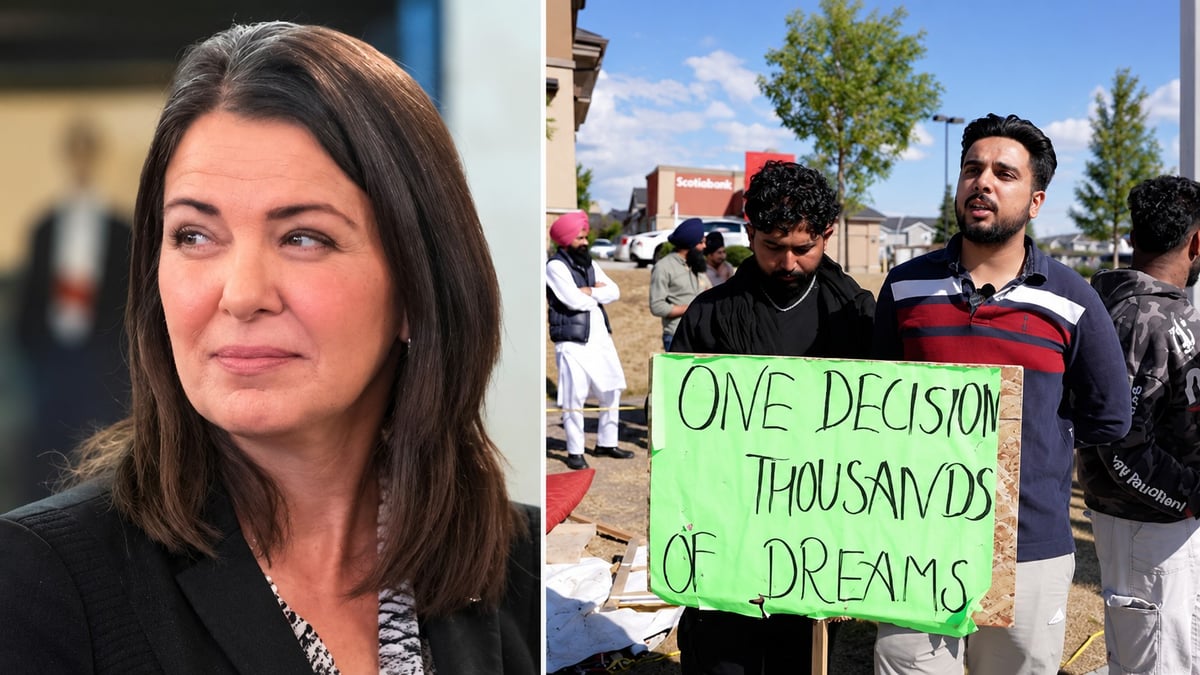
Premier Danielle Smith has put a potential price on one of Alberta's most closely watched referendum proposals.
"$1,900 per person."
That's the figure Smith floated Tuesday while speaking to a Calgary Chamber of Commerce audience about charging some temporary residents for access to publicly funded health care. Reporting indicates the government is considering a range of roughly $1,400 to $1,900 per person.
It's one of the first concrete numbers attached to Question 4 on Alberta's October 19 referendum.
But Alberta isn't introducing a $1,900 health premium, at least not yet.
The government hasn't settled on a rate. The referendum is non-binding. And the ballot question covers both health care and education, without mentioning any dollar amount.
What Smith actually said
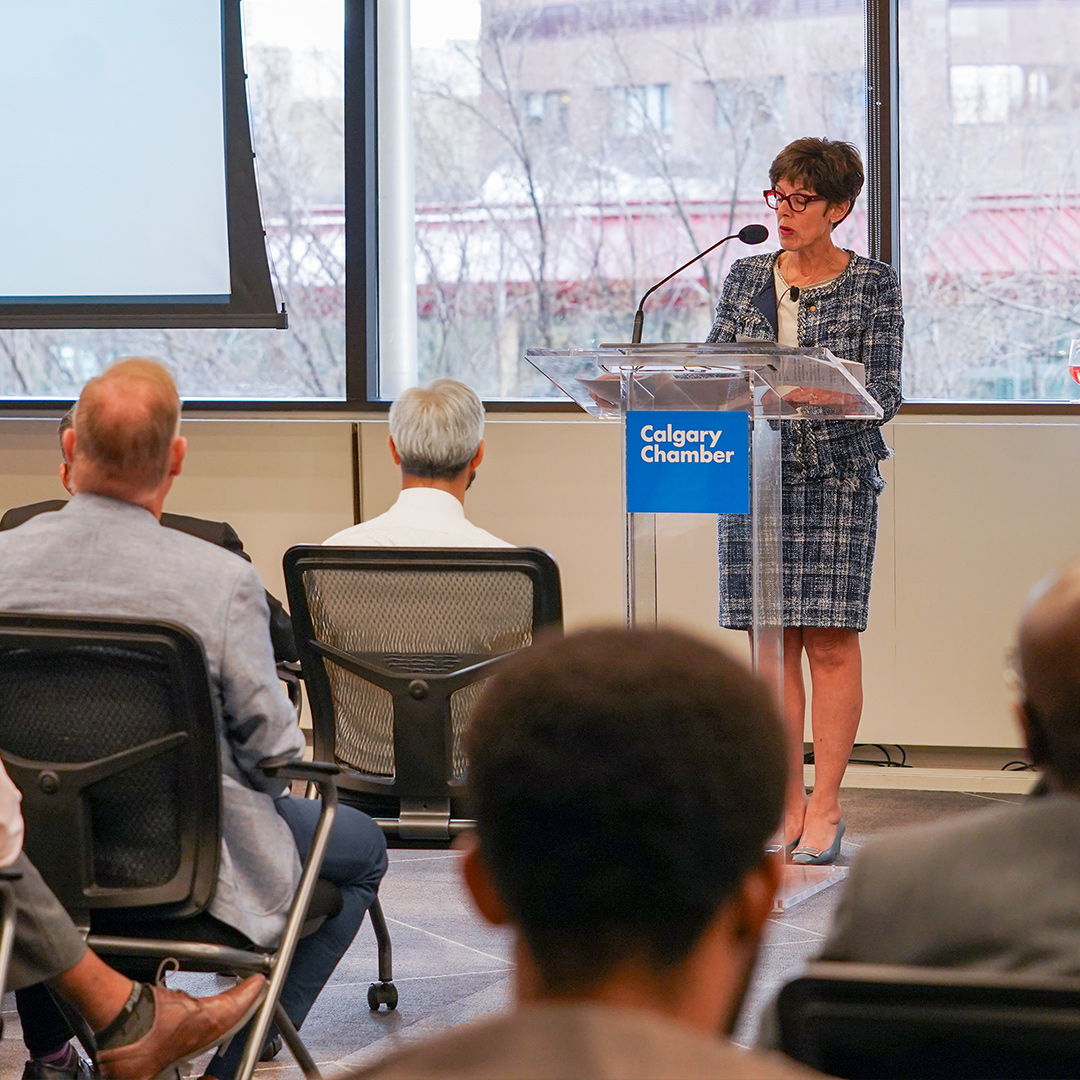
Smith raised the proposal during a Calgary Chamber event alongside Chamber president and CEO Deborah Yedlin. The Chamber says the September 22 event focused broadly on Alberta's economic competitiveness, investment, infrastructure, talent and services.
Smith said the government is looking at a premium modelled in part on the United Kingdom's immigration health surcharge.
"I gave you the idea of what we're looking at," she said. "$1,900 per person."
She described it as a "new conversation" and argued that rapid population growth has strained provincial services.
Smith also drew a distinction between permanent and temporary residents, arguing that people here temporarily should contribute more directly toward the services they use.
And she suggested the bill might not fall entirely on workers. Employers recruiting temporary foreign workers could end up absorbing some or all of the cost.
What Albertans are actually voting on
The $1,900 figure isn't on the ballot.
Question 4 asks:
"Assuming that all Canadian citizens and permanent residents continue to qualify for public health care and education as they do now, do you support the Government of Alberta charging a reasonable fee or premium to individuals with a non-permanent immigration status living in Alberta for their and their family's use of the healthcare and education systems?"
Two parts of that wording matter.
It covers health care and education together, not health care alone.
And it asks about a "reasonable fee or premium" without defining what reasonable means.
The referendum is also non-binding. Elections Alberta says the order establishing these questions explicitly states the results are not binding.
A majority Yes wouldn't produce a bill for anyone. The government would still have to decide who's covered, how much they pay, whether existing temporary residents are included, who's exempt and whether workers or employers carry the cost.
Finance Minister Jason Nixon has indicated consultation would be required and implementation would likely come only after Alberta's next provincial election in 2027.
Albertans are voting on the principle of charging a premium, not on Smith's number.
The math behind the proposal
The Alberta government's referendum campaign says providing services to temporary residents costs provincial taxpayers more than $1 billion a year.
Smith has cited roughly 246,000 temporary residents in the province.
Using that number, a $1,900 annual charge applied to all of them would generate about $467 million. At $1,400, about $344 million.
Those are simple calculations, not government revenue projections. An actual program could produce very different numbers depending on coverage, exemptions and collection.
Either way, both fall well short of the government's stated $1-billion cost.
There's another wrinkle. The 246,000 figure isn't the same as the latest Statistics Canada estimate, which put Alberta's non-permanent resident population at 279,477 as of July 1.
The government has provided some detail behind its broader cost argument, saying more than $600 million annually is spent educating approximately 45,000 children of temporary residents.
But the published figures don't allow an independent reconstruction of the full $1-billion estimate.
Alberta already covers some temporary residents
This wouldn't be starting from a system where every temporary resident pays privately.
Some already qualify for the Alberta Health Care Insurance Plan.
Under current rules, a temporary resident arriving from outside Canada may qualify for AHCIP if they establish residency in Alberta, intend to live in the province for at least 12 consecutive months, and hold an acceptable immigration document with at least six months remaining. Eligible documents can include certain work and study permits.
Temporary foreign workers can qualify if they meet residency requirements and have an eligible work permit. Qualifying international students can also receive coverage under specific conditions.
A future premium would therefore change how at least some people who currently qualify for publicly funded coverage are treated.
How that transition would work hasn't been settled.
Temporary residents already pay taxes
NDP Leader Naheed Nenshi has challenged the financial argument by pointing out that temporary workers already contribute to provincial revenues.
"Her math doesn't make sense either because, let's remember, the temporary workers pay taxes," Nenshi said.
His argument is that the cost of providing services can't be weighed without also weighing the taxes temporary residents pay while living and working here.
That leaves the central policy question: whether people with temporary status who already contribute through the tax system should also pay a separate premium.
Businesses could end up paying
Some of the most immediate pushback came from the room where Smith raised the idea.
Yedlin questioned what an additional charge would mean for companies already dealing with costs and labour shortages.
She argued a $1,900 charge would be much harder for a lower-wage worker to absorb than someone in a highly paid profession, potentially leaving the employer to cover it.
That could matter particularly in industries like hospitality, where margins are thin and businesses depend on access to workers.
"This is not necessarily going to make businesses more competitive in Alberta," Yedlin said.
Smith framed it differently. She suggested that if $1,900 materially changes the economics of hiring someone into a lower-skilled position, it could encourage businesses to hire young Albertans instead.
That disagreement gets at the biggest unresolved question: who actually pays.
A premium charged because of a worker's immigration status doesn't necessarily mean the worker absorbs the cost.
Why Smith says Alberta should charge it
Smith's argument is built around capacity and cost.
The government's referendum campaign says high levels of temporary immigration have increased pressure on health care, education and other public services.
The province is looking internationally for models. Smith has pointed to the United Kingdom, where many visa applicants pay an immigration health surcharge as part of the immigration process. The standard British rate is £1,035 per year, with a lower rate for some groups including students and people under 18.
She has also connected it to employment, arguing that higher costs for recruiting temporary workers could push employers to fill some lower-skilled positions locally.
What's still unknown
For all the attention on $1,900, the most important details haven't been decided.
The final rate. Smith has discussed $1,900. Reporting says the government is considering $1,400 to $1,900. Nothing is finalized.
Who would pay. Smith has raised employers absorbing it. No payment structure exists.
Who would be covered. The government hasn't settled whether a charge would apply to temporary residents already in Alberta or only to new arrivals.
Exemptions. Not established.
Education. The ballot question covers it. The $1,900 figure was framed around health coverage.
Implementation. There is no legislation.
Those details could dramatically change both what a family pays and how much the province collects.
What happens on October 19
Albertans will vote Yes or No on Question 4.
They won't be voting on a $1,900 premium. They'll be voting on whether they support charging people with non-permanent immigration status a "reasonable fee or premium" for their and their family's use of Alberta's health care and education systems.
And the result is non-binding.
For now, $1,900 is a proposal, not a bill.
Sources
2026 Referendum questions — Elections Alberta
Immigration questions — Government of Alberta
Health care coverage for temporary residents — Alberta Health
A conversation with Premier Danielle Smith — Calgary Chamber







Comments
Conversation