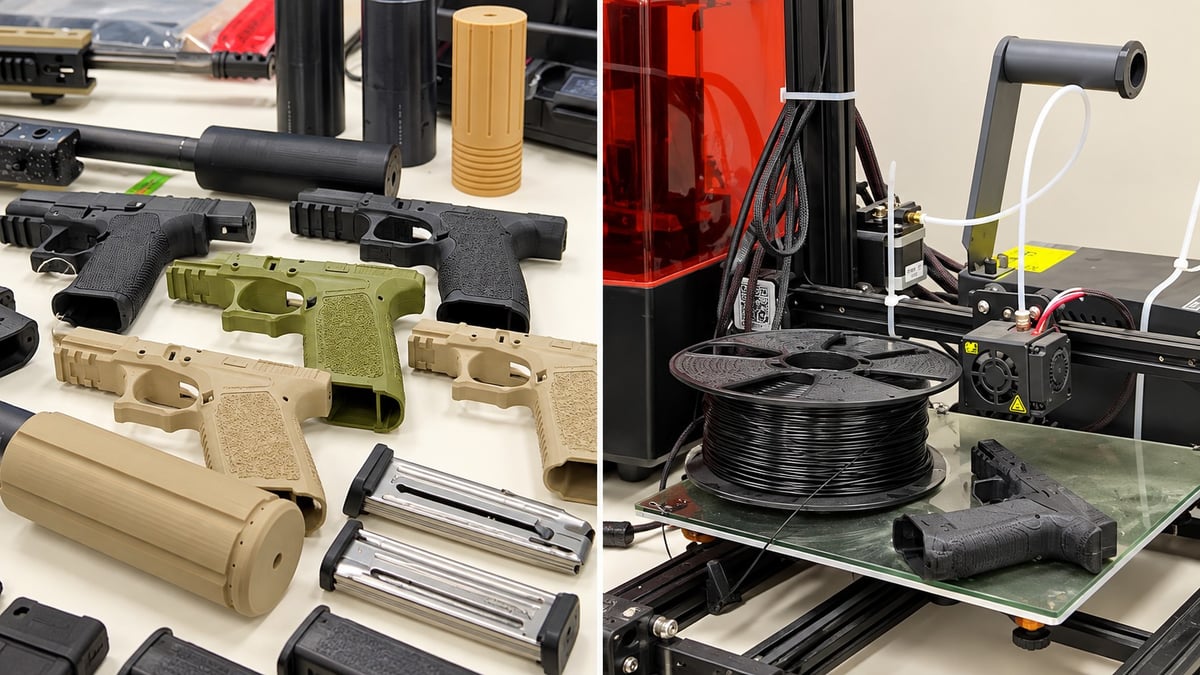
Police found 16 Glock-style handguns inside an Edmonton home.
Nobody made them in a factory. They came off a 3D printer in the house.
Roy Tucker, 31, was sentenced Wednesday to three years in prison after being convicted of manufacturing and possessing prohibited firearms he produced at home.
Police also found a commercial-grade 3D printer, firearm blueprints, magazines, gun parts and a homemade suppressor when they searched his property in 2023. Several of the privately made handguns were later successfully test-fired.
But the court heard no evidence that Tucker had tried to sell any of them.
That became a central part of the defence case, after police initially alleged the scale of the operation suggested the firearms were being made for trafficking.
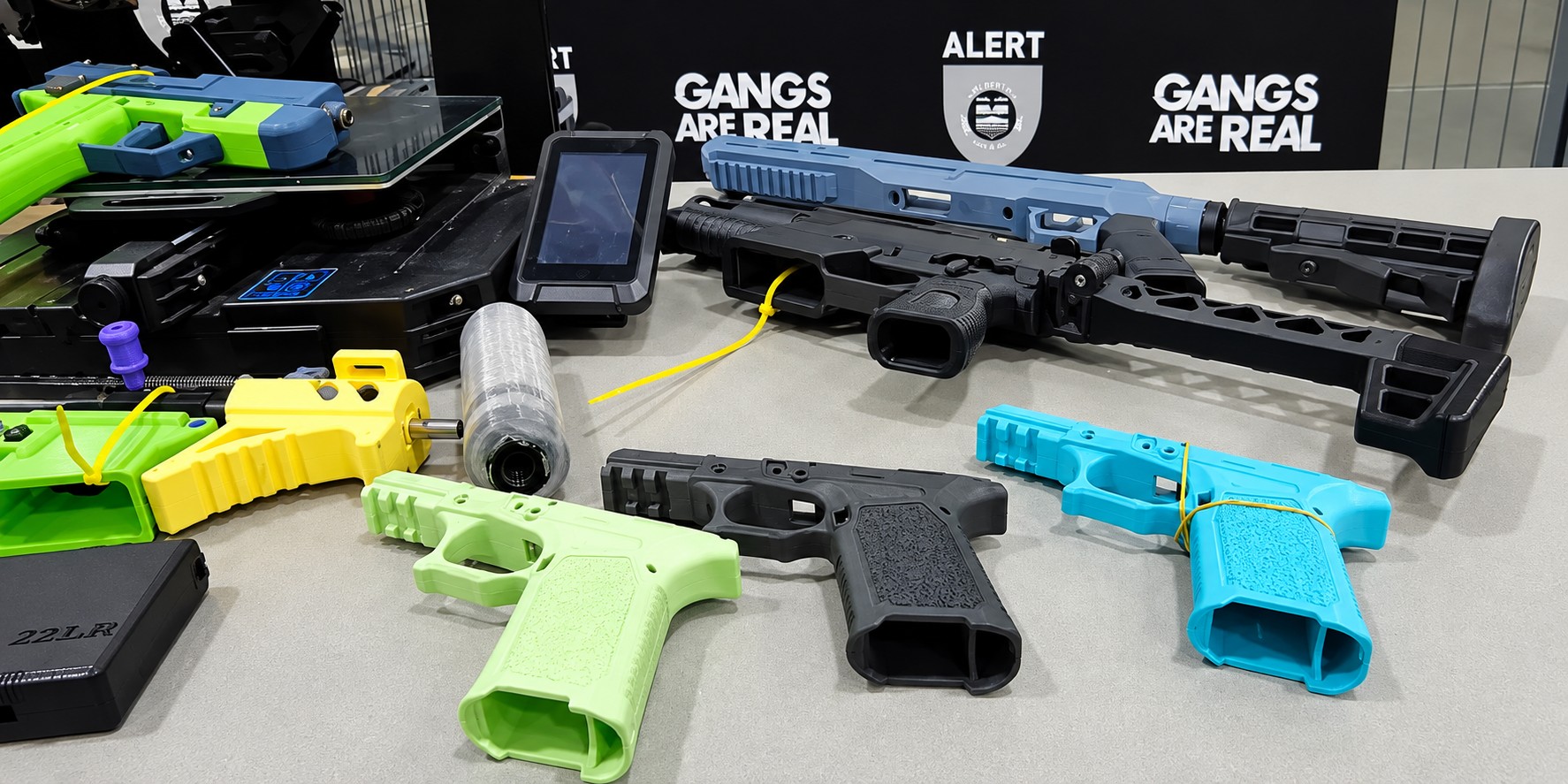
What police found
Edmonton police searched Tucker's home and vehicle on June 20, 2023, after receiving information connected to a national investigation into privately manufactured firearms.
The seizure was substantial.
16 privately manufactured Glock-style handguns.
Three loaded handguns.
A steel privately manufactured firearm, a homemade suppressor and 27 high-capacity magazines.
A large commercial-grade 3D printer, firearm blueprints, and electronic devices containing code used to print firearm frames and receivers.
Two prohibited semi-automatic firearms, which police said investigators believed had been smuggled into Canada from the United States.
There was also a large quantity of 3D-printed firearm parts police said could be assembled quickly.
Tucker wasn't someone who had never legally owned a gun. Court proceedings heard he had paperwork for other firearms and kept roughly 30 non-restricted firearms, mainly in a locked gun room.
The issue was what he'd begun manufacturing himself.
Police successfully test-fired three of the Glock-style handguns.
When EPS announced the case in 2024, Staff Sgt. Eric Stewart of the guns and gangs section made a point of saying these weren't plastic replicas.
"It works just like a normal handgun," Stewart said of one of the firearms.
The investigation started with a tip from Quebec
The case didn't begin in Edmonton.
In early 2023, the Sûreté du Québec alerted Edmonton police that an Edmonton man was allegedly purchasing components used to build 3D-printed firearms from a supplier in Montreal.
Among those purchases were rail kits, components used in the construction of some privately manufactured firearms.
The information was connected to Project Reproduction, a national investigation targeting illicit firearms manufacturing and trafficking.
Police searched Tucker's property on June 20. Searches were carried out across the country the following day as part of the broader operation.
In Alberta, ALERT searched seven homes in Grande Prairie, Penhold, Innisfail, Brooks, Lloydminster and Lac Ste. Anne County, ultimately reporting nearly 100 3D-printed firearms, handguns and rifles seized in the province.
Across Canada, Project Reproduction produced dozens of arrests and hundreds of firearms seized.
EPS called it Edmonton's first significant 3D-printed gun seizure
When Edmonton police announced charges in February 2024, Stewart called it the first significant seizure of 3D-printed firearms in the Edmonton area.
EPS also described it as the second-largest seizure connected to Project Reproduction in Western Canada.
Tucker initially faced 43 charges.
At the time, police alleged the scale of the manufacturing operation suggested he was preparing to traffic firearms.
More than two years later, the evidence at sentencing painted a narrower picture. Tucker was convicted on three firearms charges, and the court heard no evidence he tried to sell the weapons.
Why police call them "ghost guns"
Privately manufactured firearms are commonly called ghost guns because they can be produced without the identifying information found on commercially made firearms.
That makes them considerably harder to trace after they're recovered.
The problem was already growing in Edmonton when Tucker's property was searched.
EPS said it seized 38 privately manufactured or 3D-printed firearms in 2022. In 2023, that number rose to 88.
Tucker's case stood out not simply because a 3D printer was being used for gun parts, but because investigators found numerous completed handguns and enough components to keep building them.
And some of those firearms worked.
The Crown wanted 4½ years. The defence wanted house arrest.
The two sides arrived at sentencing with very different ideas about the punishment.
The Crown sought four and a half years in prison.
The defence sought two years of house arrest.
Tucker's lawyer characterized him as a gun collector whose interest crossed into illegal manufacturing, rather than someone making weapons for the criminal market. The defence also raised Tucker being on the autism spectrum as part of its submissions about his circumstances and his collecting.
Most significantly, the defence pointed to the absence of any evidence he'd attempted to sell the firearms.
Tucker addressed the court himself, apologizing and saying his motivation wasn't violence or profit but curiosity.
"I realize my hobby and curiosity were very, very far from the law," he said.
The Crown took a more serious view of what police had found. Whatever Tucker intended, investigators recovered a collection of privately manufactured prohibited handguns, including weapons they were able to fire.
None of that made manufacturing them legal. Under Canadian law, making a prohibited firearm is an offence regardless of intent, and possessing one you made is a separate offence again.
The judge landed between the two positions.
Tucker was sentenced to three years in prison.
Sources
Edmonton Police Service
Multi-province partnership leads to seizure of privately made firearms — RCMP, June 21, 2023
Update: Cross-Canada firearms manufacturing operation — ALERT





Comments
Conversation