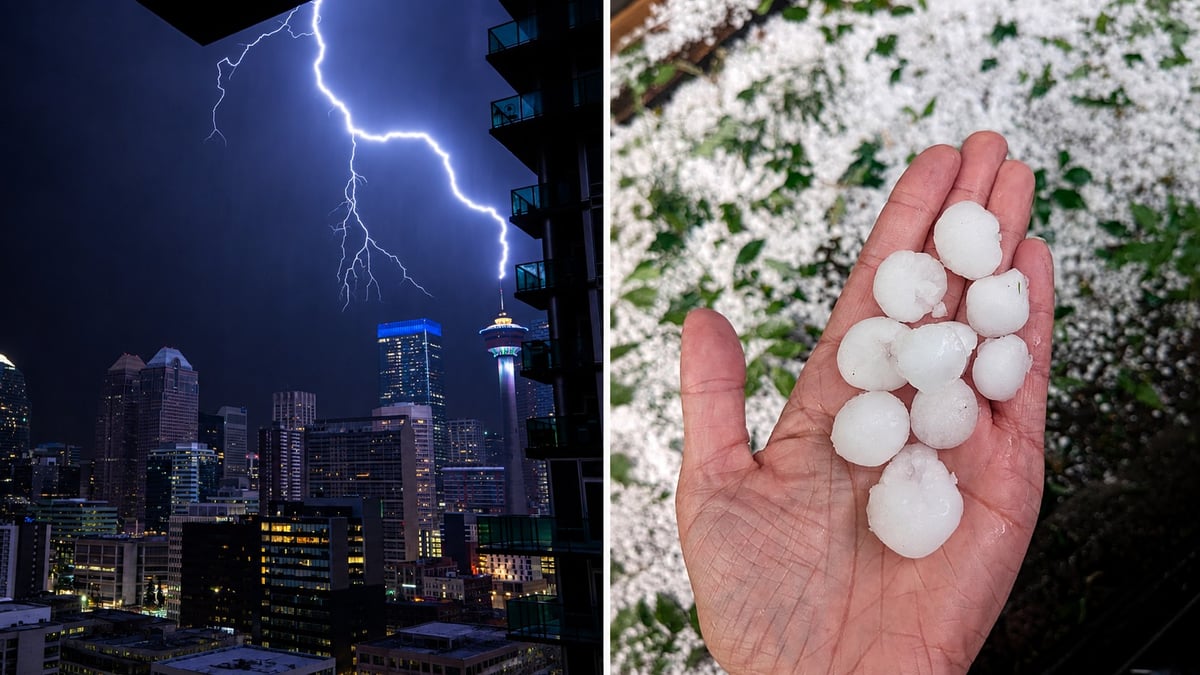
Saturday night in northwest Airdrie, Environment Canada issued a severe thunderstorm warning at 9:23 p.m. Twelve minutes later, FortisAlberta logged an outage.
Another storm risk is on the board today.
What Environment Canada has
Cloudy with a 60 per cent chance of showers and a risk of a thunderstorm. Wind becoming north 30 km/h in the afternoon. High 17. Showers overnight, low 10.
No watch and no warning are in effect as of publication.
The three alert levels are worth knowing apart. A special weather statement highlights significant weather or flags uncertainty. A watch means conditions are favourable for storms capable of producing damaging hail, wind or rain. A warning means severe weather is imminent or already occurring, and warnings are usually issued six to 24 hours ahead, though thunderstorms and tornadoes can arrive with less than half an hour's notice.
None of the three is currently posted for Calgary.
What the model guidance suggests
Alberta storm forecaster Ben Chernesky, who publishes as @BenChernesky, said guidance was showing an increasingly concerning look for damaging hail potential.
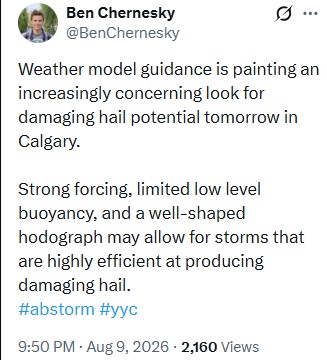
He described strong forcing, limited low-level buoyancy and a well-shaped hodograph, and said that combination could allow storms efficient at producing damaging hail.
Models were generally showing development west of Water Valley, he said, with cells potentially moving toward Calgary's north end or Airdrie. Water Valley is a hamlet in Mountain View County northwest of the city.
He compared the setup to August 5, 2024.
Chernesky said limited instability could hold the maximum hail size to roughly 55 millimetres, egg-sized. He also said the setup requires relatively cool surface temperatures of around 20 degrees to initiate, raising it while explaining why he did not expect wildfire smoke to be a significant factor today. Environment Canada's forecast high for Calgary is 17.
That is a forecaster's read of model output, not an observation, and no official alert reflects it.
What happened Saturday
Environment Canada issued a severe thunderstorm warning at 9:23 p.m. for Rocky View County near Airdrie and Crossfield, citing quarter-sized hail and damaging winds. At 9:22 p.m. the agency was tracking a line of storms from near Crossfield to near Norman Lake, moving east at 60 km/h. By 9:54 p.m. that line ran from just east of Crossfield to 10 kilometres west of Calgary.
At 9:35 p.m., FortisAlberta logged an outage that grew from 1,675 customers to 2,118 through the evening across northwest Airdrie and surrounding Rocky View County. The utility listed the cause as unknown and under investigation, and no restoration estimate was given. Some northwest Calgary residents reported power returning close to 2 a.m.
The outage map showed a band of affected areas running from Bearspaw through Balzac to Airdrie, overlapping the broader area the storm moved through.
Our full report on Saturday's storm, including the outage timeline and how to file for spoiled food, is here: Severe Storm Hits Calgary, Airdrie and Crossfield: 2,100 Without Power, Quarter-Sized Hail and Damaging Winds
Saturday's was the first thunderstorm in Calgary since July 20.
This hail season against last
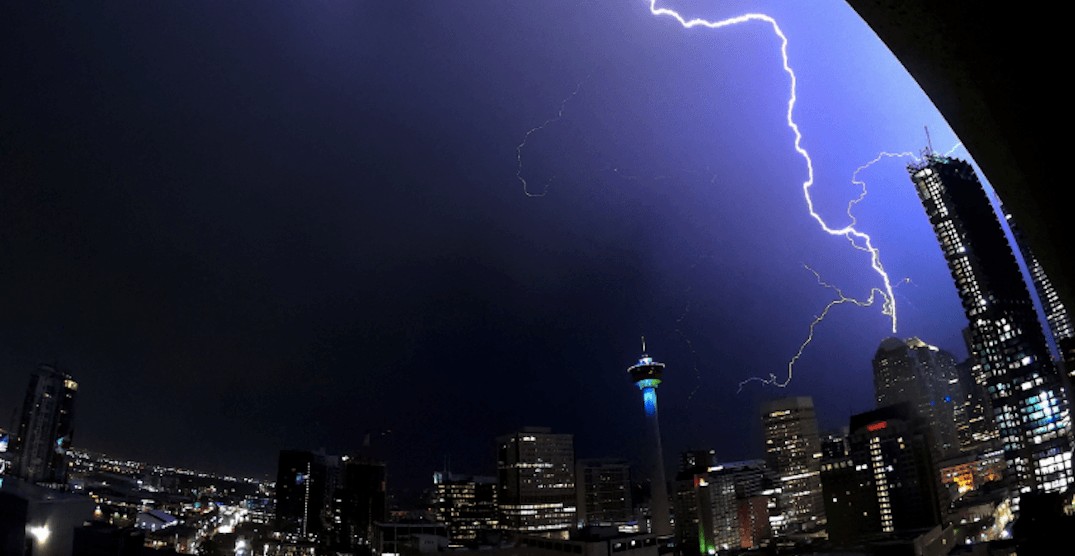
Weather reporter Kyle Brittain has Calgary at 13 thunderstorm days this year, against a normal-year average of 24.
By this point last summer the city had already taken its hit. The July 13, 2025 storm brought 90 km/h winds and toonie-sized hail. CatIQ's initial insured damage estimate was $92 million. Two months later it stood at $164 million, a 78 per cent increase that the Insurance Bureau of Canada attributed to the volume of claims filed and the time needed to assess them. Sixty-five per cent of the damage was to vehicles.
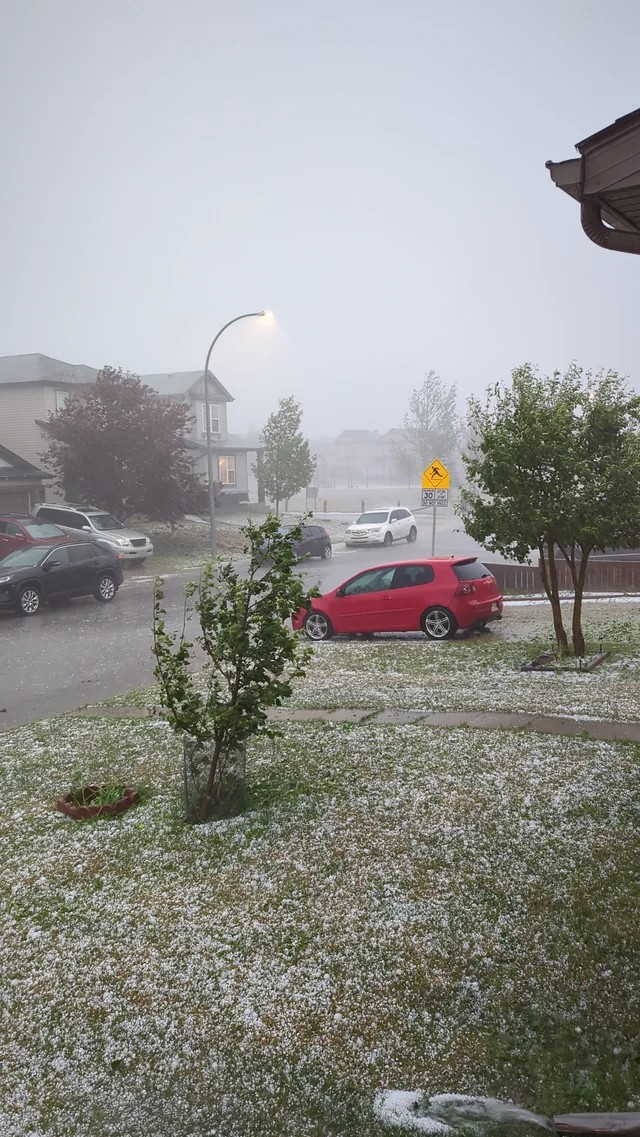
The year before was larger by an order of magnitude. On August 5, 2024, Environment Canada received multiple reports of hailstones the size of chicken eggs across north Calgary. The storm produced more than 130,000 claims and about $3.3 billion in CatIQ's most recent estimate, making it the costliest hailstorm in Canadian history and the second-costliest natural disaster of any kind, behind the 2016 Fort McMurray wildfire.
Before that, the June 13, 2020 storm in the Calgary area produced roughly 70,000 claims and more than $1.3 billion in insured damage.
Three expensive storms, in three different months. IBC vice-president Aaron Sutherland has said Alberta has recorded at least one major hailstorm every year for the past two decades, totalling more than $11 billion in insured damage, with $6 billion of that in the last five years alone.
Alberta's hail season runs May through September, with the heaviest activity June through August. Seven weeks remain.
A quiet season to date is not a finished one. It takes one cell over the wrong twenty kilometres.
Why this region
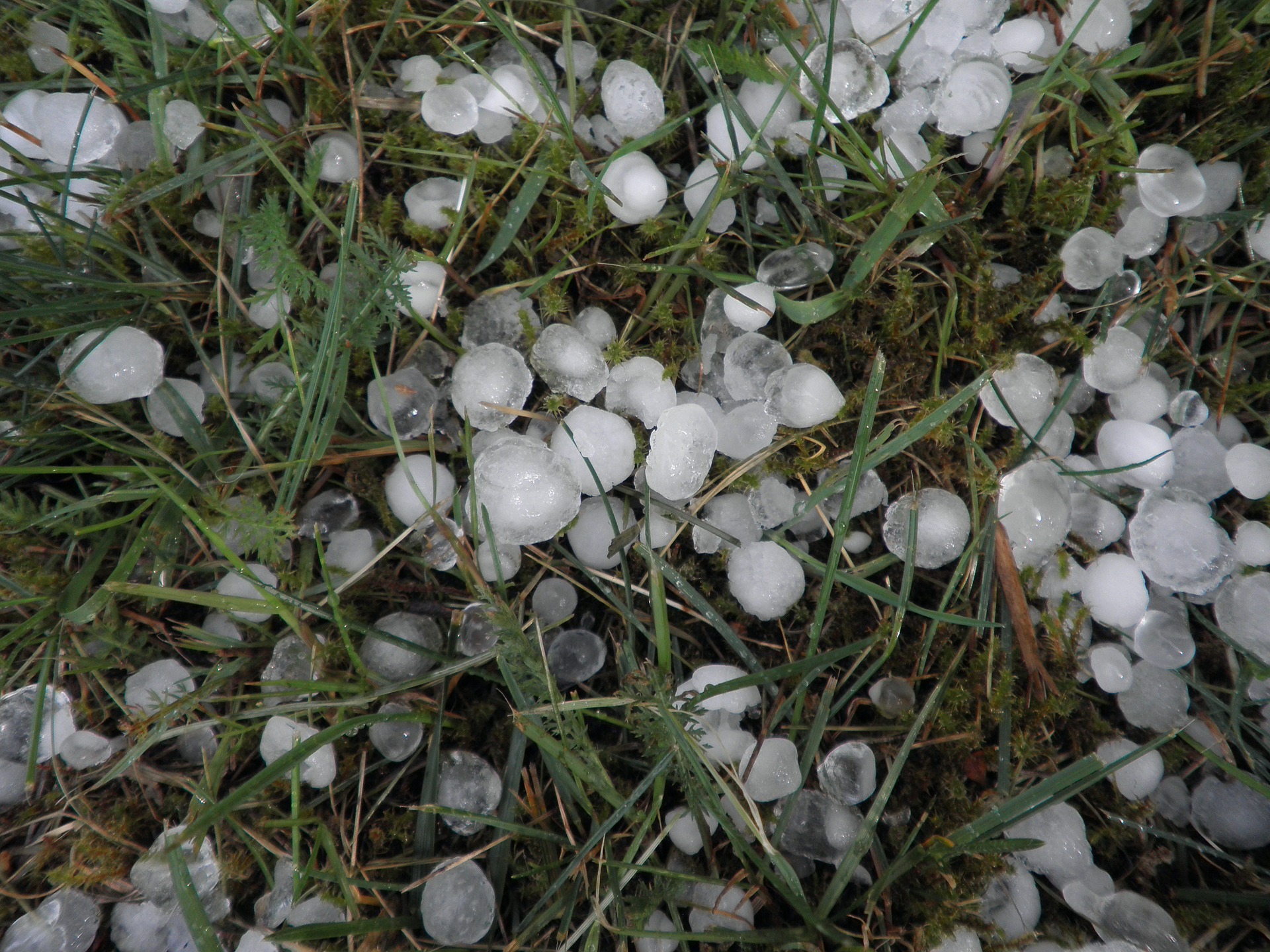
Calgary sits within Hailstorm Alley, a corridor running from High River north through Red Deer into central Alberta. Warm, moist air pushes against the Rockies and is lifted, fuelling storm updrafts, while strong winds aloft organize those storms into hailstorms. Julian Brimelow, director of the Northern Hail Project at Western University's Canadian Severe Storms Laboratory, has described that combination as what makes the Calgary area distinctive for hail research.
Researchers with the project, which has fielded summer crews out of Olds since 2022, have estimated the corridor sees more than 40 hailstorms each summer.
Sutherland has pointed to northern Calgary in particular, where residential communities now stand on land that was agricultural when the same storms were damaging crops rather than roofs. He has argued for mandating hail-resistant roofing and siding, noting how much of the housing stock in the corridor is asphalt shingle and vinyl, and that some Alberta properties now carry claims from multiple separate storms within four years.
What to do this afternoon
Park under cover. Given that 65 per cent of last July's damage was vehicles, a garage or covered stall is the cheapest protection available and the only one that has to happen before a storm arrives.
Check whether you carry comprehensive auto coverage. Hail damage to a vehicle falls under comprehensive, which is optional in Alberta. Liability and collision alone will not cover it.
Check whether your home policy pays replacement cost or actual cash value on a roof. Some policies depreciate, and the difference can be substantial on a claim you may not discover you needed until months later.
Bring in patio furniture and pets. Close blinds on west-facing windows.
If a storm arrives, take cover in a basement or interior room and stay away from windows. If you are outside, protect yourself from flying debris and hail.
If you take damage
Photograph everything before you clean up. Roof, siding, windows, and any vehicle parked outside. Hail damage to a roof is often not visible from the ground and can surface as a water problem the following spring.
Call your insurer early. Claim queues after an Alberta hailstorm fill quickly, and the July 2025 revision shows how long these files take to settle.
If you lose power, report outages and downed lines to FortisAlberta at 310-WIRE, or ENMAX inside Calgary. Treat any downed line as live, stay well back, and call 911 if anyone is near it. Photograph spoiled food before throwing it out and note your outage start and end times. Compensation for spoiled food is handled through your distributor, so check their current claim window and requirements directly rather than assuming.
The rest of the week
The pattern turns wet. The upper ridge that held over southern Alberta through July has broken down, replaced by troughs moving in off the Gulf of Alaska.
Forecast totals southwest of Calgary reach 50 millimetres between High River and Diamond Valley by Wednesday, with 30 to 40 millimetres from Calgary east to the Saskatchewan boundary on Thursday and foothills highs in the single digits.
Calgary averages about 57 millimetres of rain in an entire August.
Staying informed
Live watches and warnings for your exact location are at weather.gc.ca. Alberta Emergency Alert pushes the most serious ones to your phone.
Severe weather can be reported to Environment Canada at ABstorm@ec.gc.ca, by calling 1-800-239-0484, or on social media with #ABStorm.
This is a developing situation. We will update this article if a watch or warning is issued.
Sources
Environment and Climate Change Canada, Calgary public forecast, alerts and alert definitions, weather.gc.ca FortisAlberta outage map and restoration data, August 8, 2026 Insurance Bureau of Canada, insured damage releases, August 5 2024 and July 13 2025 Calgary hailstorms Catastrophe Indices and Quantification Inc., loss estimates and revisions Northern Hail Project, Canadian Severe Storms Laboratory, Western University Alberta Emergency Alert City of Calgary, hail and high wind preparedness









Comments
Conversation