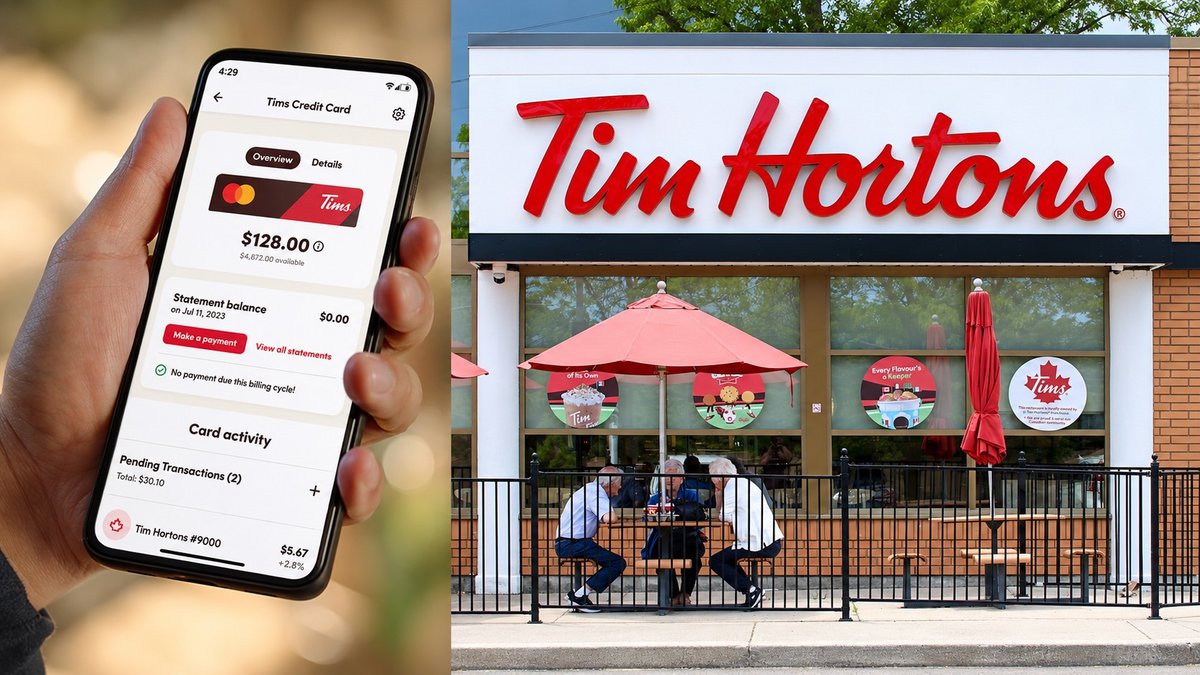
Before you pick a coffee or scan for rewards, the Tim Hortons app is already talking to someone else.
Researchers at the University of Calgary found that the app sends information about your phone to a third party the second it opens. That includes your device’s identifiers and the names of the Wi-Fi networks around you.
The company on the other end is Forter, a fraud-prevention firm founded in Israel by three veterans of Unit 8200, the Israeli military’s signals intelligence unit.
Tim Hortons says the data is used to stop fraud. Critics say it’s far more than a coffee order needs. And a lot of Canadians are now asking the same question: does my data end up in Israel?
What the app sends when you open it
Computer science professor Joel Reardon and his team tested six popular apps on Android for CBC Marketplace: Tim Hortons, PC Optimum, The Weather Network, Facebook, Amazon and YouTube. A privacy evaluator called Privo tested the same apps on iOS.
When the Tim Hortons app launched, it sent:
Your device’s unique identifiers
Details about your phone’s camera and sensors
Your ringtones
The names of nearby Wi-Fi networks
Ringtones sound harmless, and on their own they are. The concern is what happens when enough small details are combined. Together they form a device fingerprint, a set of signals that lets a company recognize the same phone again later.
The Wi-Fi names are the bigger concern. The networks around you act like landmarks, so they can reveal where you are even if you never gave the app your location.
“The collection occurs prior to consent, and in my view is excessive,” Reardon told Al Jazeera this week. He said fraud can be prevented without collecting data that points to a user’s precise location.

How Forter was named
CBC’s Nov. 13 investigation didn’t name the company receiving the data. It said “accountability rests with the app developer.”
On Nov. 17, Canadians for Justice and Peace in the Middle East (CJPME), a Montreal-based advocacy group, said it had contacted the Calgary researcher and confirmed the company was Forter. Two days later, Al Jazeera reported that it had independently confirmed the Tim Hortons app shares user data with Forter.
CJPME has also filed a complaint with CBC’s ombud over the decision to leave Forter unnamed.
Who is Forter? The Israel connection
Forter was founded in Israel in 2013 by Michael Reitblat, Liron Damri and Alon Shemesh. The Times of Israel has reported that all three served in Unit 8200.
Unit 8200 is the Israeli military’s signals intelligence and cyberwarfare division, often compared to the U.S. National Security Agency. Its alumni have gone on to found dozens of tech companies, and Forter is one of the biggest. In 2021 it raised US$300 million at a US$3 billion valuation. Today it screens online purchases for major retailers around the world, and its main office is in New York.
The ties go beyond the founders’ résumés. In 2018, The Jerusalem Post reported that Forter’s technology was “enhanced by” Israeli military intelligence. CJPME pointed to that claim in its release.
Unit 8200 has faced growing scrutiny since the war in Gaza began. In September 2025, Microsoft said it had cut off a set of cloud and AI services to a unit within Israel’s Ministry of Defence. That followed reports that the military was storing intercepted phone calls of Palestinians on Microsoft’s cloud. The Guardian, which broke the story, identified the unit as Unit 8200.
CJPME wants Tim Hortons to drop Forter. “Canadians ordering coffee should not have their unique and sensitive user data shared with an Israeli cyber-tech company,” said Michael Bueckert, the group’s vice-president.
Still, CJPME’s Jason Toney told Al Jazeera he would not speculate that Forter uses the data in a “nefarious” way. There is no evidence that it does. Al Jazeera said it couldn’t confirm whether Forter still uses Israeli military intelligence, or whether Israel’s government can access any data the company holds.

Does Tim Hortons send your data to Israel?
It can. Whether Tim Hortons data actually does is still unknown.
Here is what Forter’s own documents say:
Storage: Forter says it stores personal information in data centres in the United States.
Processing: Forter’s privacy policy lists Israel and the U.S. as places data may be transferred. Its Tel Aviv company is one of four Forter entities, along with those in New York, London and Singapore, that “may process your information locally.”
Government requests: Forter’s transparency report says it received zero data requests from any government or police agency, in any country, from January 2021 to June 2025.
Selling: Forter says it doesn’t sell personal data or share one retailer’s customer data with another. It does use data from across its network to train its fraud models.
Those rules cover Forter’s services in general. Tim Hortons hasn’t said where its customers’ data specifically goes. Forter didn’t respond to Al Jazeera’s questions.
What Tim Hortons says
Tim Hortons told CBC the data is used only for “fraud prevention, account protection, and payment abuse prevention,” and not for marketing or ads. It said it doesn’t sell users’ personal information, and that its third-party provider isn’t allowed to sell it either.
Reardon wants the chain to be clearer about who that protects. “It is useful to be clear if Tim Hortons is talking about protecting [themselves] from fraud, or if they [are] protecting the users,” he told Al Jazeera.
Tim Hortons and its parent company, Restaurant Brands International, had not responded to Al Jazeera when its story was published.

Alberta has been here before
This isn’t the app’s first privacy scandal, and Alberta played a part in the last one.
In June 2022, Alberta’s privacy commissioner joined the federal, B.C. and Quebec commissioners in finding that the Tim Hortons app had broken privacy laws. Through a U.S. service called Radar, the app tracked users’ locations every few minutes, even when it was closed.
Tim Hortons wasn’t fined. The federal commissioner can’t issue fines under PIPEDA, Canada’s private-sector privacy law, which is more than 25 years old.
“Under it, a company can send your data to a service provider without asking you, as long as it says it remains ‘accountable’ for that data,” Matt Hatfield, executive director of the digital rights group OpenMedia, told Al Jazeera.
Alberta’s law goes a step further. Under Alberta’s Personal Information Protection Act (PIPA), a company that uses a service provider outside Canada must tell customers how to get information about its policies on those providers. It must also name someone who can answer their questions.
Would the new federal privacy law help?
Partly.
Ottawa introduced Bill C-36, the Protecting Privacy and Consumer Data Act, on June 15, 2026. If passed, it would:
Require companies to assess privacy risks before personal information leaves Canada
Allow penalties of up to $10 million or 3% of global revenue, and fines up to $25 million or 5% for the most serious offences
Create a new enforcer, the Digital Safety and Data Protection Commission of Canada
Hatfield said the bill “would only partially help,” because companies could still hand data to service providers without asking customers first.
What you can do
Don’t open the app unless you’re ordering. The researchers saw data sent the moment the app launched.
Turn off location access for the app in your phone’s settings. The tests don’t show how much this changes what gets sent at launch, but it limits what the app can read.
Order at the counter or the drive-thru. You lose the rewards points, but the app never sees the visit.
Ask Tim Hortons directly. You can request what personal information it holds about you, what it shared with Forter and where that data was processed. Under Alberta’s PIPA, start with the company’s privacy officer.
Escalate if needed. If the answer doesn’t satisfy you, Albertans can complain to the Office of the Information and Privacy Commissioner of Alberta. Anyone in Canada can also go to the federal privacy commissioner, where CJPME has already asked for a new investigation.
Related: Tim Hortons is building 17 new Alberta restaurants and renovating 49 more







Comments