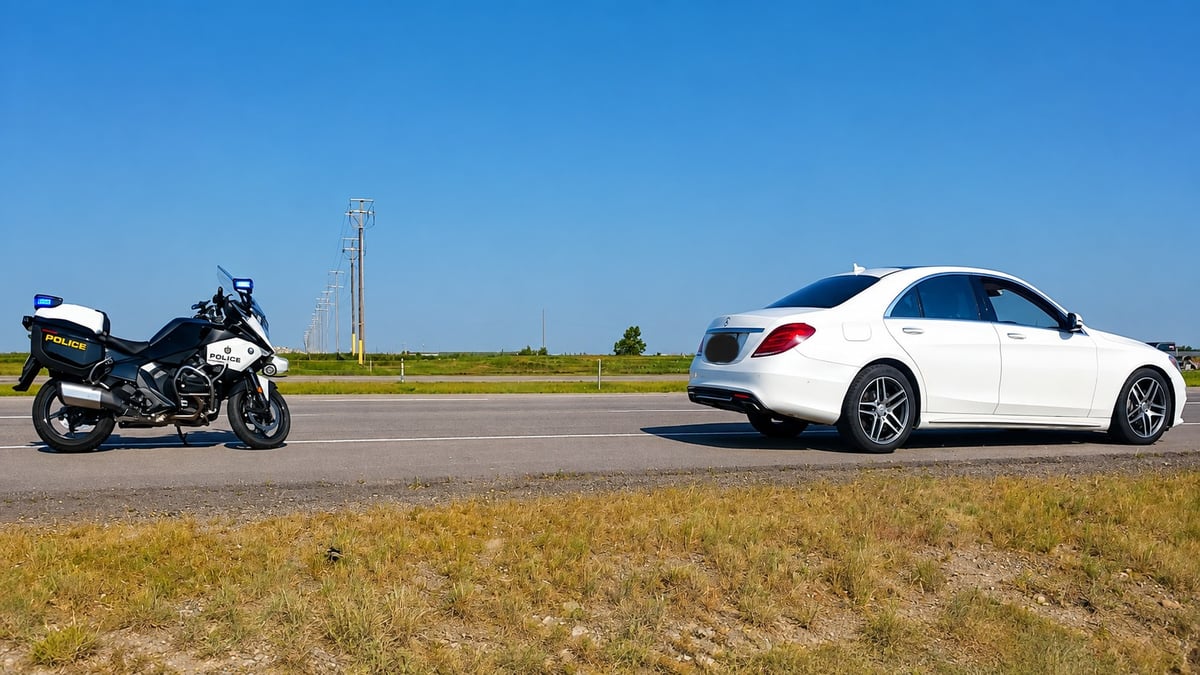
Calgary police clocked a car at 218 km/h on southbound Stoney Trail near Peigan Trail S.E. on the afternoon of Sunday, July 19. The limit there is 100.
The driver was arrested for dangerous operation of a motor vehicle.
A ticket and an arrest, the same afternoon
At 1:15 that afternoon, police stopped a driver doing 154 km/h in a 70 zone in the Airport Trail tunnel. That driver was ticketed for speeding and illegally tinted windows and drove away, because Alberta legislation doesn't permit police to impound a vehicle for speeding at any speed.
About four and a half hours later, police arrested the Stoney Trail driver instead.
The key distinction isn't simply how fast either driver was travelling. Police treated the Stoney Trail stop as potentially dangerous driving, a Criminal Code offence, rather than as a speeding matter under Alberta's traffic legislation.
What dangerous operation actually means
Section 320.13 of the Criminal Code makes it an offence to operate a conveyance in a manner that, having regard to all the circumstances, is dangerous to the public.
The Crown has to prove the driving was a marked departure from the standard of care a reasonable person would show in the same circumstances. That's a higher bar than carelessness. Actual harm doesn't need to have resulted, and the Crown doesn't have to prove any intent to hurt anyone.
The circumstances a court weighs include the nature and condition of the road, how it was being used, and the amount of traffic that was there or could reasonably have been expected.
Speed alone doesn't usually get you charged
Most dangerous driving charges follow a collision. Someone gets hurt, or a vehicle ends up somewhere it shouldn't, and the attending officer has physical evidence of what the driving produced.
A charge laid on speed with nothing else attached is a different call. There's no crash to point at, so the Crown's case rests on the reading, the road, the traffic and the officer's account of what was happening around the car.
That's why the specifics in this file matter more than the number. Southbound Stoney Trail near Peigan Trail is a ring road interchange, not an empty stretch, and it was a Sunday afternoon in July.
Statistics Canada records roughly 3,000 to 4,500 dangerous driving incidents nationally each year across all categories, most of them involving harm or a collision.
What a conviction carries
In practical terms, a criminal charge can mean fingerprints, a photograph and a criminal court process. A conviction can result in a criminal record, with the immigration and employment consequences that follow, and a driving prohibition.
Dangerous operation is a hybrid offence carrying a maximum of 10 years on indictment, with no mandatory minimum. The versions involving bodily harm or death carry considerably more.
A discharge is possible, which would avoid a criminal record. That's a matter for the court.
No charge has been proven, and the driver has not been named.
Alberta can't seize the car
Alberta doesn't allow police to seize a vehicle for speeding, which the Calgary Police Commission raised in February.
Vice chair Kelly Ogle put the scenario to police directly: someone doing 155 on Stoney gets pulled over, gets a ticket, and drives away. Deputy Chief Cliff O'Brien confirmed the legislation doesn't allow seizure and said the idea had been discussed.
British Columbia, Saskatchewan and Ontario all permit impoundment for excessive speed. In Saskatchewan, 50 or more over brings a 30-day impoundment. Ontario's rules include any speed over 150 km/h and carry a mandatory 14-day seizure.
Alberta has no equivalent, which is part of why the Criminal Code charge stands out here.
Where the tickets are being written
Calgary police issued 677 speeding tickets on Stoney Trail in a single month this year, and 149 along Deerfoot Trail. Thirty-five of those were for more than 51 km/h over the limit.
At 51 or more over, Alberta stops issuing a set fine and the ticket orders a mandatory court appearance instead, with the penalty left to a judge. Fines below that threshold rose about 50 per cent in March, the first increase since 2015.
Calgary police are directing drivers to the city's Vision Zero campaign at calgary.ca/visionzero.
Sources:
Calgary Police Service, traffic enforcement posts, August 2026
Criminal Code of Canada, section 320.13
R. v. Beatty, 2008 SCC 5, on the marked departure standard
Government of Alberta, speeding fines: https://www.alberta.ca/speeding-fines-in-alberta
CBC News, "Calgary police commission questions why its officers can't impound vehicles for excessive speeding," February 27, 2026
Statistics Canada, dangerous driving incidents









Comments
Conversation